Silver Dollars & Trade Dollars of the United States - A Complete Encyclopedia
Q. David Bowers
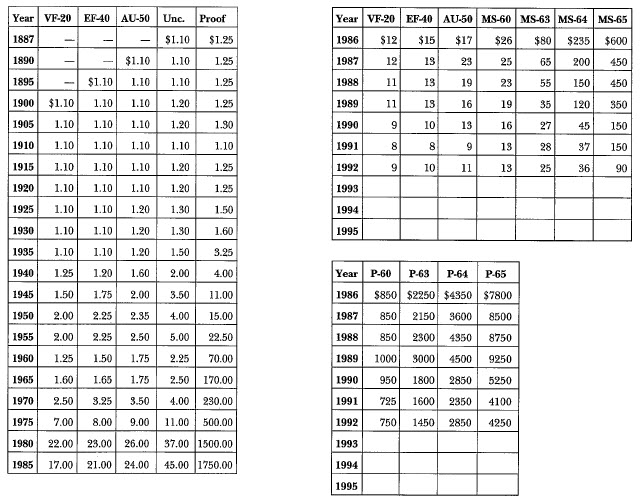
1887 Morgan: Market Values
1887 Morgan: Summary of Characteristics
Business Strikes:
Enabling legislation: As earlier, plus Act of February 28, 1878
Designer: George T. Morgan
Weight and composition: 412.5 grains; .900 silver, . 100 copper
Melt-down (silver value) in year minted: $0.758
Dies prepared: Obverse: 55; Reverse: 54
Business strike mintage: 20,290,000; Delivery figures by month: January: 2,020,000; February: 1,950,000; March: 2,020,000; April: 2,000,000; May: 1,900,000; June: 1,500,000; July: none; August: 1,500,000; September: 1,700,000; October: 2,000,000; November: 2,000,000; December: 1,700,000.
Estimated quantity melted: Probably millions under the 1918 Pittman Act and other legislation. Certainly many others during the rise in silver bullion prices in the late 1970s.
Approximate population MS-65 or better: 70,000 to 100,000 (URS-18)
Approximate population MS-64: 350,000 to 500,000 (URS-20)
Approximate population MS-63: 500,000 to 800,000 (URS-21)
Approximate population MS-60 to 62: 1,200,000 to 2,400,000 (URS-22)
Approximate population G-4 to AU-58: 2,000,000 to 4,000,000 (URS-23)
Availability of prooflike coins: Common, but usually without much contrast between the devices and the fields. Cameo DMPL coins remain to the extent of several thousand pieces.
Characteristics of striking: Varies from flat to strong, with most being average .
Known hoards of Mint State coins: Many were re-leased by the Treasury circa 1938-1961; additional quantities released 1962-1964. Millions of Mint State coins probably exist.
Proofs:
Dies prepared: Obverse: 1; Reverse: 1
Proof mintage: 710; Delivery figures by month:
January: none; February: none; March: 380; April: none; May: none; June: 90; July: none; August: none; September: 40; October: none; November: none; December: 200.
Approximate population Proof-65 or better: 114+/ - (URS-8)
Approximate population Proof-64: 118+/- (URS-8)
Approximate population Proof-63: 60+/- (URS-7)
Approximate population Proof-60 to 62: 260+/- (URS-10)
Commentary
In Mint State grades the 1887 is the commonest silver dollar dated prior to 1921. Millions survive.
Additional Information
Proof and Other Coins
The Annual Report of the Director of the Mint, 1887, noted that the Mint produced more Proof coins than the demand required. At the time there was a popular penchant for investing in certain Proof coins, especially $1 and $3 gold pieces. However, this excess coinage apparently affected other denominations as well, possibly including Proof Morgan dollars:
"There was also executed the usual complemental coinage, consisting of all other coins of the series, in number sufficient to meet the public demand for Proof sets and other cabinet purposes, and as many besides as were deemed enough to prevent overvaluation from immediate rarity."
The same report gave an overview of regular coinage for the fiscal year:
"The silver coinage consists of 44,231,288 pieces, of the coinage value of $34,366,483.75, of which $33,266,831.00 was in silver dollars, executed principally at the mints in Philadel-phia and New Orleans, and $1,095,279.50 in dimes. The re-mainder, being half dollars and quarter dollars, constituted the usual complemental coinage for Proof pieces, etc.
"Average price of silver was $0.883965 per standard ounce or $0.981072 per fine ounce during the year. "There were manufactured during the year, by three mints, 33,266,831 silver dollars. The amount of silver used in this coinage was 28,588,682.89 standard ounces, the cost of which was $25,343,272.39. In addition to this employment there was wasted by the operative officers 15,337.87 standard ounces, costing $13,473.13, and sold in sweeps 35,548.50 standard ounces, costing $31,994.86, making the total amount of silver used in the silver dollar coinage 28,639,569.26 standard ounces, costing $25,388,740.51. The seignorage on silver dollars coined during the year was $7,923,558.61."
This same Annual Report, by James Putnam Kimball (of, appropriately, Salem, Mass.) announced a witch-hunt for patterns, experimental, and off-metal strikings, redefining "pattern" contrary to all prior usage, and retroactively outlawing all such pieces, including those publicly sold by his predecessors.
Silver Dollar Storage Still a Problem
In Philadelphia the storage of dollars continued to be an aggravation, as noted in the Annual Report of the Director of the Mint 1887:
"Resort is still had to temporary and inefficient expedients for want of vault facilities, to which attention was called in my last two fiscal reports. There are still at the Post Office building 21.75 million silver dollars in charge of the superintendent of the mint, and for which this officer is held responsible.
"Compartment vaults in which the coin could be sealedup are very much needed at this mint, as well as at the other mints of the United States. Such a provision would avoid the constant re-weighing of the immense amount of coin now stored at these institutions. It would especially do away with the important loss which necessarily results from handling the precious metals in such large quantities on occasions like the annual settlements or changes in fiduciary officers.
"Coin once weighed and sealed up in compartments would not be disturbed except when needed by some other institution, or by some other branch of the Treasury Department. Experiment has shown that the loss by abrasion in handling $1 million in gold coin is $5 for every handling, even when the utmost care is exercised, and that the loss is absolute. It is estimated that at the annual settlement and other counts the weighing of the bullion and coin requires no less than eight handlings." (A significant comment from a numismatic viewpoint in that it is stated that annually each silver dollar in storage is handled eight times, probably mostly by mechanical counting devices. In addition, the bags of coins themselves were handled before and after each such counting. No wonder the vast majority of Morgan dollars acquired many marks!)