Silver Dollars & Trade Dollars of the United States - A Complete Encyclopedia
Q. David Bowers
1893 Morgan Dollar
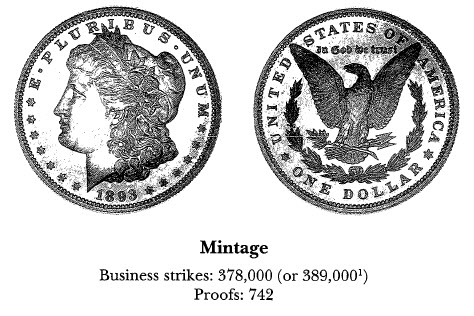
Numismatic Information
Hoard coins: many bags of 1893 dollars were released by the Treasury in the mid-1950s and very early 1960s. John Jay Ford, Jr. handled at least one bag in 1952, dribbling out the contents for years; circa 1959, John Love reported handling one bag, at least one bag was sold by LaVere Redfield prior to his death, and multiple bags were bought by Superior Stamp & Coin Co. from Redfield's widow prior to the sale at auction of Redfield silver dollars in January 1976, by which time the holding had been reduced to two to four bags. Few bags were in the 1962-1964 Treasury release.
Circulated grades: The 1893 is readily available in worn grades, but among Philadelphia Mint Morgan dollars the 1893 is one of the more elusive dates.
Most business strike 1893 dollars are decent strikes but have somewhat "greasy" lustre, not a deep frosty surface. Others are lightly struck at the Mint State grades: After 1901 and 1894 (and not counting the non-existent 1895), the 1893 is the rarest business strike Philadelphia Mint Morgan silver dollar. However, the 1901 (in particular) and 1894 are far rarer.
Most business strike 1893 dollars are decent strikes but have somewhat "greasy" lustre, not a deep frosty surface. Others are lightly struck at the centers and often have dull lustre. Once again, cherrypicking for quality is advised. Lower range coins are apt to have smaller (less heavy or damaging) bagmarks than seen on many other Morgan dollars. Higher grade coins with minimum bagmarks are often found as well.
Most coins known today are in lower ranges such as MS-60 to 62, of which probably 30,000 to 60,000 exist. MS-63 coins, with an estimated population of 10,000 to 20,000, are more elusive. Rarer still are MS-64s, of which possibly 4,000 to 8,000 survive. Rarest of all are MS-65 or better pieces, which exist to the extent of only 400 to 800 coins.
Many 1,000-coin bags were once in numismatic channels, as noted earlier. However, relatively few of these coins have ever been certified. This situation is not unique to 1893, but occurs for many other varieties as well-most notably the Carson City Mint dollars of the mid-1880s. This causes no end of frustration to a growing number of "market analysts" who use as their sole source of information the population reports published by NGC and PCGS.
Prooflike coins: Prooflike coins are very rare, and DMPL pieces are exceedingly rare. As of September 1992, NGC and PCGS had certified only two PL coins and one DMPL!
Wayne Miller reported that prooflike coins usually have unsatisfactory surfaces and contrast, and for this reason they are usually less desired than high-grade Mint State coins with frosty surfaces. Semi-prooflike coins were often sold as fully prooflike in the years before certified grading. Now, with certified grading, the situation is not particularly clearer, due to erosion of the standards as to what constitutes a prooflike (PL), deep prooflike (DPL), etc. coin (see my introduction to the Morgan dollar section for more details)'
Proofs: The situation of flatly struck Proof coins begun in 1888-coins with lightness of strike above Miss Liberty's ear on the obverse and on the eagle's breast feathers on the reverse-was continued. In 1892 and 1893 dollars the flatness is particularly noticeable; more so than in the earlier years. Often the obverse center is quite flat, and on the reverse the eagle's feathers are missing. The majority of Proof 1893 dollars are flatly struck. The VAM text calls the 1893 dollars "the most poorly struck Morgan Proofs."
Varieties
Business strikes:
1. Normal date: Breen-5630. It is uncertain if open and closed 3 are different logotypes. That this low mintage for circulation actually used at least five obverses out of seven pairs of dies furnished means that the dies did not last long: average 77,800 impressions, about a third of normal. Surprisingly, no coins have been reported with die breaks or other failures. One obverse shows top of 3 repunched. Strongly doubled obverse stars are a feature of VAM-4, which is scarce, but which is occasionally seen prooflike.
Proofs:
1. Proof issue: Proofs (not given a numerical designation in VAM, but mentioned in the text) have closed 93; plain horizontal die file marks between back of neck and wing. Usually poorly struck.