Silver Dollars & Trade Dollars of the United States - A Complete Encyclopedia
Q. David Bowers
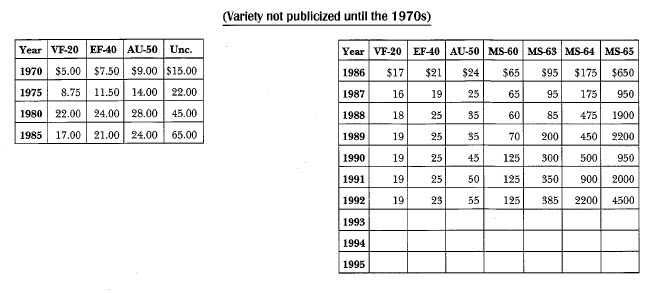
1882-0/S Morgan: Market Values
1882-0/S Morgan: Summary of Characteristics
Business Strikes:
Enabling legislation: As earlier, plus Act of February 28, 1878
Designer: George T. Morgan
Weight and composition: 412.5 grains; .900 silver, .100 copper
Melt-down (silver value) in year minted: $0.87833
Dies prepared: Obverse: unknown; Reverse: unknown
Business strike mintage: Unknown part of 1882-O, probably in the hundreds of thousands.
Estimated quantity melted: Unknown
Approximate population MS-65 or better: 0 to 10 (URS-0)
Approximate population MS-64: 100 to 200 (URS-8)
Approximate population MS-63: 200 to 400 (URS-9)
Approximate population MS-60 to 62: 500 to 1,000 (URS-11)
Approximate population G-4 to AU-58: 10,000 to 20,000+ (URS-15)
Availability of prooflike coins: Very rare. Wayne Miller stated he knew of just two or three. None certified as of September 1992.
Characteristics of striking: Striking varies from weak to sharp, but most are sharp.
Known hoards of Mint State coins: Released as a small part of Treasury dispersals of 1882-O.
Proofs:
None
Commentary
This overmintmark variety has become increasingly popular in recent years. With three reverses used, compared to 30 non-overmintmarked, one might expect a couple of hundred thousand struck. The actual figure must be much smaller, the 1882 O/S forms far less than 1% of total survivors of this date and mint, and may eventually be priced accordingly.
1882-S Morgan Dollar
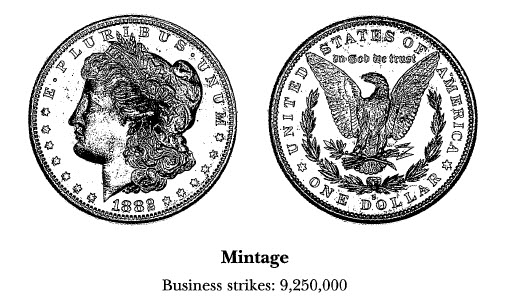
Numismatic Information
Hoard coins: It is believed that as of June 30, 1913, most of the original mintage of 1882-S was stored at the San Francisco Mint, to be paid out over a period of decades thereafter. Later, some of these were transferred to the Treasury Building in Wash-ington, D.C. However, enough coins dribbled onto the market over a period of years that 1882-S was never considered to be a rarity in Mint State.
During the 1926 convention of the American Nu-mismatic Association in Washington, D.C., numerous attendees were delighted to obtain atface value Uncirculated 1882-S dollars which were being paid out at the Cash Room of the Treasury Building in the same city. Although the San Francisco Mint usually served as the storage depot for its own coins, portions of the mintage of several issues-including 1882-S and 1904-S-were shipped to vaults in Washington.
For many years, through at least the early 1950s, 1882-S dollars were available at face value from the San Francisco Mint. Further, probably well over a million were released by the Treasury Department in 1962-1964, especially in 1963. In The Forecaster, September 15, 1971, John Kamin suggested that about 10% of the original mintage of 1882-S was re-leased circa 1962-1964, a figure equal to about a million coins.
Dollars of 1882-S were among the most abundant varieties in the Redfield and Continental-Illinois Bank hoards.
Circulated grades: Examples are scarce in worn grades, but ready availability of Mint State coins has taken attention from circulated specimens, and they are hardly noticed.
Mint State grades: The 1882-S is one of the most common of all San Francisco Mint dollars in Uncirculated grade. Most hoard coins are in the MS-60 to MS-64 range, but MS-65 and better coins represented an estimated 15% or so of those found. How-ever, in Mint State 1882-S is the least common San Francisco dollar from 1879 through 1882.
To be more specific, I suggest that 250,000 to 500,000 survive in grades from MS-60 to 62, 180,000 to 250,000 MS-63, 120,000 to 180,000 MS-64, and a generous 100,000 to 150,000 MS"65 or finer.
The striking is usually excellent on the 1882-S, and bagmarks, when found, are usually not disfiguring (although there are numerous exceptions). Many coins exhibit deep, frosty mint lustre.
Prooflike coins: Prooflike 1882-S dollars are very common. Typically, the contrast is not great, and the coins will have somewhat of a silky appearance. Probably, 40,000 to 80,000 or more survive. DMPL coins are about eight to 10 times less plentiful. In PL and DMPL, 20% or so are MS-65 or better.
Varieties
Business strikes:
1. Normal date: Breen-5568. Open or closed 2; over 16 V AM varieties show repunched dates, some of which are entirely repunched. VAM-20 has S mintmark tilted significantly to the left; however, mintmarks punched into dies out of position have created relatively little collector interest thus far.