Silver Dollars & Trade Dollars of the United States - A Complete Encyclopedia
Q. David Bowers
1899 Morgan: Market Values
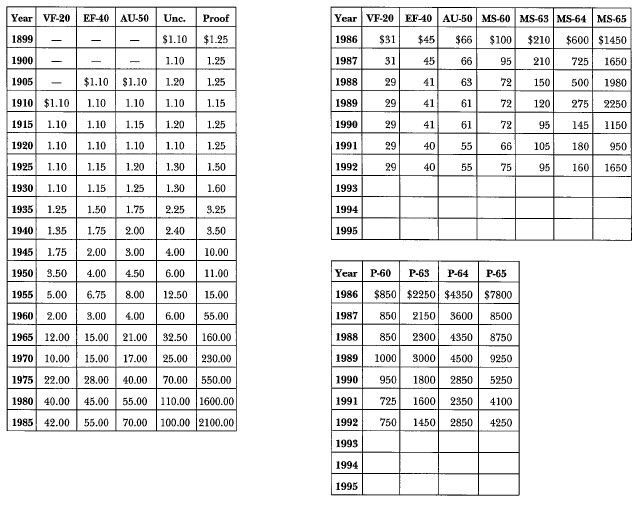
1899 Morgan: Summary of Characteristics
Business Strikes:
Enabling legislation: Act of February 28, 1878, plus the Shennan Silver Purchase Act of July 14, 1890
Designer: George T. Morgan
Weight and composition: 412.5 grains; .900 silver, .100 copper
Melt-down (silver value) in year minted: $0.46525
Dies prepared: Obverse: 3; Reverse: 3
Business strike mintage: 330,000; Delivery figures by month: January: none; February: 76,000; March: none; April: none; May: 214,000; June November: none; December: 40,000
Estimated quantity melted: Possibly 150,000 or so in the early days.
Approximate population MS-65 or better: 2,500 to 5,000 (URS-13)
Approximate population MS-64: 7,000 to 14,000 (URS-14)
Approximate population MS-63: 25,000 to 50,000 (URS-16)
Approximate population MS-60 to 62: 50,000 to 100,000 (URS-17)
Approximate population G-4 to AU-58: 6,000 to 12,000 (URS-14)
Availability of prooflike coins: True prooflike coins are somewhat scarce; DMPL coins are slightly more so. About 20% of extant DMPL coins are MS-65 or better.
Characteristics of striking: The striking varies widely, from weak and dull to sharp and frosty.
Known hoards of Mint State coins: Bags were released by the Treasury in the 1950s, and additional bags were part of the 1962-1964 distribution, however this date never fell into the "common" category.
Proofs:
Dies prepared: Obverse: 1; Reverse: 1
Proof mintage: 846; Delivery figures by month: January: none; February: none; March: 301; April: none; May: none; June: 73; July: none; August: none; September: 145; October: none; November: none; December: 327.
Approximate population Proof-65 or better: 52+/- (URS-7)
Approximate population Proof-64: 90+/- (URS-8)
Approximate population Proof-63: 100+/- (URS-8)
Approximate population Proof-60 to 62: 195+/- (URS-9)
Commentary
The 1899, a semi-scarce date, has always been popular because of its low mintage figure.
Additional Information
Mints Busy
The Annual Report of the Director of the Mint; 1899, told of coining activity:
"The mints at Philadelphia and New Orleans have been hard pressed throughout the year to meet the demands upon them. The mint at New Orleans has been employed chiefly upon the coinage of silver dollars, but has turned out subsidiary silver coins to the amount of $1,659,000. The mint at Philadelphia, besides turning out the usual supply of minor coin, has borne the brunt of an exceptionally heavy demand for subsidiary silver, given some assistance to fill the required quota of silver dollars, and applied the rest of its capacity to the coinage of gold. Both of these institutions have been obliged to run more or less overtime, the New Orleans Mint doing so for the greater part of the year.
"The Carson City Mint was reduced officially at the end of the fiscal year to an assay office authorized by Congress in the act carrying the appropriation of the maintenance of the institution. Thus, the Carson City Mint was a mint until June 30, 1899, although no coins had been struck there since 1893. After that it was an assay office."
Dollars "Unfit for Circulation" The Numismatist, June 1899, printed this news:
"In moving the 60 million in silver dollars from the Mint and the Post Office vaults to the new mint, Superintendent H.K. Boyer has just made the discovery that $2 million of the silver cartwheels are unfit for circulation. They are rusty and moldy, having been wet by water which percolated through the vaults of the Mint years ago, and caused the bags in which they were stowed to rot.
"This might seem a serious matter were it not for the fact that the dollars are not really intended for circulation. They aresimply held to give value and security to the silver certificates issued against them, and for this reason they will not be cleaned, not being needed for circulation, but will be allowed to continue to rust and grow tarnished in the splendid big vaults of the new Mint."
Dollars Accumulate at the Mint
The Annual Report of the Director of the Mint, 1899, told of storage and distribution quantities of dollars during the fiscal year: Philadelphia: In mint July 1, 1898, 66,269,954; coinage fiscal year 1899, 3,466,709; total, 69,736,663; in mint July 1, 1899, 69,610,954; total, 69,610,954; distributed from mint, 125,700.
Silver Dollar Coinage Summary
Silver dollar coinage to date under various acts (from the 1899 Annual Report):
"February 28, 1878 (Bland-Allison Act) $378,166,793; from July 14, 1890, to repeal of the purchasing clause of the Sherman Act, $36,087,285; From November 1, 1893 to June 12, 1898, $42,139,872; Coined under the War-Revenue Bill approved June 13,1898 $18,778,809; Total under Act of July 14,1890, $97,005,966; March 3,1891, recoinage of trade dollars) $5,078,472; total $480,251,231."
The Year 1899 in History
In Maya conference was held at The Hague, the Netherlands, and there were, two dozen delegates met to discuss warfare limitations, disarmament, and the arbitration of international disputes. In the Philippine Islands, guerrilla forces engaged American troops at Manila on February 4, 1899. When the smoke cleared, 57 Americans and about 500 Filipinos were killed. The rebellion was against U.S. rule and lasted until March 23, 1901, when guerrilla leader Emilio Aguinaldo was captured. President McKinley signed a peace treaty with Spain on February 10th, ending the Spanish-American War. Under the terms of the treaty, the United States acquired Guam and Puerto Rico, $20 million was paid for certain rights in the Philippines, and Cuba became independent of Spain.
On February 14, Congress authorized the use of voting machines if individual states desired them. On October 14, the Literary Digest stated, "The ordinary horseless carriage is at present a luxury for the wealthy; and although its price will probably fallin the future, it will never, of course, come into as common use as the bicycle." In the summer of 1899 President William McKinley became the first American president to ride in an automobile when he took a spin in a Stanley Steamer at his Canton, Ohio home. On June 9, James J. Jeffries knocked out Bob Fitzsimmons in the world heavyweight boxing championship held at Coney Island. Jeffries retired undefeated in 1905.)
Among popular songs of the time were My Wild Irish Rose and A Bird in a Gilded Cage. Thorstein Veblen's book, The Theory of the Leisure Class, was published, as was Winston Churchill's novel, Richard Carvel. (Churchill, the American author, was a different person from the British politician.) Scott Joplin's Maple Leaf Rag was published by John Stark, of St. Louis, who learned of Joplin, pianist at the Maple Leaf Club in Sedalia, Missouri. The melody was immediately popular and joined a number of ragtime and cakewalk tunes of the 1890s, including At a Georgia Camp Meeting and Smoky Mokes. Elbert Hubbard's article, "A Message to Garcia,"was published and was set against a backdrop of the Spanish-American War. In the 19408 it was still being read in schools by children who had no idea who Garcia was; since the 1960s, many instead think of Garcia as Jerry Garcia, lead guitarist of The Grateful Dead.