Silver Dollars & Trade Dollars of the United States - A Complete Encyclopedia
Q. David Bowers
1902-0 Morgan Dollar
Numismatic Information
Hoard coins: Although 1902-O dollars seeped outover a period of years from storage in the Treasury Building in Washington, D.C., especially in the late 1950s and very early 1960s (before autumn 1962),the date was not considered common until a vasttorrent of hundreds of thousands emerged from asealed vault in the Philadelphia Mint in October 1962 and ensuing months. Earlier, the 1902-O was considered to be a rarity in Mint State, and for aperiod of years it was priced higher than, for ex-ample, the 1884-S.
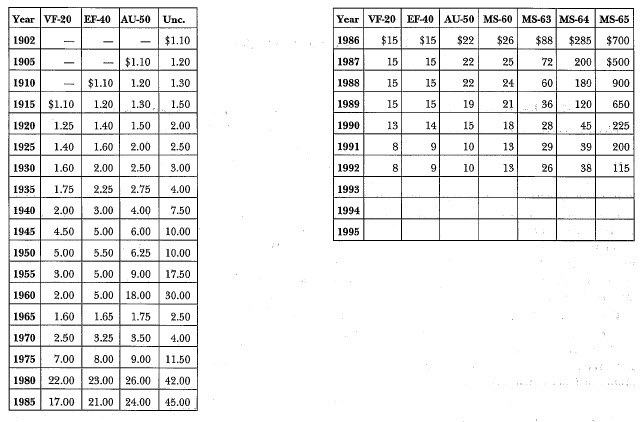
Circulated grades: Today, the 1902-O is slightly scarce in worn grades. However, it sells for littlemore than a common date. The depressed valuationfor circulated coins is due to the widespread avail-ability of Uncirculated pieces.
Mint State grades: In Uncirculated grades the 1902-O is very common. Most are in lower levels,but enough MS-64 and MS-65 coins exist that little effort is required to locate a specimen. I estimate that 300,000 to 600,000 survive at the MS-60 to 62 level, 125,000 to 250,000 in MS-63, 100,000 to 200,000 in MS-64, and 14,000 to 28,000 MS-65s.
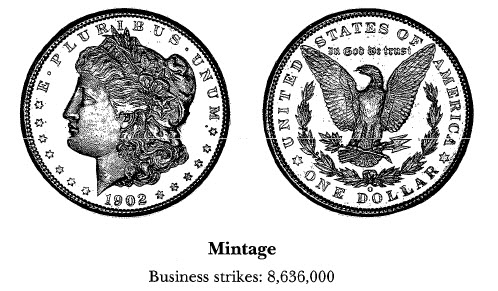
The striking quality of 1902-O dollars is usually poor, with flatness at the centers, particularly thereverse. Lustre ranges from dull to "greasy" on most pieces. There are exceptions, as might be expected from such a large coinage, and diligent cherry-pick-ing may yield a sharply struck, lustrous coin at, who knows, perhaps for not much more money than a flat strike.
Prooflike coins: Wayne Miller wrote that the issue was believed to be elusive, until one or two bags of Prooflike pieces came on the market in 1968. Unfortunately, these coins lacked satisfactory con-trast and were gray in appearance, which seems to be par for the course for prooflikes of this date. Most of these coins have long since been absorbed into collections. Probably 5,000 to 10,000 PL coins exist. DMPL coins are about four or five times harder to find than PL. Apparently, high-contrast cameo DMPL coins are unknown.
Varieties
OLD REVERSE HUB: NARROW WING/NECK
SPACE, SMALL STARS
VAM C-3 REVERSE
Business strikes:
1.Small Round o. "Micro 0." Breen-5690, VAM-3, F&S $1-011, there called "Rarity-6" (13 to 30 known). Called "ultra rare" by Jeff Oxman in the S.S.D.G. Joumal, Spring 1992. Tiny mintmark as in 1880-O, 1896-O, 1899-O (probably this die was left over from 1899), and 1900-O. Usually seen in low grades. Walter H. Breen and Jeff Oxman report that they have never seen an Uncirculated piece. Apparently, this variety was not represented in the Treasury releases of 1962-1964.
NEW OVER OLD HUB: DOUBLE OLIVE AT CLAW
1. C-4 reverse hub over C-3: Breen-5692, VAM-8, 12, 15-21, 23, 25, 27-32, 34-39. Reverse die variations differ from each other minutely. An outstanding example of a cluster of varieties of a major type relatively unknown as recently as 20 years ago, but now considered common.
VAM C-4 OVER C-3 REVERSE
Business strikes:
NEW REVERSE HUB: WIDE NECK/WING SPACE, LARGESTARS
Business strikes:
1. Medium O. Breen-5691, VAM 1-2,4-11, others, mostly positional varieties. Many survive from the huge Treasury releases of this date.
Evidently most of the 140 obverses, 107 reverses intended for 1902-O (various hub types combined) were unused.
1902-0 Morgan: Market Values