Silver Dollars & Trade Dollars of the United States - A Complete Encyclopedia
Q. David Bowers
1887-S Morgan Dollar
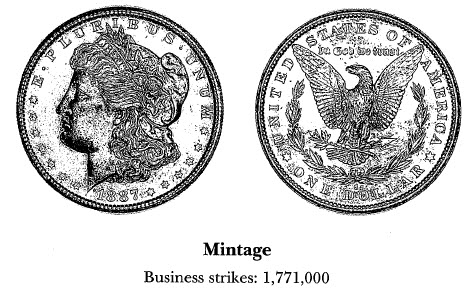
Numismatic Information
Hoard coins: Apparently, many 1887-S dollars were put into circulation in the late nineteenth century, after which undistributed quantities remained in storage at the San Francisco Mint. I have no record of any quantity of these dollars being released during the early twentieth century. On the numismatic market, Uncirculated coins were considered to be rare through the end of the decade of the 1930s. Beginning in late 1941 or early 1942, mintsealed bags of 1,000 coins each were paid out at face value, and the value dropped precipitously. From that point until the early 1950s, quantities continued to be available at face value from the Mint. However, the numismatic market was limited, and few people wanted more than one coin or, at best, a roll of 20.
In September 1950, W.E. Johnson, a California dealer, offered rolls for $24 each ($1.20 per coin). Within the next three or four years, quantities began to be scarce, and no longer were bags of 1887-S dollars obtainable easily from the Mint. It could have been that an occasional bag or two came to light later, for roll quantities remained plentiful until the end of the decade. Sample roll prices of the 1950s include these figures: W.E. Johnson, April 1954, $30.30 per roll; Joe Gordon, August 1956, $35.00 per roll; Joe Gordon, January 1957, $44.00 per roll;Daniel J. Morafka, October 1957, $35.00 per roll; and Morafka, March 1958, $32.00 per roll.
After the late 1950s, the supply of 1887-S in quantity seems to have dried up. There is no record of the issue being included in the massive Treasury releases of 1962-1964, although it is possible some may have been. LaVere Redfield obtained an estimated five to 10 bags of this date, probably from Nevada casinos or from California dealers who had acquired them in the 1950s. Upon dispersal of the Redfield estate, these coins were found to be of "high quality" (per Wayne Miller's comment in his Morgan and Peace Dollar Textbook). The Redfield coins are believed to have been sold to a wide number of buyers. Today, rolls of 1887-S are seldom seen.
Circulated grades: The 1887-S is common in worn grades up to and including AU-58. Apparently, large quantities were released into circulation at or near the time of mintage. Historically, worn specimens have never been rare. Quantities of AU-55 to 58 coins also exist, and in the 1960s and 1970s were often sold as "sliders."
Mint State grades: At one time the 1887-S in Mint State was considered to be a rarity. In 1898, one crossed the auction block at $4.10, a figure more than double the value of a Proof 1895 at the time. In 1914 one sold at auction for $12.50, and in 1915 a sale was registered at $9.00. While the 1887-S was easy to obtain in worn grades, Uncirculated pieces remained elusive until the early 1940s (see "Hoard coins" above).
Today, single specimens of 1887-S dollars are fairly plentiful in low Mint State levels. The Redfield hoard was reputed to have many such coins, plus numerous "sliders." Above MS-62, each jump in one numerical grade step results in a tripling or more in rarity, until at the MS-65 or better plateau, probably only 700 to 1,200 survive.
Most Mint State coins are well struck with good lustre. However, some pieces are weak at the centers. It will pay you to cherrypick for quality for this Issue.
Prooflike coins: Prooflikes are usually one-sided, obverse only, and are from incompletely polished dies (with numerous die finish lines showing under magnification). Wayne Miller wrote that all of the prooflike coins in the Redfield hoard were "heavily hairlined" because of this; however, as die finish lines are raised on the coin, they differ from hairlines (which are incused from cleaning. Several hundred deeply prooflike (on both sides) 1887-S dollars appeared on the market in the late 1970s and were quickly absorbed by collectors and investors. Today, these are usually found one at a time, and not often. Several hundred or more PL 1887-S dollars are estimated to exist, and a smaller number of DMPL, the latter mostly being MS-63 DMPL or lower. MS-64 DMPL coins are rare; higher grades are extremely rare. The three reports of Proofs may well be DMPLs: 1) S.H. & H. Chapman sale, June 17-18, 1889, "not very brilliant," $3-though they claimed only one other was known; 2) B.M. Douglas, The Numismatist, 12/51; 3) Harry Budd, The Numismatist, 8/53.
Varieties
Business strikes:
1. Normal date: Breen-5598. Many positional varieties exist, although the San Francisco Mint probably did not use all 20 obverse or 13 reverse dies received from Philadelphia for the 1887-S coinage. At least two obverses show partial repunching ondates (VAM-3, 4), the latter rarer than supposed. VAM-2 has strongly repunched mintmark and is probably the most numismatic ally interesting 1887-S variety.