Silver Dollars & Trade Dollars of the United States - A Complete Encyclopedia
Q. David Bowers
1901-S Morgan: Market Values
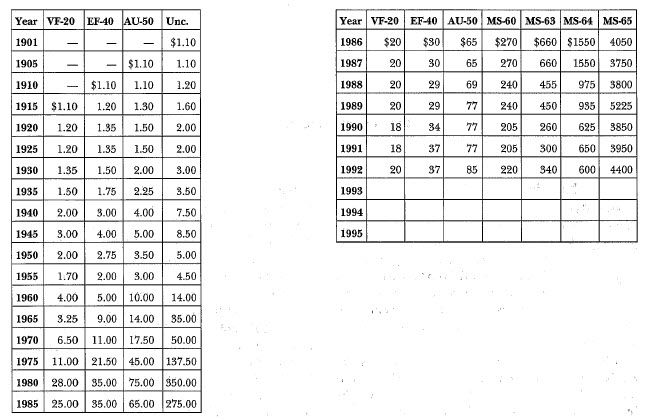
1901-S Morgan: Summary of Characteristics
Business Strikes:
Enabling legislation: Act of February 28, 1878, plus the Sherman Silver Purchase Act of July 14, 1890
Designer: George T. Morgan
Weight and composition: 412.5 grains; .900 silver, .100 copper
Melt-down (silver value) in year minted: $0.46093
Dies prepared: Obverse: 25; Reverse: 25.
Business strike mintage: 2,284,000; Delivery figures by month: January: 338,000; February: 500,000;March: 400,000; April: 400,000; May: 210,000; June: none; July: none; August: 218,000; September: 218,000; October: none; November: none; December: none.
Estimated quantity melted: Probably, relatively few under the Pittman Act; many under later, including private, melts.
Approximate population MS-65 or better: 500 to 1,000 (URS-13)
Approximate population MS-64: 3,000 to 6,000 (URS-13)
Approximate population MS-63: 6,000 to 10,000 (URS-14)
Approximate population MS-60 to 62: 15,000 to 25,000 (URS-15)
Approximate population G-4 to AU-58: 200,000 to 400,000 (URS-19)
Availability of prooflike coins: True prooflike coins are very rare. Nearly all have poor contrast and are unattractive. DMPL coins are very rare.
Characteristics of striking: Striking varies; see text. Known hoards of Mint State coins: Limited quantities were released from storage in the San Francisco Mint in the 1950s and early 1960s.
Proofs:
None
Commentary
The 1901-S is fairly scarce within the context of Morgan dollars from this mint at the turn of the century.
Additional Information
Distribution of Dollars
The Annual Report of the Director of the Mint, 1901, told of the distribution of silver dollars during the fiscal year: San Francisco: In the mint July 1, 1900, 51,775,509; coinage, fiscal year 1901, 4,888,000; total, 56,663,509; in mint July 1, 1901,55,977,333; total, 55,977,333; distributed from mint, 686,176.
1902 Morgan Dollar
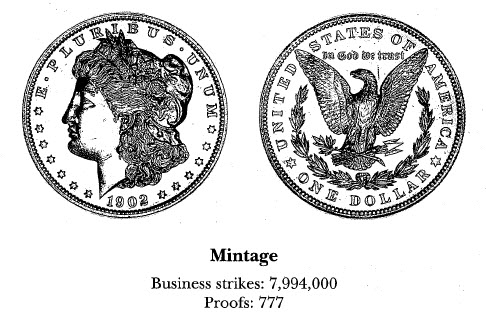
Numismatic Information
Commentary: The 1902 Philadelphia Mint dollar was the first issue employing the C-4 reverse on all dies. Interesting varieties are those from a reverse die made by impressing the new C-4 hub over the old C-3, and distinguished by having the "2 Olive Reverse." Of course, these over-hubs exist for other, earlier dates as well, and for certain later issues through 1904. Credit goes to Leroy C. Van Allen and A. George Mallis for coordinating and distilling the research efforts of many enthusiasts in the field. Years ago, no one knew about the over-hub issues.
Hoard coins: Like a number of other Philadelphia Mint Morgan dollars, the 1902 in Mint State was elusive before the 1930s. Demand for high grade specimens of the date was answered by Proofs. Circa 1947-1948, the Treasury paid out bags of 1902 dollars, but still they remained somewhat scarce. In the early 1950s, additional quantities were paid out, and in the closing years of the decade, many bags came to light. Today, probably well over 100,000 Mint State coins exist.
Circulated grades: Low grade 1902 dollars are common. At the higher end of the scale, numerous sliders exist; AU coins that are sometimes sold at bargain prices as "Uncirculated."
Mint State grades: Mint State coins are relatively plentiful from Treasury releases, although this is not one of the more common dates. Most surviving Uncirculated} 902 dollars are in lower ranges such as MS-60 through 62 and 63. MS-65 coins are quite scarce, relatively speaking. Estimated population: MS-60 to 62, 80,000 to 160,000; MS-63, 20,000 to 35,000; MS-64, 15,000 to 30,000; MS-65 or better, 5,000 to 10,000.
Most Uncirculated dollars of this date are satiny rather than deeply frosty. Striking varies from poor to sharp. Once again, cherrypicking will pay dividends. Bagmarks, when seen, are apt to be light and widely scattered.
Prooflike coins: Prooflike coins are elusive, and probably fewer than 1,000 exist. Most have low con-trast and are rather unappealing. One of the best, certified by NGC, is in the Anthony M. Scirpo Collection. DMPL coins are rarer yet.
Proofs: In keeping with Proof dollars of the next two years, Proofs of 1902 are of low contrast due to having the dies polished on the devices. This feature recurs on practically all Proofs 1902-1907.
Varieties
NEW OVER OLD HUB: DOUBLE OLIVE AT CLAW
VAM C-4 OVER C-3 REVERSE
Business strikes:
1. C-4 reverse hub over C-3: Breen-5689, VAM 6-11. Publicized only relatively recently, the variety is probably plentiful, but most 1902 dollars have not been inspected for this feature.
NEW REVERSE HUB: WIDE NECK/WING SPACE,LARGESTARS
VAM C-4 REVERSE
Business strikes:
1. Breen-5688, V AM 1-5, positional varieties.
V AM-4 has doubled die obverse, with doubling on Liberty's ear, nose, lips, and chin; rare. Not all the 80 obverses, 67 reverses were used. Common.
Proofs:
1. Proof issue: Breen-5688. Only one variety of Proofs seen, VAM-2: date well to left, closed 9, die file mark slanting down to right at left ribbon bow.