Silver Dollars & Trade Dollars of the United States - A Complete Encyclopedia
Q. David Bowers
1889-CC Morgan: Market Values
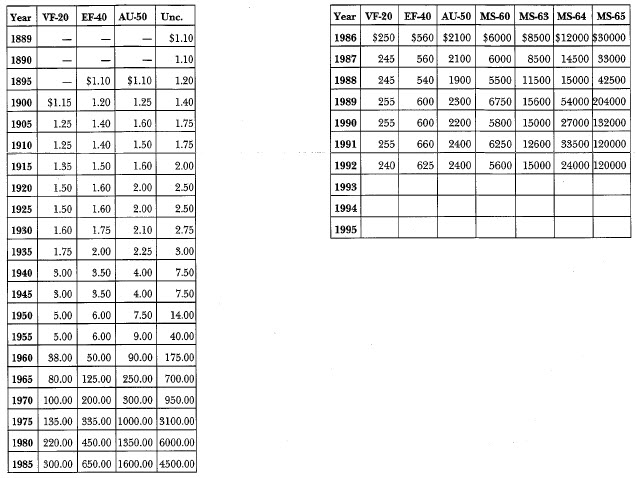
1889-CC Morgan: Summary of Characteristics
Business Strikes:
Enabling legislation: As earlier, plus Act of February 28, 1878
Designer: George T. Morgan
Weight and composition: 412.5 grains; .900 silver, .100 copper
Melt-down (silver value) in year minted: $0.724
Dies prepared: Obverse: 10; Reverse: 7; (at least 3 pairs were used from this quantity)
Business strike mintage: 350,000; Delivery figures by month: January-September: none; October: 100,000; November: 100,000; December: 150,000.
Specimens sent to the Assay Commission: 175
Estimated quantity melted: Unknown, but probably at least 250,000.
Approximate population MS-65 or better: 80 to 150 (URS-8)
Approximate population MS-64: 400 to 800 (URS-10)
Approximate population MS-63: 1,500 to 3,000 (URS-12)
Approximate population MS-60 to 62: 5,000 to 8,000 (including several thousand coins still undistributed in bags) (URS-14)
Approximate population G-4 to AU-58: 3,500 to 7,000 (URS-13)
Availability of prooflike coins: Nearly 50% of all known Mint Statecoins have prooflike surfaces. Numerous DMPL coins exist, mostly at the MS-63 level or below. Population included in the above Mint State figures.
Characteristics of striking: Usually seen well struck. Known hoards of Mint State coins: At least 1,000 coins and possibly as many as 3,000'were in the 1962-1964 Treasury release (Breen); possibly as many as seven other bags (7,000 coins) came to light in the 1950s and 1960s. This coin is somewhat of an enigma in Mint State, for the actual market availability of coins and the number of pieces certified is much less than the number of reported mint-sealed bags would indicate. See above.
Proofs:
None
Commentary
The 1889-CC is the rarest and most desired issue among Carson City Morgan dollars.
Additional Information
The Carson City Mint in 1889
The Annual Report of the Director of the Mint, 1889, commented that the business of the Carson City Mint during the fiscal year, which ended June 30, 1889, was confined to that of an assay office. Further:
"Since the commencement of the present fiscal year the mint at Carson has been reopened for coinage and is now in full operation, Samuel C. Wright was appointed by the President superintendent, vice William Garrard, and took charge July 1, 1889.
"P.B. Ellis was appointed by the President assayer, vice Joseph R. Ryan, July 1,1889. E.B. Zabriskie was appointed by the President melter and refiner, July 12, 1889, vice [melter and refiner] John H. Dennis. Charles H. Colburn was appointed by the President coiner, July 1, 1889,"
Coinage at Carson City 1889-1890
The Annual Report of the Director of the Mint, for the fiscal year ended June 30, 1890, told of the Nevada facility:
"The mint at Carson was reopened for coinage on July 1, 1889, but, owing to the dilapidated condition in which the building and machinery was found, after four years of idleness, repairs and betterment of the building and overhauling and repairing the machinery were necessary, and consequently the coinage of gold and silver was not commenced until October 1, 1889 .... The melter and refiner received, during the year, bullion containing 183,635.672 standard ounces of gold. He made 83 melts of gold ingots, of which 6 were condemned.
"He returned to the superintendent in settlement, at the close of the fiscal year, an excess of 3.322 standard ounces of gold. The same officer received, during the year, bullion containing 1,812,222,15 standard ounces of silver. He made 1,358 melts of silver ingots, of which 39 were condemned. He returned to the superintendent in settlement, at the close of the year, an excess of 921.80 standard ounces of silver.
"The coiner received from the superintendent 192,722.350 standard ounces of gold. There were coined in his department and delivered to the superintendent 92,460 double eagles of the value of $1 ,849,200, being 51.5% of good coin produced from ingots operated on. He had a gold wastage of 6.689 standard ounces,
"The same officer operated upon 2,331,896 standard ounces of silver and delivered to the superintendent 1,438,000 standard silver dollars, being 54% of good coin produced from ingots operated upon. He had a silver wastage of 378.98 standard ounces."