Silver Dollars & Trade Dollars of the United States - A Complete Encyclopedia
Q. David Bowers
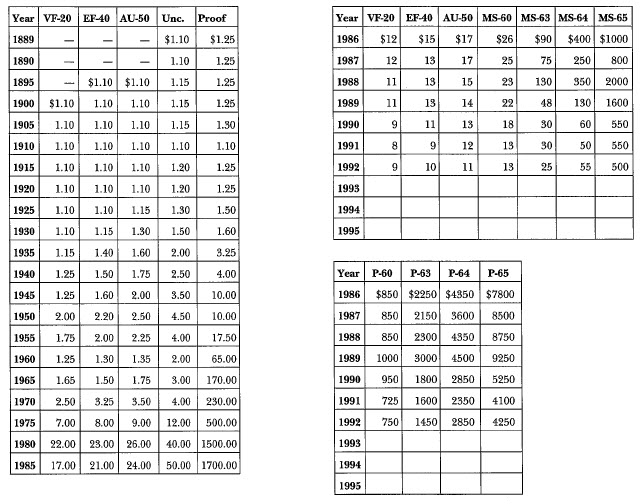
1889 Morgan: Market Values
1889 Morgan: Summary of Characteristics
Business Strikes:
Enabling legislation: As earlier, plus Act of February 28,1878
Designer: George T. Morgan
Weight and composition: 412.5 grains; .900 silver, .100 copper
Melt-down (silver value) in year minted: $0.724 Specimens sent to the Assay Commission: 14,589
Dies prepared: All 57 obverses and 50 reverses must have been used until they wore out. The average of 381,158 coins per obverse is very high, and one suspects typographical error.
Business strike mintage: 21,726,000; Delivery figures by month: January: 2,000,000; February: 1,710,000; March: 2,000,000; April: 1,878,000; May: 2,064,000; June: 2,164,000; July: 800,000; August: 1,900,000; September: 1,860,000; Octo-ber: 2,000,000; November: 2,000,000; December: 1,350,000.
Estimated quantity melted: Probably 10,000,000 or more under various acts; probably most under the 1918 Pittman Act.
Approximate population MS-65 or better: 5,000 to 10,000 (URS-14)
Approximate population MS-64: 35,000 to 70,000 (URS-17)
Approximate population MS-63: 100,000 to 180,000 (URS-18)
Approximate population MS-60 to 62: 400,000 to 800,000 (URS-20)
Approximate population G-4 to AU-58: 4,000,000 to 8,000,000 (URS-24)
Availability of prooflike coins: Scarce semi prooflike; scarcer DMPL. Most DMPL coins are below MS-65.
Characteristics of striking: Usually seen softly struck at the centers.
Known hoards of Mint State coins: Many were re-leased by the Treasury in December 1954; additional quantities more or less continuously through 1962-1964.
Proofs:
Dies prepared: Obverse: At least 1; Reverse: At least 1.
Proof mintage: 811; Delivery figures: 300 of these are known to have been delivered in the first quarter of 1889.
Approximate population Proof-65 or better: 76+/- (URS-8)
Approximate population Proof-64: 78+/- (URS-8)
Approximate population Proof-63: 85+/- (URS-8)
Approximate population Proof-60 to 62: 190+/- (URS-9)
Commentary
The 1889 dollar is plentiful in all grades. However, those with prooflike surface are rare.
Additional Information
Improvements in Silver Dollar Storage
The Annual Report of the Director of the Mint, 1889, stated the following:
"During the last fiscal year there have been material improvements in the way of additional accommodations for the storage of coin at the mint at Philadelphia. The last of the small brick vaults in the basement for the use of the cashier was lined with steel and furnished with modern doors and improved locks. There was constructed beneath the central court-yard of the mint a steel-lined, burglar-proof vault with a storage capacity of 85 million silver dollars. There was also constructed a large steel vault in the central area of the mint on a level with the main floor of the building, said to be the only one of its style in the United States, divided into compartments for the daily use of the melter and refiner, the coiner, and the superintendent, for the immediate safe-keeping of the large silver bars received on purchases."
Elsewhere in the same report, this was noted:
"During the year, 42 million silver dollars were transferred from the mint at Philadelphia, and eight million from the mint at New Orleans, to the Treasury of the United States at Washington, for storage."
The Year 1889 in History
President Benjamin Harrison opened 1.9 million acres of former Indian lands to white homesteaders at noon on April 22nd. However, by morning many who had come earlier-"sooners," as they were called-had already staked their claims. By nightfall, communities were established at Guthrie, Oklahoma City, and elsewhere. In the same year, North Da-kota, South Dakota, Montana, and Washington were admitted to the Union. On May 31st, a dirt dam burst above the community of Johnstown, Pennsylvania, and in the ensuing flood over 2,000 citizens were killed. The Johnstown Flood is remembered as one of the worst American disasters, along with the 1871 Chicago fire and the 1906 San Francisco earthquake, and 1992's Hurricane Andrew.
The United Confederate Veterans group was organized in New Orleans in 1889, while the Sons of the American Revo-lution began in New York City. Nellie Bly (Elizabeth Cochrane Seaman), a reporter for Joseph Pulitzer's New York World, sought to better mythical figure Phineas Fogg's 80-day round-the-world trip, and made the journey in 72 days, 6 hours, 10 minutes, and 58 seconds, finishing amidst much press-agentry.
The Wall Street Journal began publication on July 8th, an expansion of a daily financial newsletter issued by Dow Jones & Company, owned by Charles Henry Dow and Edward D. Jones. The first two volumes of The Winning of the West, by Theodore Roosevelt, were published. Roosevelt was a prolific researcher and writer, who had a passion for the outdoor life and the American West. A Connecticut Yankee in King Arthur's Court, by Mark Twain, saw print.
The Chicago Auditorium opened on December 9, 1889, with President Harrison among those in attendance. Featured soloist was Adelina Patti, who sang Home Sweet Home. Mme.
Patti, who lived in Craig-y-Nos Castle in Wales, was the world's most acclaimed diva. John Philip Sousa, America's march king and, at one time, leader ofthe Marine Band, wrote the Washington Post March, named after a District of Columbia newspaper. The focal point of the Universal Exhibition held in Paris in 1889 was the Eiffel Tower.
The director of the Mint was James P. Kimball, who served from July 1885 through October 1889. Serving from October 1889 through May 1893 was Edward O. Leech. At the Phila-delphia Mint the superintendency changed from Daniel M. Fox (1885-1889) to Col. Oliver C. Bosbyshell (1889-1894). Unlike Fox, who seems to have been indifferent on the subject, Bosbyshell had at least a passing interest in numismatics. The Carson City Mint, which had last produced coins in 1885, reopened July 1, 1889, and again struck gold and silver denominations.