Silver Dollars & Trade Dollars of the United States - A Complete Encyclopedia
Q. David Bowers
1892 Morgan Dollar
Numismatic Information
Once a rarity: From the time of mintage through the early decades of the twentieth century, the 1892 was a major rarity. Very few had been released into circulation. However, Proofs were available readily enough, and they took care of the need to acquire a business strike of the date. This situation was true of such other Philadelphia Morgan dollar dates as 1894, 1897, and 1899, among others. The relatively few transactions involving Mint State 1892 dollars sold prior to 1940 did not take place at high prices. Accordingly, the erstwhile rarity of this date was not recognized until I researched the matter in connection with the present text.
Hoard coins: Large quantities of Mint State 1892 dollars were released by the Treasury in the late 1950s and early 1960s, before which time they were rare, as noted. By the late 1950s, they were very common. Harry J. Forman reported that Uncirculated 1892 dollars were second only to 1891 dollars from the standpoint of availability through Philadelphia banks at the time. However, by the time that the Treasury began emptying its vaults in earnest, circa 1962-1964, most 1892 dollars had already been paid out. The date was not well represented among later Treasury hoard coins.
It has been suggested that the Redfield hoard had a partial bag of coins, and these mostly graded MS-60 to MS-62. By that time, most other quantities had been dispersed.
Circulated grades: 1892 dollars are plentiful in higher circulated grades but rare in lower grades. Few were placed in circulation at or near the time of striking. In 1925, numismatist E.S. Thresher reported that despite searching since 1919, he had not been able to find an example in circulation; one of just eight coins absent from his Morgan dollar collection (the others were 1884-CC, 1885-CC, 1889-S, 1893-S, 1894, 1897, and 1899). Most worn coins seen now are those that were placed into the channels of commerce well into the present century.
Mint State grades: Estimated populations have a rapid fall-off as grades increase: MS-60 to 62, 75,000 to 150,000 exist; MS-63, 20,000 to 40,000; MS-64, just 2,000 to 4,000; and MS-65 or better, only 600 to 1,200.
As a class, 1892 dollars are chameleons. Some are sharply struck with very nice lustre, and are a joy to behold. However, the typically encountered coin is apt to be flatly struck at the centers, have poor lustre, and be peppered with bagmarks. Once again, cherrypicking is advised when buying at any grade level. As always, this attention to detail will yield quality coins for your collection, while unknowing investors can take up the slack with poorly struck pieces.
Prooflike coins: Prooflike and DMPL 1892 dollars are rare. Many prooflike coins are bagmarked and/or are flatly struck. However, Wayne Miller reported that "many" prooflike coins came on the market in the 1970s. About 10% of extant DMPL coins are MS-65 or finer.
Proofs: The situation of flatly struck Proof coins began in 1888. Dollars dated 1892 continue the trend and show lightness of strike above Miss Liberty's ear on the obverse and on the eagle's breast feathers on the reverse. Among extant 1892 and 1893 Morgan dollars the flatness is particularly noticeable; more so than in the earlier years. Perhaps half of the surviving 1892 Proof dollars show this lack of detail.
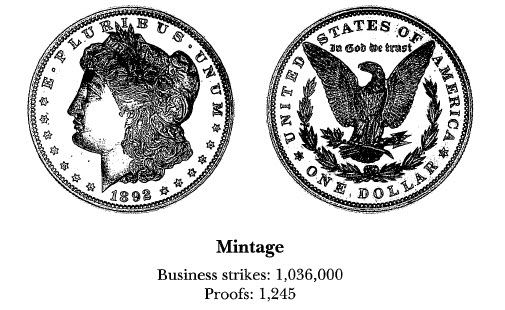
The generous mintage figure of 1,245 Proof dollars is explained by their inclusion in 1892 silver Proof sets, which were in special demand due to the new Barber designs for the dime, quarter, and half dollar. It is probable that a couple hundred or more unwanted 1892 Proof Morgan dollars were spent for face value.
Varieties
Business strikes:
1. Normal date: Breen-5625. Positional varieties exist. VAM-3, Doubled Reverse, has many features doubled. VAM-6 and 7 also show doubling on the reverse. VAM-5 has a doubled profile to Miss Liberty and tripling of E PLURIBUS UNUM. Probably not all nine pairs of dies were used.
Proofs:
1. Proof issue: Proofs have closed 9, die polish below initial M; reverse of 1891 Proofs. The Proof mintage of 1,245 should have taken two or three die-pairs; to date only this one variety has been described.