Silver Dollars & Trade Dollars of the United States - A Complete Encyclopedia
Q. David Bowers
1888 Morgan Dollar
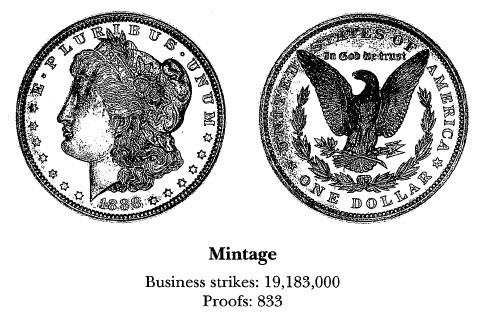
Coinage Context
Mintages continue: The year 1888 saw continuing mintages of vast quantities of silver dollars under the provisions of the 1878 Bland-Allison Act. Most production was accomplished at Philadelphia and New Orleans, with a lesser amount at San Francisco.
Numismatic Information
Hoard coins: As is the case with a number of other Philadelphia Mint issues, the 1888 was not considered to be a common coin in Mint State until the 1950s. Apparently, quantities were released into circulation at or near the time of mintage. After that, many went into storage, while probably millions of others were undoubtedly melted under the 1918 Pittman Act. Mint State coins, although not common in the market decades ago, were inexpensive, as there were enough Proofs around to satisfy the demand of high-quality examples of the date. In the mid-1950s, 1888 dollars were released in quantity probably by the millions. Few were saved by collectors, investors, or dealers. Most eventually ended up in mixed bags of Morgan dollars. The quantities were so vast, that even though most bags were broken up, individual coins remained very common.
During the great Treasury release of 1962-1964, many more 1888 dollars were paid out. In fact, bags of 1888 dollars were still being shipped by the Federal Reserve in March 1964, the last month that silver dollars were available in quantity at face value from the government.
Circulated grades: 1888 dollars are very common in all worn grades.
Mint State grades: Mint State 1888 dollars are very plentiful and have been for several decades. As Mint State 1888 dollars were so common when they were released in quantity in the mid-1950s, continuing through 1964, they were viewed with disdain by investors and dealers, and most of those released in the 1950s remained in banks or in limited circulation, where they acquired light wear. As a result, select quality Mint State coins are not among the most plentiful Morgan dollars in the higher levels such as MS-64 and MS-65.
Many 1888 silver dollars are seen with some light-ness of striking, particularly evident at the center of the obverse and reverse. Others are sharply struck. Some have an irregular surface in the fields, particu-larly near the rim-probably the result of the use of worn dies.
Cherrypicking is strongly advised when buying an 1888 dollar. Two coins, each described as MS-65, can be as different as day and night. One can be sharply struck and lustrous, and the other can be weakly struck with dull surfaces. The variance in striking is accounted for by striking coins from many die pairs over a long period of time during the year. Some coins were carefully struck. Others weren't. Most coins have frosty surfaces with nice lustre.
Prooflike coins: Prooflike coins are elusive and are usually not deeply mirrorlike. Rather, the surfaces are usually somewhat satiny or semi-prooflike. Weimar W. White reported seeing a full bag of DMPL coins in New York City in the early 1960s. Wayne Miller bought three rolls of prooflike coins from a Reno dealer in 1976, who said that he had a full bag; presumably, this was a different bag than the one seen in New York. Hundreds, if not 2,000 or more, of DMPL coins are believed to remain, most of which are below MS-65.
Proofs: Due to inadequate die spacing, many 1888 Proof dollars are weakly defined in the higher details, induding the hair above Miss Liberty's ear on the obverse and the eagle's breast feathers on the reverse. This general situation continued at the Mint through and including 1893. At the time at the Mint there was a disaffection with collectors, and the production and sale of Proof coins was considered a bother by the Mint personnel, rather than a sales opportunity. Many 1888 Proof dollars have a cameo appearance due to nicely frosted motifs set off against the mirror fields. Mintage figures differ. The Annual Report of the Director of the Mint suggests 832 plus one coin men-tioned in a separate footnote, for a total of 833; Walter Breen's Encyclopedia suggests 800.
Varieties
Business strikes:
1. Normal date: Breen-5599. Dates show minor positional differences. VAM-4 and others have por-tions of the reverse doubled. Six doubled die reverses are presently known; VAM-4, 6, 7, 12, 16, and 17. Four doubled die obverses have been discovered: VAM-11, 14, 18, 19. Probably all of the 64 obverse and 54 reverse dies were used until they wore out. Average 298,328 coins per obverse is very high.
Proofs:
1. Normal date: Breen-5599. Most Proofs seen have the date slanting up to right: VAM-1
2. Doubled date. Breen-5600. Not in VAM.
Proofs only. Date first punched lower and slanting up to right, then corrected higher and level. Walter Breen has seen no more than a half dozen specimens since the discovery coin in the Anderson Dupont sale in 1954.