Silver Dollars & Trade Dollars of the United States - A Complete Encyclopedia
Q. David Bowers
1882-CC Morgan: Market Values
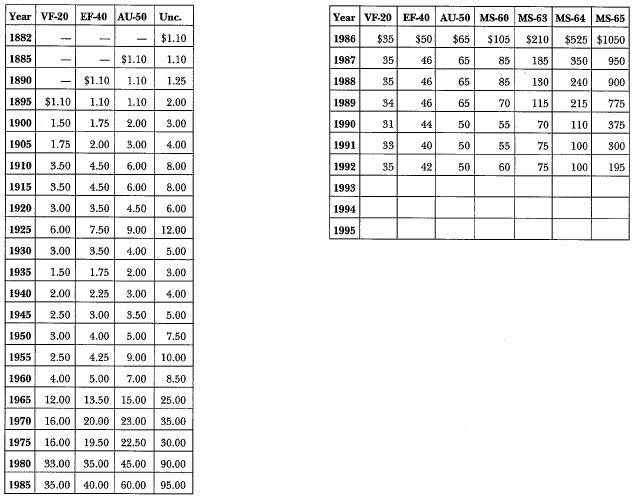
1882-CC Morgan: Summary of Characteristics
Business Strikes:
Enabling legislation: As earlier, plus Act of February 28, 1878
Designer: George T. Morgan
Weight and composition: 412.5 grains; .900 silver, .100 copper
Melt-down (silver value) in year minted: $0.87833
Dies prepared: Obverse: 15; Reverse: 15
Business strike mintage: 1,133,000
Estimated quantity melted: Possibly 200,000 to 300,000, nearly all under the 1918 Pittman Act and/ or the 1942 Silver Act.
Approximate population MS-65 or better: 25,000 to 35,000 (URS-16)
Approximate population MS-64: 75,000 to 100,000 (URS-18)
Approximate population MS-63: 150,000 to 200,000 (URS-19)
Approximate population MS-60 to 62: 350,000 to 450,000 (URS-20)
Approximate population G-4 to AU-58: 8,000 to 16,000 (URS-15)
Availability of prooflike coins: Prooflike coins, including DMPL specimens, are plentiful on the market.
Characteristics of striking: Most are very well struck, but a few are weak on the eagle's breast feathers and on the hair above Miss Liberty's ear.
Known hoards of Mint State coins: 605,029 were held back from 1962-1964 Treasury release and subsequently sold by the General Services Administration. Others were released by the Treasury in the 1950s and early 1960s.
Proofs:
None
Commentary
The majority of 1882-CC dollars were not released at the time of issue but were held by the Treasury. Many decades later, over 600,000 were sold by the government at a premium to collectors. Add between 51 % and 69% of the original mintage survives in Unc., mostly out of numismatic hands.
Additional Information
1882 Report on the Carson City Mint
The Annual Report of the Director of the Mint, 1882, page 13, told of the facility's operations during the fiscal year ending June 30, 1882:
"The difficulty in procuring silver for coinage was less than that experienced in former years, and coinage operations, which had been previously suspended, were resumed in the month of October and continued during the remainder of the year. The refinery was kept open during the whole year for the purchase of silver and reception of deposits for parting and refining.
"The work performed at the Carson Mint, as to the value of the deposits, number of pieces, and value of the coinage, was nearly double that of the preceding year. The annual settlement made at the close of the fiscal year was satisfactory."
A Free-For-All!
At the annual American Numismatic Association convention, held in Washington, D.C. the third week of August in 1926, attendees were treated to a numismatic bonanza. The Numismatist, October 1926, p. 564, told the story:
"There was a rush on the Treasury Department, just opposite the hotel [where the convention was held], when it was learned that one could exchange any old kind of a dollar there for an Uncirculated silver dollar of 1882, CC Mint, and many of them found their way into collectors' hands. It was stated unofficially that a bag of these dollars had recently been discovered in the Treasury vaults, and that while they lasted they would be issued to redeem silver certificates, or other currency, for that matter."