Silver Dollars & Trade Dollars of the United States - A Complete Encyclopedia
Q. David Bowers
1896-S Morgan Dollar
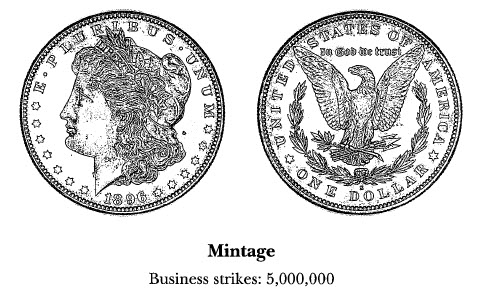
Numismatic Information
Commentary: The 1896-S is another of the Morgan dollar issues of which worn specimens are very common, but Mint State coins are rare. Bags of 1896-S Uncirculated dollars were paid out from the San Francisco Mint during the very early 1950s, when scant attention was paid to them as they had little value at the time. A few years later, John Skubis and Arnold Rosing jointly bought a bag which turned up at a bank in Oakland, California. Perhaps another bag or two came out as well during that era. The issue seems to have been plentiful enough as singles in the 1950s and 1960s, but rare in quantity, although it should be noted that Harry J. Forman advertised a 20-coin roll for $2,700.00 in May 1965.
At least several hundred coins, probably from a California or Nevada dealer source, found their way to the holdings of eccentric Reno investor LaVere Redfield and were later included in his estate. Reportedly, most of the Redfield coins would grade from MS-60 to 63 if evaluated today.
Wayne Miller reported that roll quantities of 1896-S dollars appeared on the market in the early 1970s, but by the early 1980s they were largely dispersed.
Circulated grades: 1896-S Morgan dollars are relatively common in lower grades from VG-8 up through VF-30. EF-40 pieces are elusive, and coins in the AU category are seldom seen. Worn pieces are not cheap, however, as the high cost of Mint State coins has placed extra demand on circulated pieces.
Mint State grades: Mint State 1896-S dollars are quite elusive in the context of San Francisco Mint Morgan issues, but they are hardly a match for such formidable rarities (in Mint State) as 1892-S and, in particular, 1893-S. Most pieces are average strikes with average to above average lustre. Others are lightly struck at the centers. Even lightly struck pieces are usually quite pleasing in appearance.
Most Uncirculated 1896-S dollars occur in the middle ranges, somewhat balanced in availability between MS-60 to 62 (3,000 to 5,000 estimated to remain) and MS-63 (2,000 to 4,000). MS-64 coins are rare; 750 to 1,500 survive. At the MS-65 or finer level, the 1896-S is seldom seen. Only about 150 to 250 survive. High-grade coins are usually quite attractive from an aesthetic viewpoint.
Prooflike coins: Prooflike 1896-S dollars are rare. DMPL coins are rarer yet. Most seen show heavy abrasions. The Redfield estate coins included DMPL specimens with prominent die polish lines, but as of September 1992 neither NGC nor PCGS had graded even one DMPL piece. The "Proof' offered by William & L. Pukall (The Numismatist 10/53) probably was a DMPL.
Caveat emptor: Beware of spurious "1896-S" dollars made by affixing an S mintmark to a common Philadelphia Mint coin.
Varieties
Business strikes:
1. Normal date: Breen-5649. Varieties are positional except for partially repunched dates and mintmarks.
1896-S Morgan: Summary of Characteristics
Business Strikes:
Enabling legislation: Act of February 28, 1878, plus the Sherman Silver Purchase Act of July 14, 1890
Designer: George T. Morgan
Weight and composition: 412.5 grains; .900 silver, .100 copper
Melt-down (silver value) in year minted: $0.52257
Dies prepared: Obverse: Unknown; Reverse: Unknown.
Business strike mintage: 5,000,000; Delivery figures by month: January: none; February: 100,000; March: 100,000; April: 250,000; May: 300,000; June: 300,000; July: 600,000; August: 750,000; September: 800,000; October: 550,000; Novem-ber: 800,000; December: 450,000.
Estimated quantity melted: Probably 2,000,000 to 3,000,000 under the 1918 Pittman Act.
Approximate population MS-65 or better: 150 to 250 (URS-9)
Approximate population MS-64: 750 to 1,500 (URS-11)
Approximate population MS-63: 2,000 to 4,000 (URS-13)
Approximate population MS-60 to 62: 3,000 to 5,000 (URS-13)
Approximate population G-4 to AU-58: 100,000 to 200,000 (URS-18)
Availability of prooflike coins: Prooflike coins are rare, and DMPL coins are exceedingly rare. Most are in lower Mint State grades.
Characteristics of striking: Striking varies from be-low average to average for the most part. The lus-tre is usually excellent.
Known hoards of Mint State coins: Bags of 1896-5 dollars were released in the 1950s and by now are mostly if not completely dispersed.
Proofs:
None
Commentary
The 1896-S is common in low grades and rare in higher Mint State levels.