Silver Dollars & Trade Dollars of the United States - A Complete Encyclopedia
Q. David Bowers
1903 Morgan: Market Values
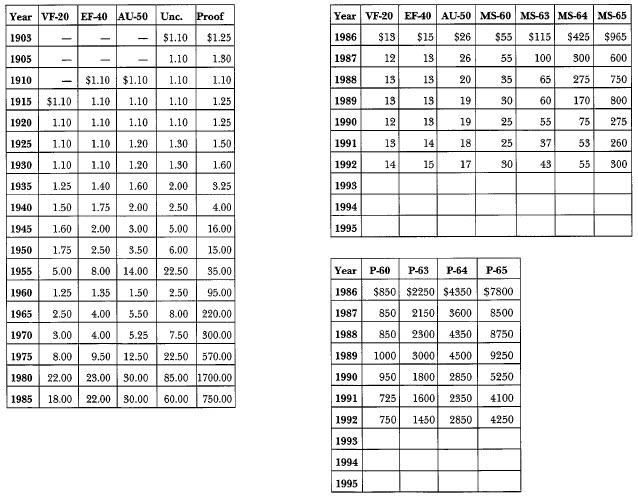
1903 Morgan: Summary of Characteristics
Business Strikes:
Enabling legislation: Act of February 28, 1878, plus the Sherman Silver Purchase Act of July 14, 1890
Designer: George T. Morgan
Weight and composition: 412.5 grains; .900 silver,.100 copper
Melt-down (silver value) in year minted: $0.41960
Dies prepared: Obverse: 46; Reverse: 40
Business strike mintage: 4,652,000; Delivery figures by month: January: 500,000; February: 1,000,000; March: 526,000; April: 428,000; May: none; June: 2,000,000; July-October: none; November: 64,000; December: 134,000.
Estimated quantity melted: Probably some under the 1918 Pittman Act; more as worn coins in later melts, including the late 1970s.
Approximate population MS-65 or better: 12,500 to 20,000 (URS-15)
Approximate population MS-64: 18,000 to 35,000 (URS-16)
Approximate population MS-63: 40,000 to 75,000 (URS-17)
Approximate population MS-60 to 62: 300,000 to 600,000 (URS-20)
Approximate population G-4 to AU-58: 400,000 to 800,000 (URS-20)
Availability of prooflike coins: Scarce fully prooflike, although semi-prooflike specimens abound. DMPL coins are scarcer yet.
Characteristics of striking: Often seen sharp.
Known hoards of Mint State coins: Many bags were released in the East by the Treasury Department in the mid-1950s; additional bags were released 1962-1964.
Proofs:
Dies prepared: Obverse: At least 1; Reverse: At least 1.
Proof mintage: 755; Delivery figures by month:
January: none; February: none; March: 325; April: none; May: none; June: 120; July: none; August: none; September: 75; October: none; November: none; December: 235.
Approximate population Proof-65 or better: 96+/- (URS-8)
Approximate population Proof-64: 76+/- (URS-8)
Approximate population Proof-63: 110+/- (URS-8)
Approximate population Proof-60 to 62: 200+/- (URS-9)
Commentary
Proofs have a partially polished portrait, rather than cameo like or frosty; the same is true of 1902 and 1904 Proofs.
Additional Information
Silver Bullion Nearly Depleted
The Annual Report of the Director of the Mint, 1903, told the following:
"Silver Bullion Nearly Exhausted: The silver dollars were all coined from bullion purchased under the Act of July 14, 1890. Of the subsidiary silver, $2,509,000 was likewise coined from this bullion. Of this bullion there remained on hand June 30,1903,17,502,938.35 fine ounces.The entire amount will be used for coinage during the fiscal year 1904.
"The limitation of the coinage of subsidiary silver was in a measure removed by the Act of March 3,1903, which permitted the bullion purchased under the Act of 1890 to be used to supply this demand. When this bullion is exhausted, which will be before the first session of the Fifty-eighth Congress closes, no more subsidiary coins can be made without further legislation giving authority for the purchase of bullion."
Distribution of Silver Dollars
The Annual Report of the Director of the Mint, 1903, told of the distribution of silver dollars at the various mints: Philadelphia: In mint June 30, 1902, $94,352,954; transferred from Treasury for storage, 500,000; coinage, fiscal year 1903,8,026,785; in mint June 30,1903,102,413,954; distributed from mint: 465,785.
San Francisco: In mint June 30, 1902, $55,804,122; coinage, fiscal year 1903, 2,030,000; in mint June 30, 1903, 56,937,453; distributed from mint: 896,669.
The Year 1903 in History
On February 19, 1903 the Elkins Act endeavored to end discrimination by railroads that were giving certain customers preferential rates. The legislation was ineffective, and in 1906 the Hepburn Act would give the Interstate Commerce Commission the power to regulate the rates charged by railroads and pipelines. The Department of Commerce and Labor was created on February 14, 1903 with its secretary holding a cabinet position. (It would be divided into two separate departments in 1913.) On November 3, 1903, citizens in Panama revolted against Colombian rule the day after Roosevelt ordered United States naval ships, including the Nashville, to report to the area. Colombia could not effectively respond to the threat, and on November 6 the United States recognized the Republic of Panama. The United States had clearly abused its power but few seemed to care. On November 18 the Hay Bunau-Varilla Treaty gave the United States control of the 10-mile strip of land in exchange for a $10 million payment plus a yearly rent of $250,000.
On December 30, 1903, the Iroquois Theatre in Chicago caught fire, and about 600 people were killed. Vaudevillian Eddie Foy was on stage at the time. Exit doors were found to be locked and fire safety facilities were minimal. Soon thereafter, many cities and towns enacted strong fire codes. As a result, when motion pictures became popular in America later in the decade, continuing to the present day, very few disasters ever occurred in occupied theatres. A short film produced by Edison, The Great Train Robbery, was all the rage. It featured Max Aaronson, who later became better known to the public as G.M. Anderson or, more familiarly, Broncho [sic] Billy. Victor Herbert's operetta Babes in Toyland was first performed on June 17.
The Ford Motor Company was established by Henry Ford.
On May 23 two automobilists in a 20-horsepower Winston began a trip across the United States, completing it on July 26-achieving what was probably the first transcontinental automobile trip. On December 17, 1903 Orville Wright made man's first powered flight in a heavier-than-air self-propelled machine. The event took place on the beach at Kitty Hawk, North Carolina, lasted for about 12 seconds and covered 120 feet. Later in the day, Wilbur Wright stayed aloft for 59 seconds and traversed 852 feet. The world would never be the same. Samuel P. Langley tested his version of an airplane by launching the device from a houseboat on the Potomac River. However, its wing hit a support of the boat and the machine crashed. For years thereafter, the Smithsonian Institution, among a very few others, steadfastly maintained that Langley was the father of powered flight and that the Wrights' claim should be discredited. The Harley-Davidson motorcycle was introduced in 1903; by 1917, production would be at an annual rate of 18,000 vehicles.
On January 19, Guglielmo Marconi sent a wireless radio message from President Roosevelt to Britain's King Edward VII, transmitting from four 250-foot wooden towers at South Wellfleet, Massachusetts. Sanka decaffeinated coffee (from the French sans caffeine) was first sold by a tradesman who found that a consignment of coffee had been exposed to sea water and the beans had lost their caffeine.
Kate Douglas Wiggins' book, Rebecca of Sunnybrook Farm, was published and became a great classic of children's literature. Among other titlesthat were popular in 1903 were Jack London's The Call of the Wild, John Fox, Jr.'s The Little Shepherd of Kingdom Come, and Frank Norris' The Pit, the latter focusing on societal problems caused by speculation in wheat on the Chicago exchange. Arthur Conan Doyle's fictional character Sherlock Holmes was the world's best-known detective, and his exploits, beginning with A Study in Scarlet, were enjoyed by millions.
The first World Series game was played when the American League and National League champions met in a postseason playoff in a best-of-nine contest in November. The winners were the Boston Red Sox (originally called the Red Stockings). The World Series would not be held the next year due to a feud between the manager of the New YorkGiants, champions of the National League, and the president of the American League. However, in 1905 the World Series would resume and would take place yearly after that time.