Silver Dollars & Trade Dollars of the United States - A Complete Encyclopedia
Q. David Bowers
1878-CC Morgan Dollar
Coinage Context
Striking coins at Carson City: The Carson City Mintstaff prepared for the; forthcoming coinage of the new Morgan dollars. I Some 600,000 planchets were ready for stamping by March 20th. However, the Philadelphia Mint was in the inidst of making changes to the design and the dies, and coinage dies were not shipped to Carson City at the expected time.
Finally, on April 16th a shipment of 10 die pairs and six collars arrived. The mint was now ready for coinage, which occurred Shortly afterward. The 'Ajax" coining-press, made in Philadelphia by Morgan& Orr and delivered in May 1876 for the coinage of trade dollars, . could turn out a cascade of 30,000 silver dollars per day. The original Morgan & Or press delivered for trade dollar coinage in 1873 also stood ready.'' as did another press delivered in 1875.
Exit trade dollars, enter Morgan dollars: The year 1878 saw a limited coinage of 1878-CC trade dollars, the last of their design, made at Carson City. Some 56,000 1878-CC trade dollars had been minted in January, followed by 4l,000 in February. Hardly had these been finished, when the presses started up in April with the production of Morgan silver dollars.
Numismatic Information
The appeal of CC dollars in all instances, the demand for Carson City Morgan dollars today is greater than for those of any other single mint. The CC mintmark has a special appeal to collectors. Figuratively speaking, Carson City, Nevada to c81lectors is like the vision of the Shining Cityoh'the Hill of biblical times-a land, if not of milk and honey, at least of sparkling gold and silver coins adorned with tiny CG letters On the reverse, an identification which, somehow, elevates them above the products of all other mints. All things being equal, a Carson City dollar of equal rarity to a Philadelphia, New Orleans, or San Francisco dollar will bring significantly more money.
1878-CC commentary: Apparently, quite a few 1878-CC dollars were released into circulation in and shortly after the year of minting. These slipped into the channels of commerce and were unnoticed by numismatists, as there was virtually no interest in collecting mintmark varieties at the time. Later, when such collecting gained many adherents, it was realized that Uncirculated 1878-CC dollars were rare. Very few existed in numismatic circles through at least about 1910. After that time, limited quantities came on the market, but in general Mint State pieces remained on the scarce side, as they would continue to be for many years.
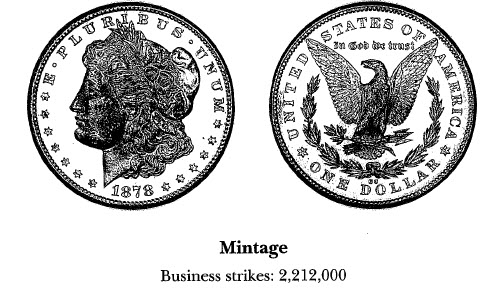
Second Reverse type: All known 1878-CC Morgan dollars are of the Second Reverse with parallel top arrow feather, and with the eagle having concave breast and seven tail feathers. The Philadelphia Mint shipped 30 pairs of dies to Carson City. When the change was made later in the year to the Third Reverse, no dies of the new type were sent to Carson City. All 1878-CC dollars have small mintmarks. The mintmark letters CC were added to the dies individually. Thus the spacing between them and their relationship with the other elements of the die vary.
Hoard coins: In the late 1930s, when quantities of CC coins were paid out by the Cash Room at the Treasury Building in Washington, D.C., very few 1878-CC dollars were among them. The scarcity of Mint State coins continued until late 1946 or early 1947, when several bags came out of Washington, and a few others may have been paid out from storage at the San Francisco Mint. Both Washington and San Francisco became storage depots for CC dollars after the Carson City Mint ceased operations.
In 1950, large numbers came out of Treasury vaults, and the 1878-CC dollars fell in value. The 1878-CC became one of the most plentiful varieties. In the early 1950s, many more were paid out by the Treasury, and bags were handled by dealers on both coasts. Quite a few ended up in the hands of casino owners in Nevada. Dealer Steve Ruddel stated that about 50 bags (50,000 coins) were released from the Treasury Building in 1955, and that this was the start of large-scale dispersals from that location. (Reference: His advertisement in The Numismatist, January 1964.)
By 1954, the 1878-CC was probably the most common Uncirculated dollar variety of this mint in dealers' hands. Around that time, Treasury dispersals trickled down to a virtual halt. Perhaps additional bags were deeper in the vaults and thus inaccessible. Whatever the reason, when quantities of other CC dollars started coming out in large numbers in 1955, the 1878-CC was not well represented among them. However, there were some scattered exceptions, such as the 1958 release of 1878-CC bags in Montana.
Probably, well over 100,000 coins were paid out by the Treasury from the early 1950s until toward the middle of that decade.
I bought a bag of these in 1956 from Rev. Edward W.W. Lewis, a Congregational Church minister in Willimantic, Connecticut, who dabbled in coin dealing. Around the same time, Harry J. Forman bought three bags in Las Vegas. Since the 1950s and early 1960s, more examples of certain other dates, namely 1882-CC, 1883-CC, and 1884-CC, have come on the market, and the 1878-CC has been scarce by comparison.
Held back from the Treasury release of 1962-1964 were 60,993 1878-CC dollars that were dispersed by the General Services Administration in 1972-1974. The G.S.A. hoard figures given in the following text for 1878-CC through 1893-CC do not include 84,165 cull coins and mixed circulated pieces, as well as 311 Carson City pieces of various dates which the General Services Administration did not consider to be salable."
All told, probably about 150,000 to 250,000 1878-CC dollars in Mint State were released in the 1950s, early 1960s, and the G.S.A. hoard.
Circulated grades: In worn grades the 1878-CC is only slightly scarce. Probably, the number surviving is in the range of 100,000. As is true with other varieties of Morgan dollars, the number in existence will never be known with finality. Most seen are quite worn and are from Good to Fine.
Mint State grades: There are enough 1878CC dollars around to satisfy the needs of the numismatic community. At the MS-60 to 62 level there are probably 120,000 to 160,000 extant, followed by a generous 30,000 to 60,000 in MS-63. MS-64 coins are scarce and are known to the extent of perhaps 10,000 to 20,000 pieces, and MS-65 or finer specimens are scarcer yet, with 3,000 to 6,000 surviving today.
Most 1878-CC dollars encountered in the numismatic marketplace are in Mint State (circulated examples are more elusive, as noted), are quite lustrous, and are extensively bagmarked. Superb pieces with a minimum of bagmarks are rare. Some issues have a muted frost, giving the coins a "white" appearance, particularly on the reverse. The striking of the 1878-CC is usually excellent, with full feather detail. As all are of the Second Reverse style, the eagle's breast is concave, giving it a weak appearance at quick glance.
Examples are usually seen well struck with lustrous, frosty surfaces. As a date, the 1878-CC is significantly scarcer.than its contemporary Carson City issues in the mid 1880s.
As noted above, the 1878-CC remains fairly easy to locate in lower ranges of Mint State, especially from MS-60 to MS-63. The vast majority of dollars of this issue are extensively bagmarked; much more so than, for example; CC dollars of the mid-1880s. Most of the nearly 61,000 1878-CC dollars sold by the G.S.A. were extensively bagmarked.