Silver Dollars & Trade Dollars of the United States - A Complete Encyclopedia
Q. David Bowers
1882-O Morgan Dollar
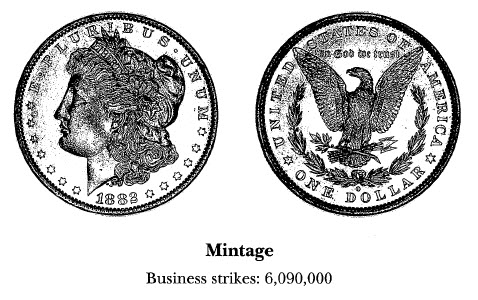
Coinage Context
At the mint: The New Orleans Mint struck many dollars in 1882. Numerous examples were circulated at the time, and many others, probably well over a million, went into Treasury storage, to emerge in the early 1960s.
Numismatic Information
Hoard coins: During the 1950s every now and then a mint-sealed bag of 1882-O dollars would come on the market through some lucky finder, who picked it up at a bank. Although this date was not in the common category at the time, it was not rare either. Roll quantities were advertised from time to time, including by Philip Maul in The Numismatist in September 1953 and by Harry J. Forman in the same periodical in September 1957.
Beginning in October 1962, the floodgates opened, and hundreds of thousands of 1882-O dollars poured out into the market, and were distributed in the Midwest and East. When the dust settled early in1963, a few months later, the 1882-O was solidly entrenched as one of the most common issues in the series. Distribution of 1882-O continued throughout much of the 1963 year, until at least the autumn.
Circulated grades: The 1882-O dollar is very common in all circulated grades, including high level AU, many from resealed mint sacks ("two-beer" dollars).
Mint State grades: All through the history of col-lecting Morgan dollars, the 1882-O has been readily available in Mint State. Here is one of the relatively few New Orleans Mint dollars that never was rare. As the 1882-O was a prime participant in the great Treasury release of dollars that began in autumn 1962, today the issue is even more common in Mint State that it was before. Most surviving coins are in lower Mint State grades from MS-60 through MS-62, at which level perhaps 100,000 to 200,000 pieces survive. Even MS-64 examples are encountered with frequency; I estimate that 40,000 or more exist at this level. MS-64 coins are about twice as scarce as MS-63s.
At the true MS-65 level the 1882-O becomes scarce and high-priced, prompting me to remind you to check carefully any MS-65 coin you contemplate buying. (This should always be done, and especially so in instances such as this in which an MS-65 coin is worth many multiples of the MS-64 price.) Probably, only about 2,500 to 4,000 MS-65 1882-O dollars survive.
The typically encountered 1882-O dollar is lightly struck, particularly on the eagle's breast feathers. However, the cherrypicker can occasionally locate as harply defined coin. Lower-quality Mint State coins were probably melted in large numbers during the rapid ascent of silver bullion prices in the 1970s; thus, many Treasury hoard coins no longer exist.
Prooflike coins: Semi-prooflike and prooflike coins are abundant and are mostly in the lower Mint State levels or AU. Most have frosty devices, but the fields are not deeply mirrorlike. Probably 5,000 to 10,000 or more PL coins exist, and 3,000 to 6,000 DMPL, but these figures may be on the conservative side. Fewer than 5% are MS-65 or better.
Varieties
Business strikes:
1. Normal mintmark: With normal O, not overmintmark Breen-5566. Many die varieties from 33 pairs of dies, although not all pairs may have been used. 0/0, VAM-7; Jeff Oxman writes;' "This is the most dramatic 0 mintmark repunching in the entire Morgan series, and is very popular; it is, however, quite common in Mint State and exists in roll quantities. VAM-22 has doubled die reverse. VAM-30 has doubled obverse. (For the 1882-0/S see the following section.)