Silver Dollars & Trade Dollars of the United States - A Complete Encyclopedia
Q. David Bowers
1891-0 Morgan Dollar
Coinage Context
Three sources of silver: 1891-O silver dollars have the unique distinction of having been made from silver acquired under three separate legislative authorizations: the 1878 Bland-Allison Act, the 1890 Sherman Silver Purchase Act, and the 1891 Trade Dollar Recoinage Act. No record was kept of die usage under these acts, and today it is not possible to make specific attributions of individual coins. Mints records show that 3,534,616 1891-O dollars were struck from reclaimed trade dollar bullion. A specific breakdown is given under the Summary of Characteristics below.
Numismatic Information
Hoard coins: The 1891-O has received little publicity over the years. Part of this is because the typical coin is poorly struck and aesthetically unappealing (see below).
Mint State coins have always been available on the market, and at low prices, probably indicating that occasional bags were released over a long span of time. A significant dispersal occurred circa 1946-1947, after which roll quantities were held by various dealer specialists. The supply then tightened. Around 1955-1956, some bags were paid out of the Cash Room at the Treasury Department in Washington, and for a time the 1891-O was plentiful, but not common. The supply seems to have dried up to the point at which Uncirculated specimens were scarce by October 1962, when O-Mint coins were released in quantity from storage at the Philadelphia Mint. Harry J. Forman, for one, handled many bags of 1891-O dollars in the early 1960s. Still, the issue was not common in the sense that 1883-O, 1884-O, and 1885-0 dollars were.
Mint State grades: The 1891-O is common in lower Mint State levels such as MS-60 through 62, in which bracket probably 35,000 to 55,000 exist, if not even more. In MS-63 grade, specimens are much harder to find. At the MS-64 stage the word rare be-comes appropriate, and is confirmed at MS-65, of which only about 250 to 400 exist.
The 1891-O is one of the Morgan dollar varieties with an exceptionally great difference in price be-tween MS-60 and MS-65 grades. At certain times on the market in recent years (1988-1991), an MS-60 has sold for under 1/100th the price of an MS-65!
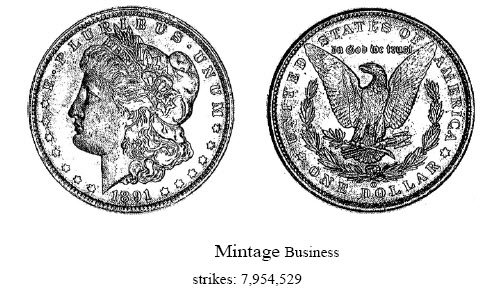
The striking quality of 1891-O dollars is, on the average, very poor, indeed the worst in the series. Many are nearly as flat as the proverbial pancake. Only a few are sharp. Cherrypicking is advised, but don't expect quick results.
Prooflike coins: Prooflike and DMPL coins are very rare at all grade levels, but nearly always have unsatisfactory surfaces. Wayne Miller wrote about a group of 40 to 60 mostly semi-prooflike coins which contained nine DMPL pieces. Most DMPL coins are fairly well struck. DMPL coins in MS-6S are major rarities; of 19 coins certified by NGC and PCGS as of September 1992, just one was better than MS-64.
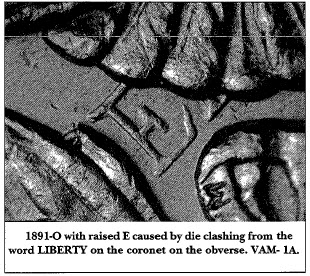
Die rotation: Specimens of 1891-O VAM-1 are known with the reverse die rotated 50° to 120° from the normal orientation. All seen by Van Allen and Mallis have been in circulated grades. Some coins were struck from clashed dies and show traces of the E and base of R in LIBERTY (from the obverse headband) below the eagle's tail on the reverse.
Proofs: Coins in the Anderson-Dupont and Carter sales (Stack's) were attributed as Proofs, the latter at $10,450. I have not seen them, nor has Walter Breen.
Varieties
Business strikes:
1. Normal date: Breen-5621. Most or all the 30 obverses and 29 reverses must have been used. Open or closed 9s, one repunched (VAM-7); two repunched mintmarks (VAM-S, 6). VAM-1A shows a raised E on reverse beneath the eagle's tail feathers on the left. This was caused by the obverse and reverse dies coming together (clashing) without an in-tervening planchet. As the E is incuse in the word LIBERTY on the coronet, it created an E-shaped in-dentation on the reverse die, which later struck coins showing the raised letter E. This same type of error occurs on other dates as described by Van Allen and Mallis. Scarce EF and AU, fewer than 20 Mint State examples exist.