Silver Dollars & Trade Dollars of the United States - A Complete Encyclopedia
Q. David Bowers
In their article in The Comprehensive U.S. Silver Dollar Encyclopedia, "The 1879-S Reverse of '78 Morgan Dollars," John W. Highfill and Walter H. Breen make a case for including this variety in collections and note in part:
The Redfield hoard's impact on the variety, despite increasing supply over a hundredfold, was to increase public demand far more, so the prices have sharply risen. A major factor in determining the 1879-S parallel arrow feather variety's future will be a separate listing as a major variety and certified population reports. Certainly the 1882-O/S and the 1900-O/CC deserve such listing; so does the 1879-S parallel arrow feather, and for at least equally good reasons. Happy hunting!
Circulated grades. Second Reverse: Very scarce; among the rarer circulated Morgan dollar varieties; rarer than 1903-O. Probably, about 1,000 to 2,000 remain.
Mint State grades. Second Reverse: This issue is presently considered to be rare in all Mint State categories. I estimate that in MS-60 through 62 grades, only 2,500 to 4,500 exist;just 1,000 to 2,000 MS-63s; only 300 to 500 MS-64s; and a paltry 75 to 150 MS-65 or better.
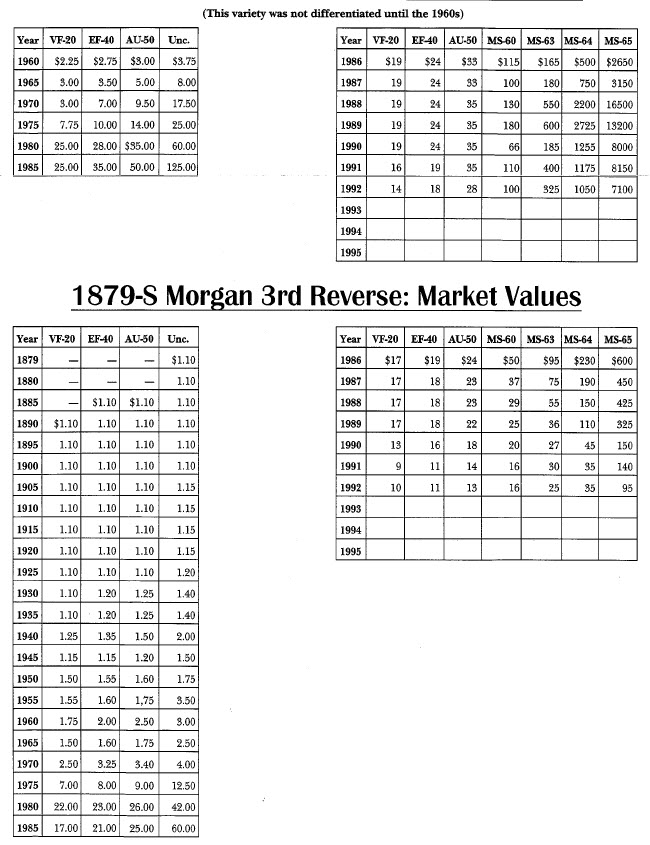
3,000 to 4,000 heavily bagmarked coins are reported to have come from the Redfield hoard; another 1,000 from Harry J. Forman's solitary bag. Nearly all seen today are MS-60 to MS-62. As noted above, MS-63 coins are very elusive, MS-64 coins are rare, and MS-65 specimens are extremely rare. Market values in 1992 do not reflect the rarity, as the variety has not been highly publicized.
Prooflike coins. Second Reverse: Hundreds remain but are in lower grade levels with relatively unsatisfactory surfaces. DMPL coins, about which little is recorded, are rarer. As of September 1992, NGC and PCGS had certified 69 PL coins (none MS-65 PL or better) and 12 DMPL coins (none MS-65 DMPL or better), On one hand, it can be suggested that the certification services have handled but a tiny percentage of extant Mint State (includingPL and DMPL) dollars. On the other hand, with regard to the 1879-S Second Reverse it is thought that more of them are in numismatically active hands than are typical Morgan dollar varieties, I believe that the total population of PL may be only 200 to 400, and DMPL just 50 to 100.
1879-S THIRD REVERSE; REV. OF 1879; SAF The 1879-S Third Reverse: Most often seen among 1879-S dollars are those with the Third Reverse, to continue the nomenclature of 1878',with slanting top arrow feather (SAF) and convex breast on the eagle. Many bagsof Uncirculated 1879-S dollars of the Third Reverse type were distributed from the Redfield estate hoard by Paramount International Coin Corporation (then located in Englewood-Ohio), Dollars of this variety were said to have been the third most plentiful holding in the Redfield group. Later, numerous bags of 1879-S Third Reverse dollars in Mint State were in the Continental Illinois Bank hoard and were put on the market.
Circulated grades. Third Reverse: Worn coins are slightly scarce, but as Mint State pieces are so common, little attention is paid to circulated grades.
Mint State grades. Third Reverse: This variety is very common and, in fact, is one of the most common of all Morgan dollars. Probably, at least 750,000 to 1,250,000 MS-60 to 62 coins exist. At the MS-63 level, the population is believed to be 225,000 to 325,000, followed by 150,000 to 250,000 MS-64s, and 100,000 to 150,000 MS-65 or finer pieces.
Many bags were released by the Treasury in 1942, the 1950s and, especially, 1962-1964. Most extant coins are well struck and have fairly light bagmarks, however there are exceptions, and weak coins are sometimes Seen, as are' heavily scarred pieces.
Prooflike coins. Third Reverse: Plentiful in prooflike condition with nice contrast. Probably 50,000 to 100,000 exist. DMPL coins are among the most available in the Morgan series but are six or seven times scarcer than regular' prooflikes. The "Proof' in Mehl's sale of the C.W. Cowell Collection (11/11/11), and those advertised by B.M. Douglas and William & L. Pukall (The Numismatist, 12/51 and 10/53) were probably DMPLs.
Varieties
Business strikes:
SECOND REVERSE:
1. Second Reverse. Parallel arrow feather. Short nock., Small mintmark. Breen-5530, VAM 4-10, 23-25, 34, 35, 39. At least seven reverses of 1978; one. (VAM-5, 8-10) has chipped r in Trust" another (YAM-6) has broken ("Tiust").
THIRD REVERSE
1. Third Reverse. Slanting arrow feather • Tall S. Breen·5531. All other VAM numbers 1 through 41, except those listed above for the Second Reverse. The 7 tail feathers SAF constitutes the overwhelming majority of this date. Extremely common in Mint State.
2. Third Reverse. Tall S over small s: Not in Van Allen-Mallis or Breen's Encyclopedia. Short sharp extra upper serif at right of serif of tall S, of different shape; base of extra S below. Reported by Walter Breen. One seen, to date, owned by ABC Coins. Others probably survive.
1879-S Morgan 2nd Reverse: Market Values