Silver Dollars & Trade Dollars of the United States - A Complete Encyclopedia
Q. David Bowers
(1) The Paramount International Coin Corporation coin purchased by the firm in November 1973 for $12,000 and later sold at auction for a then-record $35,000. The coin was described as gorgeously toned, with minimum bagmarks, but it "was marred by a series of hairline striations across the face."
(2) A specimen sold by Colonial Coins to a New York collector for $28,500. This coin is said to be "very boldly struck with frosty, coruscating lustre, and minimal bagmarks."
(3) A specimen purchased by John Love and Joel Rettew in 1974, as part of a silver dollar collection formed in the 1950s. Wayne Miller noted that the coin was "fully struck and almost free of abrasions; the surfaces were semi-prooflike and very lustrous." The coin later went to a Washington collector, then appeared in 1978 in a Kagin auction, and in February 1980 was purchased by Fred Sweeney through Bruce Amspacher, and resold to a Rhode Island collector for a price over $100,000. Wayne Miller considered this specimen to be the finest known to him as of his 1982 writing.
(4) The Amon Carter Collection coin was described as being similar in quality to No.3 above, but "it may have a few more minor abrasions, but is nevertheless a fully gem piece."
(5) To the above can be added the Norweb Collection coin, riot seen by Wayne Miller when he wrote his book, which I catalogued and which Auctions by Bowers and Merena, Inc. sold for $357,500, a record for any Morgan silver dollar. I described the coin as MS-65, but PCGS subsequently certified it as MS-67. The purchasers were David Carter and Dr. George Bodway. In 1990 and 1991 this coin went on tour as the highlight of the PCGS Silver Dollar Exhibit.
A well-known West Coast numismatic firm experienced an unfortunate situation in the 1970s when the United States government seized an authentic 1893-S, believing it was a counterfeit made by adding an S to an 1893 Philadelphia coin. They ignored or were not aware of die diagnostics, and elected to dip the coin in a strong acid to see if the mintmark would' fall off. It didn't. The result was a ruined former Mint State1893-S. I furnished a sworn statement on behalf of the coin's authenticity and the firm in question, but I do not know if the government ever paid compensation.
Prooflike coins: Prooflike coins are exceedingly rare in Mint State. However, a good percentage of Mint State coins exhibit some prooflike surface. Wayne Miller noted that of the 15 or so Mint State coins that came on the market in the 1970s, about half were partially prooflike. Miller said that he had never seen a fully prooflike dollar. As of autumn 1992, PGCs certified one MS-62 PL 1893-S dollar, but I have not examined it. No other PL or DMPL coins have been certified by NGC or PCGs.
Caveat emptor: Numerous phony "1893-S" dollars exist, most of which have been made by adding an S mintmark to an 1893 Philadelphia Mint coin. Others have been made by altering the obverses of 1898-S or other San Francisco dollars. Authentica-tion is mandatory before you buy one in any grade.
Varieties
Business strikes:
1. Normal date: Breen-5632. All known are from a single pair of dies. Authentication tip: Look for the raised line up from upper left edge of T(Y) through crossbar; this shows on all genuine 1893-5 dollars even in Very Good, but on none from 1883, 1893, or 1898 of any mint. No second genuine obverse has even been rumored, far less authenticated; most likely the rest of the 10 obverses and five reverses remained unused.
1893-S Morgan: Market Values
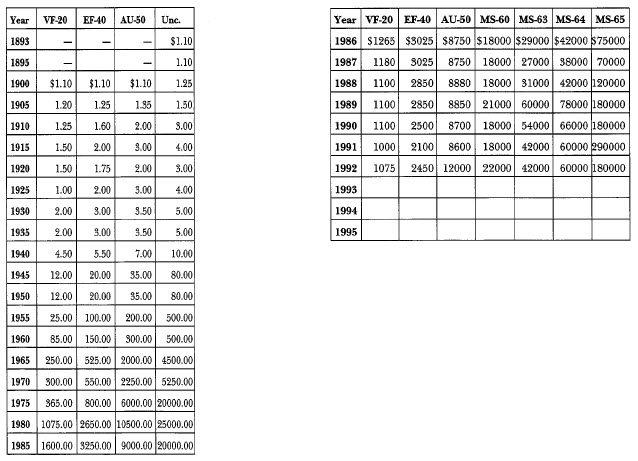
1893-S Morgan: Summary of Characteristics
Business Strikes:
Enabling legislation: Act of February 28, 1878, plus the Sherman Silver Purchase Act of July 14, 1890
Designer: George T. Morgan
Weight and composition: 412.5 grains; .900 silver, .100 copper
Melt-down (silver value) in year minted: $0.60351
Dies prepared: Obverse: 10; Reverse: 5; apparently just one pair of dies was used
Business strike mintage: 100,000; Delivery figures by month: January: 100,000; February-December: none. Coinage suspended June 1.
Estimated quantity melted: Possibly, tens of thou-sands under the provisions of the 1918 Pittman Act.
Approximate population MS-65 or better: 12 to 24 (URS-5)
Approximate population MS-64: 10 to 15 (URS-5)
Approximate population MS-63: 25 to 50 (URS-6)
Approximate population MS-60 to 62: 50 to 100 (URS-7)
Approximate population VF-20 to AU-58: 4,000 to 8,000 (URS-14)
Approximate population VG-8 to F-15: 2,000 to 4,000 (URS-13)
Availability of prooflike coins: Exceedingly rare. Characteristics of striking: Usually seen well struck. Known hoards of Mint State coins: A group of 20
Mint State coins was found mixed in a bag of 1894-S dollars in Great Falls, Montana in the 1950s.
Proofs:
None
Commentary
The 1893-S is generally considered to be the most desirable single Morgan dollar issue struck at a branch mint.