Silver Dollars & Trade Dollars of the United States - A Complete Encyclopedia
Q. David Bowers
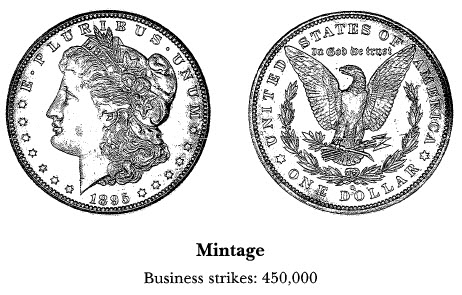
1895-0 Morgan Dollar
Coinage Context
Striking quality: During this period, the coiners at the New Orleans Mint had a job to do: to coin as many silver dollars as possible in the least amount of time. To say that their workmanship was shoddy would be an understatement; from a numismatic viewpoint, it was terrible. Knowing that most of these silver dollars were not wanted in the channels of commerce and would simply go into bulk storage after they were minted, the workers had little incentive to create an attractive product. To churn out a stream of Morgan dollars with as little attention to the presses as possible, the coiners spaced the dies slightly too far apart, thus minimizing die wear and breakage. The result was as stated: terrible-looking coins. Not that this extended die life; if all five die pairs were used, they averaged only 90,000 coins per obverse. If only the three VAM obverses were used, the figure is 150,000-still very low.
While most 1895-O dollars went into storage and were melted later, probably well over 100,000 were placed into circulation.
Numismatic Information
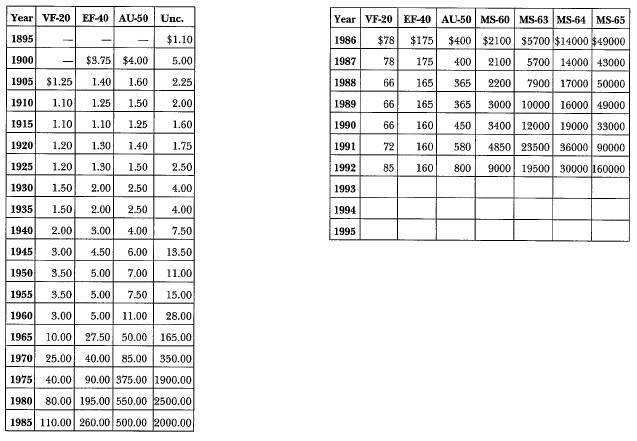
Market notes: Around the year 1900 there was a sudden enthusiasm for 1894-O, 1894-S, 1895-O, and 1895-S silver dollars, and a few specimens were sold for several dollars apiece. The interest soon faded, and Uncirculated pieces could be obtained for less than $2 apiece. From that time until the 1940s, few Mint State coins appeared on the market. Even the most famous collections were apt to contain worn pieces.
Around the 1950s, a small number of Mint State coins were released from storage in the Treasury Building in Washington, D.C. Probably from a few dozen to a couple of hundred went into the hands of dealers and collectors. Market information is difficult to obtain today, for listings of "Uncirculated" coins years ago were apt to represent what we would call AU today. This was the era of "sliders." Harry J. Forman, who has handled as many O-Mint dollars as anyone, never heard of a quantity of true Mint State 1895-O dollars. Apparently, no 1895-O dollars were represented in the Treasury release of 1962-1964.
Circulated grades: Circulated coins are slightly scarce today. Most are in lower grade levels. AU coins or "sliders" are often seen on the market, and in the years before certified coins were often sold as "Uncirculated." John Highfill reported purchasing an 1895-O dollar certified as MS-63/65 by ANACS in 1980, and sending it to PCGS and NGC in 1989 and having both services grade it AU-55, a commentary on the changing grading scene. Wayne Millerwrote that in his experience, high grade AU coins are often more attractive than low grade Mint State coins.
Mint State grades: Most 1895-O dollars are poorly struck and have unattractive surfaces. In lower Mint State levels from MS-60 to MS-63, this is the rarest New Orleans Mint dollar today. In higher Mint State levels it is also very rare.
My estimates of survival are as follows: MS-60 to 62, 125 to 250 coins; MS-63 70 to 110; MS-64, 30 to 50; and MS-65, only 8 to 15.
The rarity and importance of the 1895-O in Mint State cannot be overemphasized. As a dealer I know full well that only rarely does a specialized collection of Morgan dollars contain a specimen in any Uncir-culated grade. Over the years, the 1895-O has received very little publicity, as virtually no one has had a vested interest (i.e., inventory).
Prooflike coins: Prooflike coins are very rare, and only a few DMPL coins exist. As of September 1992, NGC and PCGS had certified six PL and four DMPL. Nearly all are in lower grades.
Varieties
Business strikes:
1. Normal date: Possibly not all five pairs of dies were used. The VAM text describes three obverses and two reverses. These could have made the whole mintage.
1895-0 Morgan: Market Values