Silver Dollars & Trade Dollars of the United States - A Complete Encyclopedia
Q. David Bowers
1878-S Morgan Dollar
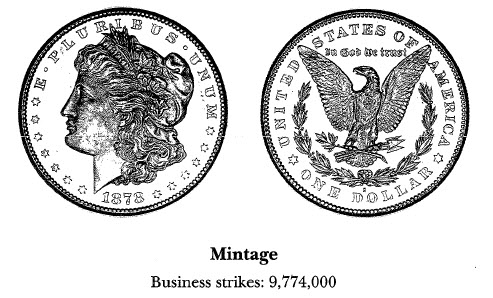
Coinage Context
The silver market in San Francisco: London was the primary market for gold and silver in the 1860s and 1870s. The discovery of the Comstock Lode deposits in Nevada 1859 and their consequent exploitation in the 1860s brought much investment capital from England to Nevada, just as the British would invest over $100 million in the Cripple Creek District gold mines in the 1890s
On the open market, the San Francisco price for silver bullion was less than in London, for about 2% had to be added for transport by sea from California to England.
In San Francisco and throughout California and Nevada there were dozens of banks, assayers, and others who took in silver bullion, refined it, and paid out ingots and bars. Typically, such refiners would charge from about 2% for large quantities, to 5% or 6% for small amounts. In contrast, the San Francisco Mint levied a charge of 1.5% for metal delivered to it. Thus, over a period of time the mint became the main depository for silver metal.
Dies and collars for Morgan dollars arrived at the San Francisco Mint on the evening of April 16, 1878.
The initial striking of Morgan dollars took place at 3:30 in the afternoon of April 17. In attendance were representatives of the press, former governor F.F. Low, mint officers, and others. The first specimen was presented to coiner Cicott, who acted as master of ceremonies for the event. After nearly 1,000 coins were struck, one of the dies broke, the press was stopped, and further coinage was suspended until the following day. (Per an account in the New Alta California, April IS, 1878, quoted by Van Allen and Mallis, p. 91, from a copy in the California State Library.)
Numismatic Information
Hoard coins: It is believed that as of June 30, 1913, the majority of the original mintage of 1878-S (probably five to six million coins out of a total of 9,774,000), and nearly all of the original mintages of 1879-S, 1880-S, 1881-S, and 1882-S were stored at the San Francisco Mint, to be paid out over a period of decades thereafter. Especially large quantities were released in the early 1950s-so many that 1878- S was one of the most often seen Mint State Morgan dollars for years afterward. Many bags were also distributed later in the 1950s and especially during the 1962-1964 dispersal. In The Forecaster, September 15, 1971, John Kamin gave his opinion that about 7% of the original mintage of 1878-S was released circa 1962-1964, a figure equal to about 600,000 coins.
Harry J. Forman bought 10 bags from Phil Carlino; they probably came to Las Vegas by truck directly from the San Francisco Mint or the San Francisco Federal Reserve Bank (to which depot many silver dollars were transferred in the late 1930s, when the old San Francisco Mint operations were transferred to a new facility on Duboce St.). This date was said to represent the fourth largest single holding of Morgansilver dollars in the Redfield hoard.' One estimate placed the Redfield quantity at 5,000 coins and noted that the coins were in lower Mint State grade ranges.
By 1982, Wayne Miller considered the 1878-S to be the least available of the early San Francisco Morgan dollar issues 1878-1882 in Mint State. However, earlier this was not the case, and he recalled a January 1964 advertisement to buy all Uncirculated silver dollars with the exceptions of the following, which at the time were considered to be the most common: 1878-S Morgan, 1921 Morgan, 1922 Peace, and 1923 Peace. Wayne Miller went on to suggest that as 1878-S dollars were once common, many investors and numismatists turned them back to hanks. While this may have been true for many 1878-S dollars, l believe that most.Uncirculated pieces released in. the late 1950s and early 1960 8 still exist but are located outside of numismatic circles. Most 1878-S dollars are "old hoard" (i.e., pre-1962) coins, whereas S-Mint coins of 1879-1882 are "new hoard" coins in many instances, and overshadow the 1878-S.
Reverse type: All 1878-S dollars, like all 1878-CC dollars, are of the Second Reverse type with 7 tail feathers, parallel arrow feather, and concave eagle breast. All but three of the 56 varieties listed by VAM have a short nock (shaft) to the arrow; the exceptions are VAM-26, 27, and 56 with long nock. All have a small mintmark.
The mysterious "1878-S 8 TF" dollar: In 1893, the leading publisher of popular. numismatic references was J.W. Scott & Co., who in that year issued Scott's Catalogue of Gold and Silver Coins. Until well into the twentieth century, this was the only widelycirculated reference book (not including the premium guides sold by Mehl, et al.) listing varieties of United States coins together with their numismatic values. Among the Morgan dollars listed by Scott were the 1878-S with 8 tail feathers priced at $2.50 Uncirculated, and the 1878-S with 7 tail feathers priced at $2.00. Accordingly, collectors had every reason to believe that 1878-S 8 TF dollars existed and were slightly scarcer than those of the 7 TF variety. What they didn't know was that the Scott Catalogue was a botched-up, poorly researched piece of work, and the 1878-58 TF never did exist. By the time that dies were shipped to San Francisco, the 7 TF variety was standard (however, it is quite possible that some 8 TF reverses were still being used in Philadelphia; use of dies was not necessarily in the order that they Were made; new dies were made to the 7 TF standard, however). Because of the Scott listing, the 1878-S 8 TF dollar appeared on collectors' want lists for the next half century.