Silver Dollars & Trade Dollars of the United States - A Complete Encyclopedia
Q. David Bowers
1880 Perfect Date Morgan: Market Values
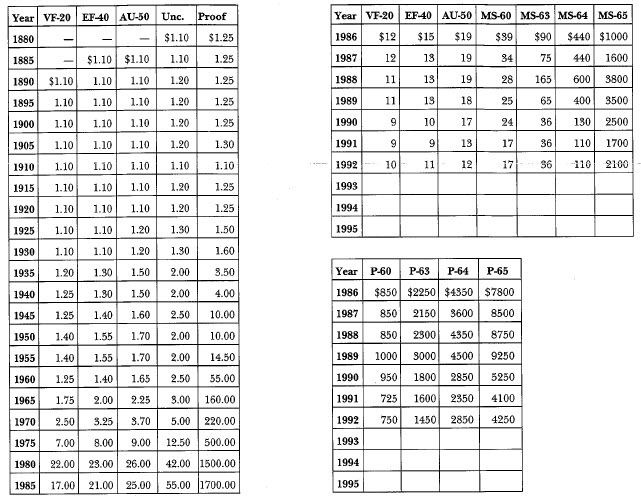
1.(Includes varieties with slight overdate features. Coins with obvious overdating are worth more, but were not popularized until the early 1960s.)
Business Strikes:
Enabling legislation: As earlier, plus Act of February 28, 1878.
Designer: George T. Morgan
Weight and composition: 412.5 grains; .900 silver, 100 copper
Melt-down (silver value) in year minted: $0.88564
Dies prepared: Obverse: 91; Reverse: 77
Business strike mintage: 12,600,000
Estimated quantity melted: Millions, including many in private melts of the 1970s.
Approximate population MS-65 or better.' 2,000 to 3,000 (URS-13)
Approximate population MS-64: 25,000 to 40,000 (URS-16)
Approximate population MS-63: 70,000 to 120,000 (URS-l8),
Approximate population MS-60 to 62: 120,000 to 240,000 (URS-18)
Approximate population G-4 to AU-58: 1,000,000 to 2,000,000 (URS-22),
Availability of prooflike coins: Scarce PL. DMPL coins are scarcer, although Wayne Miller men-tioned a hoard of 1,000 pieces.
Characteristics of striking: Usually well struck.
Known hoards of Mint State coins: Many bags were released by the Treasury Department in the 1950s and 1960s .
Proofs:
Dies prepared: Obverse: At least 1; Reverse: At least 1
Proof mintage: 1,355
Approximate population Proof-65 or better: 220+/ (URS-9)
Approximate population Proof-Bds 174+/- (URS-9)
Approximate population Proof-63: 160 +/- (URS-9)
Approximate population Proof-60 to 62: 305+/- (URS-10)
Commentary
This is the first year of Morgan dollars with overdates. They exist in many varieties from all four mints.
Additional Information
Activities at the Philadelphia Mint
The Annual Report of the Director of the Mint, 1880, covering the fiscal year ended on June 30th, commented as follows:
"Treasury and public demands for coin in exchange for the heavy importation of foreign gold, and the urgent and increasing demand for one cent bronze coins, rendered it impossible to increase the coinage of standard silver dollars at the Philadelphia Mint. It was also found more advantageous to purchase and coin silver bullion at New Orleans than at San Francisco, as the resulting coin could be far more rapidly and economically distributed from the former than the latter. No difficulty was experienced in procuring at market rates during the year all the silver bullion necessary for the Philadelphia Mint. At no time during the year was that institution without an ample stock of bullion .... "
Distribution of Silver Dollars in 1880
The Annual Report of the Director of the Mint, 1880, told of the distribution of Morgan silver dollars up to that point. Coins had been produced since 1878: from time to time, to the assistant treasurers, depositaries, and other officers of the United States, under general regulations proposed by the director of the Mint and approved by the secretary of the Treasury.
"Under the provisions of these acts the issue and paying out of silver dollars has been effected.
"First. By payment in standard silver dollars for all silver bullion purchased for coinage and delivered at the mints during the year, amounting to $24,972,161.81.
"Second. By exchange for gold coin.
"Third. Under general regulations prescribed by the director of the Mint, and approved by the secretary of the Treasury September 3, 1878, directing that the superintendents of the coinage mints 'upon the receipt of a written request of the Treasurer of the United States, forward by express standard silver dollars in the sum of one thousand dollars, or a multiple thereof, to such party or parties as he may designate. The expense of transportation to be paid by the mint from the silver profit fund.'
"Section 27 of the Coinage Act of 1873 provides that the expense of distributing the subsidiary silver coins shall be paid from the silver profit fund. In the act directing the coinage of the standard silver dollar the gain arising from such coinage is required to be accounted for and paid into the Treasury as provided under existing laws relative to the subsidiary coinage.
"Under these provisions and the regulation referred to, standard silver dollars are transported from the mints not only to assistant treasurers, depositaries, and other officers of the United States, but to such point as the Treasurer of the United States may designate, and the expense is charged to the silver profit fund .... "
The figures revealed that on July 1, 1878 some 78,080 silver dollars were held for payment of certificates outstanding while 5,273,964 dollars were available for distribution. In circulation at the time were an estimated 3,292,456 silver dollars. Unsurprisingly, 1878 Silver Certificates ($10 up, counter-signed) are great rarities.
By November 1, 1880 some 19,980,241 pieces were held for payment of certificates, 27,304,218 were held by the Treasury for distribution, and 25,763,291 were in circulation. The 1880 Silver Certificates ($10 up, not countersigned) later became rare, but not nearly as rare as the 1878s.