Silver Dollars & Trade Dollars of the United States - A Complete Encyclopedia
Q. David Bowers
1921-S Morgan Dollar
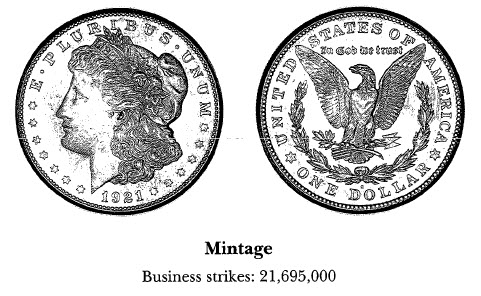
Coinage Context
San Francisco Mint. Like the Philadelphia and Denver facilities, the San Francisco Mint was pressed into service to strike large quantities of new Morgan dollars in 1921. Coinage began on May 9, 1921.
Numismatic Information
Commentary: The 1921-S dollars, like the 1921-D coins, all have a Micro S mintmark.
In B. Max Mehl's sale of the Alex J. Rosborough Collection, April 9, 1929, a 1921-S was catalogued as follows: "1921-S Microscopic S. AU. This specimen is one of the first 50 struck, secured by members of the Pacific Coast Numismatic Society." Apparently, such coins had no special surface quality apart from normal business strikes.
Hoard coins: Dollars of this date and mint were scarce during the 1920s, for relatively few were released. This changed when quantities were paid out from storage at the San Francisco Mint at intervals from the 1930s through the 1950s. 1921-S dollars were little esteemed in their time, thus few original mint-sealed bags were saved. Not even casino operators and other silver dollar hoarders liked the 1921 Morgan from any of the three mints. Today, while individual coins are exceedingly common, bags of
1921-S are few and far between. The Redfield estate (1976) apparently had a partial bag. The Numismatist, December 1939, told of a recent release of 1921-S Morgan dollars:
Morgan Type Dollar From San Francisco Mint: An interesting sight in the daily change around San Francisco recently has been the 1921 Morgan dollars in Mint or Uncirculated condition, some having just been released in that condition through the regular course of business.
It is thought that possibly 10 to 15 million were melted under provisions of the 1942 Silver Act. In comparison to surviving 1921 Philadelphia Mint coins, 1921-S dollars are far more elusive than the respective mintage differences (approximately 2:1) would indicate.
Circulated grades: In worn grades the 1921-S dollar is very common. An estimated two to four million survive.
Mint State grades: The usually-seen Mint State specimen is very poorly struck, has abraded surfaces, and even if the lustre is rich (as it is on some), the high points of the design are apt to be dull. Fully struck, lustrous coins exist, are scarce, and when seen are apt to be bagmarked. Of the 1921-S, Wayne Miller noted the following: "This date is by far the worst of any Morgan dollar in terms of appearance. Most are a weak mushy strike."
As is the case with other 1921 Morgan issues, grading interpretations for 1921-S are rather loose in comparison to earlier Morgan dollar dates.
My population estimates are as follows: MS-60 to 62, 1,000,000 to 2,000,000; MS-63, 200,000 to 400,000; MS-64, 30,000 to 60,000; and MS-65 or better (per current interpretations), 2,000 to 4,000.
Prooflike coins: Semi-prooflike 1921-S dollars are occasionally seen, but with far less frequency than with their Denver or Philadelphia Mint counterparts. Full prooflike pieces are great rarities; possibly fewer than a dozen exist (could these be "Zerbe Proofs," described below?). As a class, the PL and DMPL Denver Mint coins of 1921 are much scarcer than those of the Philadelphia and San Francisco mints. Be careful when buying these. See my comments under 1921 Prooflike; they also apply here.
1921-S "Zerbe Proof" dollars: The following is from an article, "Notes on 1895 Morgan Dollars," by Stuart Mosher, in the July 1955 issue of The Numismatist. While the article dealt primarily with 1895 dollars, the following anecdote was repeated concerning the 1921-S dollars:
Occasionally I notice Morgan dollars from branch mints are advertised as being in "Proof' condition. I have never seen one although I have seen many with the so-called prooflike surfaces and these I have considered as early strikings and not as intentional proofs. While they have bright surfaces, they lack the sharpness, the mirror-like finish and the wire edges of genuine Proof coins.
The scope of my observations and remarks are not intended to imply that branch mint Proofs are nonexistent. There are a lot of things I have never seen. About lO years ago, Farran Zerbe, father of the Peace dollar and our first American numismatic missionary, told me an intriguing story regarding a branch mint Morgan dollar issued in Proof.
In 1921 he was in California awaiting the arrival of the dies that were to be used to strike the first Peace dollars at the San Francisco Mint. The mint phoned him that the dies had arrived and he hastened there to see them put into operation. The new 1921 dies had arrived all right but they turned out to be dies for the old Morgan design which had not been coined since 1904, and not the dies for the Peace dollar which he had worked so hard and long to promote.