Silver Dollars & Trade Dollars of the United States - A Complete Encyclopedia
Q. David Bowers
1884 Morgan Dollar
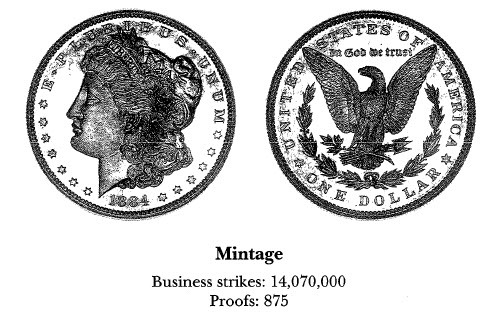
Coinage Context
The price of silver: Each year the Annual Report of the Director of the Mint devoted space to the silver and gold market. For fiscal year 1884 (ending June 30, 1884), the average cost of silver purchased during the year was $1.00080 per standard ounce (.900 fine) and $1.11200 per .999 fine ounce. (A Morgan dollar theoretically contained 0.77343375 oz. of pure silver.)
Numismatic Information
Hoard coins: 1884 Morgan dollars have been common for decades, and when I sorted through large quantities of bank-held dollars in the early 1950s, this date was abundant in higher grades. The Treasury releases each year in the 1940s and 1950s, particularly at Christmas time when the holiday demand called for silver dollars for use as gifts, often contained bags of this and other Philadelphia Mint dates from 1878 through 1887. A particularly large release occurred in December 1954. At first, there was something special about finding Uncirculated coins that were the best part of a century old, for face value, but as a teenager at the time, my budget was small, and I could only keep one coin, but I would constantly upgrade it. As present readers who were numismatically active at the time will recall, the novelty of obtaining old dollars for face value soon passed, and few collectors bothered to acquire dollars by date and mintmark variety.
The great Treasury release of 1962-1964, extending to March 1964, saw additional quantities of the 1884 (and many other) Philadelphia Mint dollars brought out from storage in government vaults. However, the number of bags of 1884 dollars released was small in comparison to certain New Orleans and San Francisco issues. Apparently, most 1884 dollars were distributed in the 1950s, and by the mid-1960s they were somewhat scarce in a comparative sense.
Sometime in the 1960s, 12 to 15 bags of 1884 dollars were stashed away in the reserves of the Continental-Illinois Bank, to come to light about 15 years later.
Today in the early 1990s, single Mint State coins are encountered with regularity, but I believe that most bags have been broken up. In 1982, Wayne Miller wrote of several wealthy investors hoarding this date, with one acquiring several bags; the disposition of these, I don't know.
A mysterious variety: Some Morgan dollars of 1884 have either a large dot (VAM-3) or a small dot (VAM-4) after Morgan's initial M on Miss Liberty's neck truncation on the obverse, and a similar dot after his initial M on the left side of the wreath bow on the reverse. This variation was first called to the attention of collectors by Francis X. Klaes in the Numismatic Scrapbook Magazine, May 1962.
In the second edition of The Comprehensive Catalog and Encyclopedia of Morgan & Peace Silver Dollars, Leroy Van Allen and A. George Mallis note the following:
Some of the silver dollars from the Philadelphia Mint in 1884 had small dots placed alongside the designer's initial M on both the obverse and reverse. In past years, small dots had been placed on coins to indicate a change of design; this was probably also the case for the 1884 silver dollar.(The author of the present text (Q.D.B.) is not aware of dots being placed on any United States coins to indicate a change of design. Some of the latest half dollar reverses of 1795 have a dot in the field below the ribbon knot; this is believed to be a privy mark of John Smith Gardner, but whatever it is, it does not signal a design change. Among Canadian coins, some 1936 cents, 10-cent pieces, and quarters had tiny dots added to indicate that issues depicting King George V on the obverse had been struck after that monarch's death, before new dies showing the intended next king, Edward VIII, were ready.) In that year the size of the date and the width of the numbers were reduced. Apparently, the dots were to distinguish the new dies with reduced date size during the transition early in 1884, in order to prevent a mix-up of the working hubs. After the transition, the raised dot on the working hub was easily ground off.
Two different sized dots have been found on the obverse. Their positions next to the initial M are also slightly different. Detection of the dot on the reverse requires a strong magnifying glass, and only one size has been found so far. The authors have seen the obverse and reverse dot die used only together-never separately. On worn coins, the reverse dot is very difficult to see.
In my opinion, here is one of the most intriguing mysteries among Morgan dollars. Undoubtedly there is an explanation for its origin, and exactly what it is may remain to be discovered.
In the years since the announcement of its discovery in 1962, the variety has received very little publicity and is largely unknown to the collecting fraternity, apart from owners of the VAM book. Perhaps the Dot variety is deserving of more attention. I suggest that with some looking, you can find one for the price of a regular coin.
A challenge!: Concerning the "dot subject," Jeff Oxman, of the Society of Silver Dollar Collectors, stated this:(Letter to the author, November 29, 1992.)
Interested in a mystery? Here it is. The two 1884 "dot" varieties, VAM-3 and 4, pose an intriguing question for variety specialists. Why were dots placed on these particular dies and no others in the Morgan dollar series? This act on the part of the engraver was obviously deliberate, because on both die pairs the dots were placed in the same locations, not only next to the designer's initial M on the obverse, but also next to his initial on the reverse ribbon bow.
Marking these dies, and possibly others, for some purpose would appear to have been the intention. But, if other dies of the same year were similarly marked, the dots were ground off the dies prior to being used in the presses. Make a name for yourself among variety collectors by coming up with the solution!
Circulated grades: The 1884 is very common in worn grades. Millions were probably distributed during the nineteenth century. Undoubtedly, many were melted in the 1970s during the rise in silver bullion prices.
Mint State grades:, The 1884 is very common in MS-60 through MS-63 grades, is readily available in MS-64 preservation, and is easy to find in MS-65 grade as well, although, of course, MS-65 coins are fewer in number than are those in lower grades.
Population estimates follow: MS-60 to 62, 150,000 to 225,000; MS-63, 50,000 to 90,000; MS-64, 30,000 to 60,000; and MS-65, 12,500 to 20,000. Most Mint State 1884 dollars seen today are well struck and very lustrous.
Prooflike coins: Semi-prooflike coins are common, but true prooflike coins are elusive. DMPL coins in high grades are rare. An estimated 5,000 or so PL and 3,000 or so DMPL survive.
Proofs: As might be expected from the mintage of 875 pieces, Proofs are readily available on the market. However, as is also the case with nearly all other early dates of Proof Morgan dollars, many have been cleaned and today are in the lower grade ranges of Proof-60 to 63.