Silver Dollars & Trade Dollars of the United States - A Complete Encyclopedia
Q. David Bowers
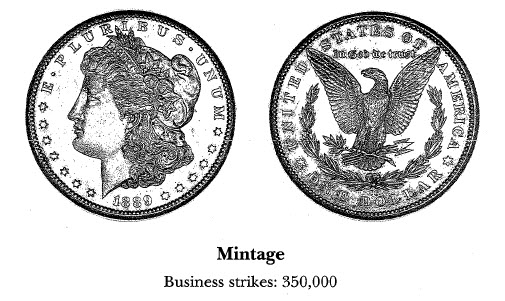
1889-CC Morgan Dollar
Coinage Context
Mint reopens for coinage: The Carson City Mint, which had produced its last gold and silver coins in 1885, reopened on July 1, 1889. Coinage resumed in October.
Numismatic Information
Desirability: The 1889-CC in Mint State is far and away the rarest Carson City Morgan dollar and handily outdistances its closest rivals, the elusive 1879-CC and 1893-CC. As such, it has acquired an aura of fame in recent years. Offerings of coins in higher grades are apt to be one at a time (instead of by the roll or bag). A Mint State coin is a candidate for a picture and effusive description in an auction catalogue.
Hoard coins: When Carson City silver dollars were being paid out from the Cash Room at the Treasury Department in Washington, many thousands of all issues 1878-1893 were distributed, except 1889-CC. Apparently, only a few single coins and rolls were given out, some of them as early as 1933-1934. By the 1950s, possibly only a few hundred coins remained on hand at the Cash Room. I have found no record of bags being distributed from Washington during that decade or any time later.
It is probably the case that more 1889-CC dollars were stored at the San Francisco Mint and/or in Federal Reserve stocks in the West than at the Treasury Building. In 1925 and 1926, quantities of 1889-CCs were paid out at face value from storage at the San Francisco Mint. Bags that came to light in the 1950s are all from the San Francisco Mint vaults, so far as I know. In the 1950s a bag of 1,000 pieces was released in Montana, followed by another in the early 1960s. Apparently, the first bag contained many heavily marked coins, "sliders" if you will, of a quality that today would be called AU-55 or 58. In addition, at least two intact bags were in existence in 1976 (one of these is from the Ben Stack group mentioned below). Probably, these have not been distributed.
Harry Warner of Mill Valley, California, told Walter Breen that he once owned a bag of 1,000 coins. Ben Stack told Harry J. Forman that he bought two bags by advertising (1954) in the Las Vegas Sun, and another was acquired in this way or by buying it separately. One of these bags went to Irving Davidoff, owner of the Klondyke Coin Exchange in New York City; another was dispersed at $140 per roll of 20 coins ($7 apiece); the third was still owned by Ben Stack as of February 1976, for he offered it to me at that time.
Only one solitary coin was left in the Treasury when the government decided to hold back CC dollars after payouts were halted in March 1964!
The 1889-CC is very scarce in worn grades. Apparently, relatively few were released into circulation in or near the year of mintage. Most that come on the market show quite a bit of wear, and grades from VG-8 through VF-30 are encountered more often thanhigher grades as EF-40 to AU-58. In 1992, the 1889-CC in worn grades was the second most valuable (after 1893-S) business strike Morgan dollar. In my own company, Bowers and Merena Galleries, it seems that I have had more worn 1893-S dollars than 1889-CCs, but I never kept specific track, so I cannot be sure. Walter H. Breen reported that in more than 20 years of keeping records, he has seen many worn 1893-S dollars but only a few worn 1893-CC coins.
Mint State grades: Most Mint State 1889-CC dollars on the market are in lower grade levels, often with dull, washed-out appearing surfaces. Marginal pieces will usually be fully struck but will have poor lustre and heavy bagmarks. The activities of PCGS, NGC, and certain of their contemporaries have made it possible to choose grades when buying and have a decent chance of getting what you expect.
Nearly all 1889-CC dollars are well struck with excellent definition of details. The lustre is usually of medium intensity on MS-63 or finer coins, often a bit satiny. Deeply frosty, coruscating, lustrous coins are not typical; in fact, I do not recall ever having seen one.
I estimate that 5,000 to 8,000 remain in the MS-60 to 62 range, this figure including several thousand coins still in bags, undistributed. At the MS-63 level about 1,500 to 3,000 are believed to survive. From that point the population drops to just 400 to 800 for MS-64 and only 80 to 150 for MS-65 or better. In the last-named grade, the 1889-CC is one of the top ten rarest Morgan dollars, although it hardly rivals the 1893-S.
Prooflike coins: Prooflike 1889-CC dollars are highly desired. However, nearly 50% of all Mint State coins display prooflike characteristics. In fact, this issue is distinctive among Morgan dollars in that it is just about as available in prooflike finish as with satiny lustre. (Among nearly all other issues, prooflike coins form only a small percentage of Mint State coins.) Prooflike coins are usually cameos, but often have numerous bagmarks from the effects of Treasury storage and handling over the years. Many DMPL coins have been certified-nearly 100 as of September 1992-but nearly all are MS-63 DMPL or lower. The "Proofs" offered by B. Max Mehl in the Alex]. Rosborough Collection (April 9, 1929) and by B.M. Douglas (The Numismatist, 12/51) were almost certainly DMPLs.
Caveat emptor: Numerous "1889-CC" dollars have been created by adding mintmarks to common 1889 Philadelphia Mint coins. Unless you are an expert and can do it yourself, have any high-value 1889-CC dollar authenticated.
Varieties
Business strikes:
1. Normal date: Breen-5610. High 9. Three varieties are known from three pairs of dies out of the 10 obverses and seven reverses furnished: VAM-1, 2, and 3. VAM-2 has higher 9 than the other obverses. VAM-3 has the date more to the right than normal.