Silver Dollars & Trade Dollars of the United States - A Complete Encyclopedia
Q. David Bowers
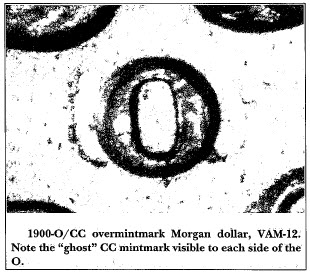
1900-0/CC Morgan Dollar
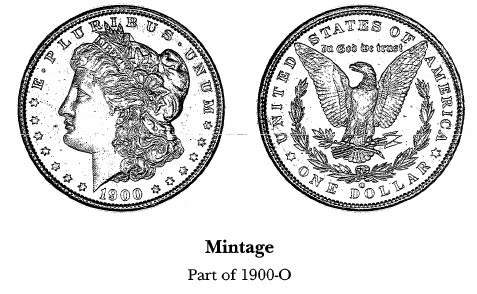
Coinage Context
Leftover dies: When it became evident that the Carson City Mint would coin no more silver dollars after July 1, 1899, and old dies on hand were returned to Philadelphia, at least six Morgan dollar reverse dies with the CC mintmarks on them were partly effaced in the mintmark area and overpunched with 0 mintmarks. Can any of the dies be specifically identified as having been used for 1893-CC or other CC coinage?
Numismatic Information
Commentary: The 1900-O/CC overmintmark has been known to numismatists for many decades, but it was not until the 1950s that a widespread demand arose for it. Five different reverse die varieties are known, distinguishable by slight positional differences in the overlapping mintmarks,
Numismatic history: The Numismatist, November 1928, carried this article (excerpted here) by Will W. Neil of Baldwin, Kansas, a pharmacist whose hobby was numismatics; in particular, the collecting of silver dollars. At the time the coin described was not listed in catalogues and was relatively unknown:
Mint Marks, Or What Have You?:
Regarding the specimen in question, it is at first glance an ordinary Morgan-type silver dollar of 1900 from the New Orleans Mint, but upon closer examination of the mintmark it has the appearance of the O having been punched in over the letters CC. If this is so, then, undoubtedly, in this instance a reverse die was taken from the Carson City Mint to the mint at New Orleans [sic; actually the punching was done in Philadelphia], where the usual O was punched in the die over the CC and used in conjunction with an obverse die of 1900.
This would be somewhat in accordance with the regular procedure, as supposedly all dies are prepared at the Philadelphia Mint and then sent to the branch mints, where, before they are put in use, a small steel letter punch is used to impress the mint mark upon the die. Just why such economy as this should have been practiced would be hard to explain, but it seems equally difficult to explain its presence as being anything else when we consider the other possible chances for such a jumble. It could hardly have been an error by the engraver, because of his having had nothing to do with punching the mint mark.
It is not likely that he who punched the mintmark had a whole alphabet of letters to choose from when only an O is ever put in use at the New Orleans Mint. It would have been impossible for him to have first punched the letter in bottom side up or otherwise muddle it up and then correct it, for an ο has neither top nor bottom.
The possibility of it being a planchet defect is quite removed, as I have seen three different specimens, two of which I now have.
With these possibilities considered, I leave the decision entirely in your hands, taking it for granted that the piece is genuine and unaltered, as it shows no evidence to lead one to believe otherwise, and will welcome any comments regarding it either direct or through the pages of our most welcome visitor, The Numismatist.
Hoard coins: Bags of 1900-O dollarshad O/CC coins mixed in. In the mid-1980s, Bowers and Merena Galleries handled a quantity of unsearched Mint State 1900-O dollars from a Montana holding, and about a third to a quarter were 1900-O/CC. However, I believe that this was an unusual situation, and that the total population of 1900-O/CC dollars is only a tiny fraction of that of 1900-O.
In 1992, Dwight Manley obtained and began the dispersal of a full original bag of 1900-O/CC dollars from a Chicago source. The distribution of grades (PCGS certification) was as follows: MS-67: 1 coin, MS-66: 10, MS-65: 150, MS-64: 260, MS-63: 340, and MS-60 through 62 (not certified): 239.1
Circulated grades: In the early days, the variety was not widely known, and examples were not culled from circulation. However, specimens are readily available today.
Mint State grades: Mint State coins remain by the tens of thousands, but are scarce in comparison to normal O-Mint coins of the era. Most are in lower grade levels. I estimate that 40,000 to 80,000 MS-60 to 62 coins exist, 10,000 to 20,000 at the MS-63 level, 5,000 to 10,000 in MS-64, and just 1,000 to 2,000 MS-65 pieces.
Most Mint State specimens seen are brilliant and somewhat lustrous, although not with "deep" frost. The strike is average. Bagmarks are apt to be light but plentiful, although I have seen heavily bagmarked pieces on many occasions. Cherrypicking is advisable, not so much for striking, but to avoid unattractive bagmarks. Of course, the higher the grade, the fewer the bagmarks.
Prooflike coins: None known.
Varieties
OLD REVERSE HUB: NARROW WING/NECK SPACE, SMALL STARS
Business strikes:
1. 1900-O/CC Medium O. Open 9, Breen-5671, VAM-9, 11. VAM-9 is by far the rarest of the die varieties.
2. 1900-O/CC Medium o. Closed 9. Breen-5673, VAM-7, 8, 10, 12.