Silver Dollars & Trade Dollars of the United States - A Complete Encyclopedia
Q. David Bowers
1879-0 Morgan Dollar
Coinage Context
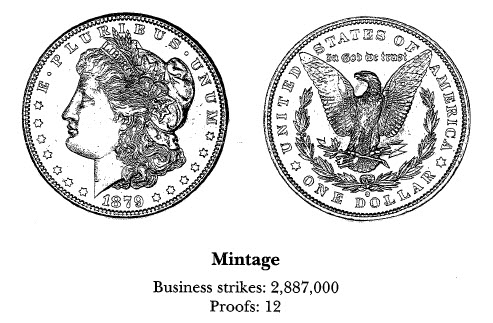
Mint reopened: The New Orleans Mint, closed in 1861 at the beginning of the Civil War, was reopened in 1879, at which time most production consisted of Morgan silver dollars. It is believed that 12 Proofs were struck on February 20, 1879 to observe the reopening.
Numismatic Information
Commentary: Perhaps because it was made early in the series and there was call for coins in circulation in the Mississippi Valley area, many 1879-O dollars were paid out into circulation at or near the time of striking. Even so, just a part of the mintage was distributed.
Hoard coins: I have no specific record of early Treasury releases, but quantities must have filtered onto the market over a long period of time. By the late 1940s and early 1950s, 1879-O Morgan dollars were considered to be on the scarce side and were not among issues recently released in mint-sealed bags. This changed in 1957 when an estimated five to 10 bags came out and went into the hands of dealers, who stocked them primarily in roll (rather than bag) quantities. The price of single coins, which had been in the $10 to $15 range for most of the decade up to that point, dropped to the $3 level, then even lower. In the September 1957 issue of The Numismatist, Harry J. Forman advertised that he had 1879-O dollars in quantity. In March 1958, Dan's (Dan Morafka) was retailing 20-coin rolls at $37 each, which was equivalent to $1.85 per coin.
Multiple bags of 1,000 Uncirculated coins came to light in October 1962 and with other New Orleans dollars were among the first of the Treasury releases that led to the depletion of the government supply of dollars. Releases of 1879-O continued well into the summer of 1963. However, the total quantity eventually released did not even remotely compare to such plentiful issues as 1883-O, 1884-O, 1885-O, 1898-O, 1903-O, and 1904-O. For some reason, 1879-O dollars did not get into the numismatic mainstream of bulk investment and dealer sales. Perhaps most went to banks in remote areas. In time, the 1879-O once again became scarce in quantity lots.
Around 1975, Harry J. Forman bought a bag of 1879-O dollars from the estate of Paul Dinerman, of Philadelphia.' Earlier, this had come from the 1962-1964 Treasury release. John Kamin's commentary: Some Uncirculated 1879-O coins were found mixed in with other contemporary issues. Apropos of this, John V. Kamin wrote the following''
I had the chance to go through many bags of O-Mint silver dollars with mint seals from the New Orleans Mint or the Federal Reserve, bags sealed up in 1880, 1881, 1882. Estimated over 90% of the contents of these bags was 1881-O, 1882-O silver dollars, with the rest evenly split between 1880-O and 1879-O. I've always assumed that the storage vault was flooded, that the original bags rotted. And, since manual counting of coins was the way it WaS done in those days, the coins were later quickly counted and scooped into new cloth bags, without regard to date in the early 1880s.
Just a few mint bags consisting solely of 1879-O silver dollars came out, and those had different seals on them. They were all Uncirculated, not mixed dates, all the same coins in the bag. Those coins were of a much higher quality. They weren't water-marked, and commanded a premium, up to triple face value at a time when most Morgans couldn't even bring 50% over face value. They were obviously Uncirculated, compared to those mixed O-Mint bags that were 'probably roughly scooped, handled, and maybe even shoveled more than once.
Circulated grades: Wayne Miller wrote this in 1982:3
The 1879-O is very common in AU condition. The reason is that the 1879-O, like the 1880-O, 1881-O, and 1882-O, was released' into circulation in the New Orleans area in large quarttities soon after striking. For reasons which have never been explained, these dollars were then gathered up after they had been lightly circulated, brought back to the Mint, and resealed into Mint bags. Mint sealed bags of these dates often contain over 90% lightly circulated pieces, including a few dollars from the Philadelphia, San Francisco, andCarson City mints, which happened to be circulating in the New Orleans.area at the time of recall. Because of the preponderance of AU 1879-Odollars, always examine them carefully. Check the breast feathers for wear.
Dean Tavenner calls the higher grade AU coins "two-beer" dollars, which is his term for coins which circulated briefly, perhaps just long enough to buy two beers, after which they went back to banks and were resewn into bags, like (and sometimes with) similar New Orleans Mint dollars of later dates,
Mint State grades: The 1879-O dollar is easily located in lower Mint State grades of MS-60 through MS-62. At the MS-63 level it becomes slightly scarce. In MS-64 grade the 1879-O is firmly in the scarce category. At the MS-65 plateau it is a candidate for a photograph and detailed description in an auction catalogue, for probably fewer than 500 such coins exist.
Population estimates follow: MS-60 to 62, 40,000 to 70,000; MS-63, 20,000 to 30,000; MS-64, 4,000 to 8,000; and MS-65 or better, only 350 to 500.
Most 1879-O dollars seen on the market today are of average to above average striking detail, although many exceptions occur to either side-weakly detailed or sharply detailed. Most coins have attractive frosty surfaces. Although variations in mintmark sizes exist (see below), nearly all collectors, apart from VAM enthusiasts,are content to include just one example of the 1879-O in their holdings.
Prooflike coins: Many prooflike coins exist, a good number ofwhich have cameo contrast. Most are in lower grade levels such as MS-60 to MS-62, are extensively bagmarked, and are not particularly attractive. Probably, 2,000 to 4,000 are known, of which 98% or more are less than MS-65 PL. Numerous AU coins, called "sliders" years ago on the market, are likewise prooflike. DMPL coins are about three times rarer than PLs.
Proofs: 12 Proof specimens are believed to have been struck on February 20, 1879. Wayne Miller described the location of fourpieces, including onein the National Coin Collection in the Smithsonian Institution." The '12 minted' figure apparently appeared first in the NYCS (David Proskey and Harlan P. Smith) auction of the R. Coulton Davis Collection, Jan. 20-24, 1890). Wayne Miller's specimen brought $41,800 in January 1986.