Silver Dollars & Trade Dollars of the United States - A Complete Encyclopedia
Q. David Bowers
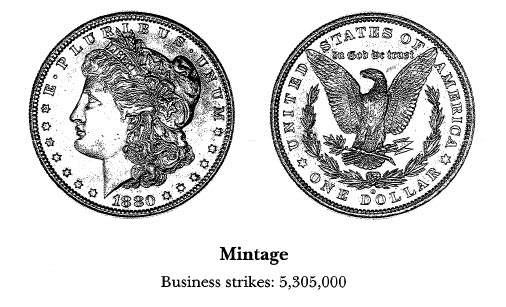
1880-O Morgan Dollar
Coinage Context
Theme continued: The 1880-O dollar continues the theme of the 1880 year at all mints and offers overdate varieties made from reprocessed 1879 dies.
Numismatic Information
Commentary: Many 1880-O dollars were released into circulation around the time they were minted, and in dribs and drabs in later years. As a result, Uncirculated pieces have always been readily available on the numismatic market. However, after the early 1960s, the 1880-O, not extensively represented in the Treasury release of 1962-1964, became scarce in comparison to many other issues.
Hoard coins: Little record exists of releases or dealer offerings of quantities of 1880-O dollars. Circa 1946 a few bags were released, and for several years single coins were more plentiful in dealers' stocks than they had been earlier in the decade. This supply dried up, and during the 1950-1955 years the price for a single Mint State coin bounced around from about $5 to $10. Around 1956-1957, additional quantities came out from Treasury holdings, and the price dropped. In May 1957, John and Frances Holden offered singles for $3.25, and in September of the same year, Harry W. Bason was retailing them for $2.50 apiece. In October 1957, Dan Morafka was selling rolls of 20 coins for $45, and in November 1958, Harry Warner was charging $49 per roll.
Again, the supply diminished, and 1880-O dollars became scarce in quantity in the early 1960s. Then came the Treasury release of New Orleans dollars beginning in October 1962 and continuing at least throughJuly 1963. At least a few bags were released during this time, but I have located no specific documentation as to quantities, which must have been small. Dealers in quantities of dollars were stocking 1880-Os by the roll in the early 1960s. Examples include Daniel]. Morafka at $70.00 per roll in May 1964 and the Mississippi Numismatic Exchange at $59.50 per roll the following November; and Harry J. Forman at $47.50 per roll in May 1965.
According to Wayne Miller, in The Morgan and Peace Dollar Textbook, a bag or more of 1880-O dollars came on the market in 1974. In 1977, the Superior Stamp & Coin Company handled the R.D. Donovan hoard of silver dollars, which is said to have contained a bag or more of this issue.
Overdates: Following the sequence of its brethren at other mints, the 1880-O exists in a number of overdate varieties. However, all of these are lightly defined, difficult to evaluate except under strong magnification, and to date in the marketplace have merited an unstifled yawn from collectors (VAM enthusiasts excepted). Wayne Miller wrote: "Many overdate varieties of the 1880-O exist. None, however, command a premium." Such overdates were not generally known to collectors until they received publicity in Coin World and elsewhere in the early 1960s, and were later delineated in the Van Allen-Mallis book.
Of the lot of overdates, the most desired is thatwith 1880/1879, identifiable under magnification by the under-digits 79 beneath 80. Most often seen, however, is the overdate with the second 8 in the date over 7. Bags of the latter are believed to have been released first in October 1962.1
Circulated grades: Many high-grade AU coins are known, some of which came from mint sealed bags, apparently returned to the New Orleans Mint shortly after issue: "two-beer" dollars. In addition, numerous low grade coins remain, although vast quantities of these and other common dollars were melted during the run-up in silver bullion prices in the 1970s.
Mint State grades: For many varieties of 1880-O except "Impaled Eagle," AU and borderline Uncirculated coins are common, gem Uncirculated coinsare rare, and prooflikes and DMPLs are rarer still. However, some varieties are quite rare in all grades; Jeff Oxman reports that the finest known VAM-6B is AU-50. (Letter to the author, November 29, 1992.)
In comparison to many other Morgan dollar varieties of this era, the 1880-O is fairly scarce. Most Mint State 1880-O Morgan dollars in collectors' hands are in grades from MS-60 to MS-62, of which 7,500 to 15,000 coins are estimated to survive. I suggest that 3,000 to 6,000 MS-63 coins exist, 1,500 to 3,000 MS-64, and the paltry quantity of just 100 to 200 MS-65s. In the latter grade, coins are sufficiently rare that often large specialized collections lack an example at this level.
Most 1880-O dollars have frosty surfaces with attractive lustre. The striking usually ranges from average to bold.
The scarcity of the 1880-O in higher grades was the topic of a commentary by Maurice Rosen:(Letter to the author January 22,1992.) "In the early 1970s, after a year of continuous accumulation, I managed to amass nearly a 1,000-coin hoard at a cost of about $25 per coin. The great majority of these coins would grade today from AU to MS-62. Since this has long been one of my favorite $1 dates, I can safely say that the date is genuinely elusive in MS-63 and higher grades."
Wayne Miller had this to say in his Morgan and Peace Dollar Textbook:
The 1880-O is much rarer in gem condition than the 1879-O. During the early 1970s the 1880-O was very much underrated in strictly Uncirculated condition-since it was readily available in AU condition-mint sealed bags of lightly circulated pieces exist-and since many collectors thought that all New Orleans Mint dollars were poorly struck, most dealers were content to deliver sliders.
Prooflike coins: This issue is elusive in prooflike finish, especially in higher grades. Probably, 1,000 or more PL coins survive, nearly all of which are less than MS-65 PL in grade. DMPL coins appear to be slightly more populous than PLS, if certification data are an indication. Nearly all are below the MS-65 DMPL level. The R.D. Donovan hoard of several hundred DMPL coins with cameo contrast was dispersed by Superior Galleries in 1977. Most of these were the VAM-4 variety.
Some AU pieces are prooflike and are not particularly rare.