Silver Dollars & Trade Dollars of the United States - A Complete Encyclopedia
Q. David Bowers
1888 Morgan: Market Values
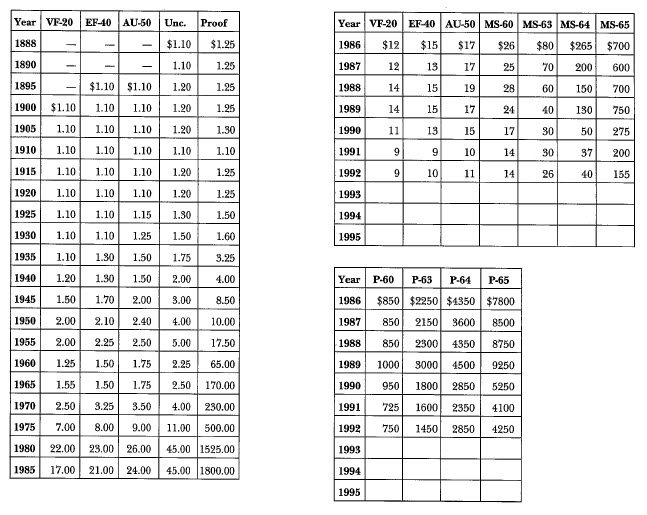
1888 Morgan: Summary of Characteristics
Business Strikes:
Enabling legislation: As earlier, plus Act of February 28, 1878
Designer: George T. Morgan
Weight and composition: 412.5 grains; .900 silver, . 100 copper
Melt-down (silver value) in year minted: $0.727
Dies prepared: Obverse: 64; Reverse: 54
Business strike mintage: 19,183,000; Delivery figures by month: January: 1,700,000; February: 1,700,000; March: 1,560,000; April: 1,434,000; May: 1,600,000; June: 1,620,000; July: 600,000; August: 1,534,000; September: 2,000,000; October: 2,000,000; November: 1,850,000; December: 1,585,000.
Estimated quantity melted: Unknown, but millions, probably including many under the 1918 Pittman Act.
Approximate population MS-65 or better: 15,000 to 25,000 (URS-15)
Approximate population MS-64: 60,000 to 120,000 (URS-17)
Approximate population MS-63: 110,000 to 200,000 (URS-18)
Approximate population MS-60 to 62: 300,000 to 600,000 (URS-20)
Approximate population G-4 to AU-58: 2,000,000 to 4,000,000 (URS-23)
Availability of prooflike coins: Often seen. Nearly always satiny or semi-prooflike, not DMPL. Two 1,000-coin bags of DMPL coins have been reported. Most DMPL survivors are below MS-65.
Characteristics of striking: Varies widely, from weakly struck with poor lustre to sharply struck with deep lustre .
Known hoards of Mint State coins: Vast quantities were released by the Treasury Department circa 1955-1964.
Proofs:
Dies prepared: Obverse: At least 2; Reverse: At least 1
Proof mintage: 833; Delivery figures by month:
March, 432, September, 100; December, 300; unknown month of striking: 1. (Coinage figures for 1888 do not include a specimen, presumably a Proof, struck for inclusion in the Mint Cabinet; per footnote on p. 155 of the Report of the Director of the Mint, 1888. The Proof mintage, usually stated as 832, thus should be 833.)
Approximate population Proof-65 or better: 38+/- (URS-7)
Approximate population Proof-64: 76+/- (URS-8)
Approximate population Proof-63: 85+/- (URS-8)
Approximate population Proof-60 to 62: 205+/- (URS-9)
Commentary
Striking quality of Mint State 1888 dollars varies widely.
Additional Information
Distribution of Silver Dollars
The Annual Report of the Director of the Mint, 1888, told of the distribution of silver dollars at the various mints: Philadelphia Mint: In mint July 1, 1887, $35,386,110; coinage of fiscal year $18,514,673; transferred to Treasury four million; available for distribution $49,900,783; in mint June 30, 1888, 47,016,836; distributed from mint: 2,883,947.
San Francisco Mint: In mint July 1, 1887, $18,788,015; coinage of fiscal year, 2,304,000; transferred from sub-Treasury five million; available for distribution $26,092,015; in mint June 30, 1888, 25,142,074; distributed from mint: 949,941.
New Orleans: In mint July 1, 1887, $8,163,744; coinage of fiscal year 11.9 million; available for distribution 20,063,744; in mint June 30, 1888, 11,850,034; distributed from mint: 8,213,710.
Carson City: In mint July 1, 1887, $9,821; available for distribution 9,821; in mint June 30, 1888, 5,315; distributed from mint: 4,506.
The Year 1888 in History
In November, Republican Benjamin Harrison (grandson of President William Henry Harrison) was elected president with 233 Electoral College votes, compared to 168 for his opponent, Democrat Grover Cleveland. However, Harrison received 100,000 fewer popular votes than Cleveland. Primaries held in Maine weeks prior to the national election gave Harrison the lead, giving rise to the popular phrase,"As Maine goes, so goes the nation."
The Washington Monument was completed in Washington, D.C., following four decades of intermittent construction. The first successful electric trolley (power taken from overhead wires) cars were introduced for public transportation, in Richmond, Virginia, presaging the demise of the horse-drawn cars then in widespread service.
The National Geographic Magazine was first published in 1888 and would go on to become an American institution, although, years later, its tax-exempt status would be challenged (unsuccessfully) when it printed a large amount of consumer advertising. Edward Bellamy's novel, Looking Backward, 2000-1887, envisioned a utopian America, with all wealth evenly distributed and citizens enjoying themselves in all pursuits of life. "Casey at the Bat," a poem by Ernest Lawrence Thayer, was printed in the San Francisco Examiner, June 3, 1888, and concluded with: "There is no joy in Mudville- mighty Casey has struck out."
George" Eastman introduced the Kodak box camera, which made it possible for amateurs to take satisfactory photographs. For $25 a would-be photographer could buy a Kodak loaded with enough roll filmto take 100 snapshots. One could send the camera and film with $10 to Kodak headquarters in Rochester, New York, and receive the camera with a new roll of film and a set of prints from the previous roll.
"We fear God, and nothing else in the world," Otto von Bismarck stated to the German Reichstag.
The year was best remembered for many years thereafter for the Blizzard of • 88, which dumped many feet of snow on the northeastern United States and which caused numerous homes and communities to be isolated for a week or more.