Silver Dollars & Trade Dollars of the United States - A Complete Encyclopedia
Q. David Bowers
1879-CC Morgan Dollar
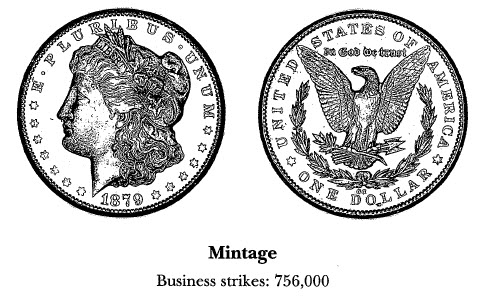
Coinage Context
Railroad rates Confiscatory tariffs posted by railroads made it cheaper to send silver bullion hundreds of miles distant to San francisco for coinage than to send it 15 miles to the Carson City Mint,As a result, silver bullion was scarce at Carson city, and the mint stopped production of dollars after only a relatively few had been coined. All coinage operations were suspended from March 1 to June 30, 1879, and again from November 1, 1879, to May 1, 1880.
Numismatic Information
Rare in their own time: Apparently, 1879-CC dollars were rare in their own time. As of 1898, silver dollar specialist George W. Rice had never seen an 1879-CC (cf. quotation under 1878 8TF above). On the other hand, Augustus G. Heaton, writing in his 1893 Mint Marks, noted that on the 1879-CC the mintmark is more over the D of DOLLAR than the space between the D and the O, and further: "It is not very common." Apparently, by 1893 Heaton saw or knew of at least several specimens.
Hoard coins: After the closing of the Carson City Mint, quantities of 1879-CC dollars were shipped in two directions for storage: westward to vaults in the San Francisco Mint, and eastward to Washington, D.C. In 1942-1943, several bags of 1879-CC dollars were paid out at face value in San Francisco. Apparently, the quantity was never large at that location.
The Cash Room in the Treasury Building in Washington distributed at least several thousand Uncirculated 1879-CC dollars in the early and mid-1950s, but by 1955-1956, the largesse stopped. Sometime around this period, Harry J. Forman bought 500 coins from a bag of 1,000 pieces owned by J. Grove Loser, of Steelton, Pennsylvania, who, like Charlie Dochkus, had a special "in" at the Cash Room.?
On the market during the 1950s, 1879-CC dollars were always available from dealers for a price, but they were harder to find in quantity than most other CC issues. The Treasury kept back slightly over 4,000 coins, which may have been deep in a vault in the 1950s and thus not known to the numismatically-wise people in the Cash Room.
As part of the General Services Administration sales in 1972-1974, some 4,123 1879-CC dollars were sold, representing coins found in the Treasury
Building in Washington. Of these about 600 (Walter H. Breen is more conservative and estimates just 300) were of the Large CC over Small CC (popularly, the "Capped CC") variety. Most were what would be graded today as MS-60 to MS-62.
The Redfield hoard, first marketed in 1976, is said to have had 400 to 500 pieces of the Large CC over Small CC, nearly all of which were in lower grades and heavily bagmarked. Harry J. Forman had one Uncirculated bag from J. Grove Loser. According to John Skubis, as quoted earlier, the Treasury unintentionally sold another bag to someone in "Montana or in Seattle." These coins came from storage in the San Francisco Mint.
Two major varieties: The 1879-CC is by far the scarcest Carson City Morgan dollar of the early (1878-1885) date range. All are of the Third Reverse (slanted top arrow feather, convex breast on eagle) type. The ownership of a nice 1879-CC dollar has always been a point of pride and accomplishment for the advanced collector of the series.
There are two major varieties of 1879-CC dollars.
The first is the Large CC over Small CC variety, which suffers from "bad press" as it has been called the "Broken CC" (Guide Book, etc.) and the "Capped CC" (The Coin Dealer Newsletter, etc.) Actually, the die had a very small mintmark (as used the previous year for all 1878-CC dollars) which was partially effaced, apparently by moving the metal to cover the most of the traces of the small CC. A much larger CC was punched over the small CC area. This was clearly delineated years ago by Van Allen and Mallis, but, somehow, the true status of the coin has slipped between the cracks in the meantime. Numismatic writers: Dig out your copy of Van Allen-Mallis, 3rd edition, read p. 181, and heed the commentary. The metal, moved to conceal the small CC, spalled or chipped off the die, thus producing a rough area around the mintmark.
The second variety is the so-called Perfect (or "normal") CC issue, which has a larger CC mintmark.
Wayne Miller's view: Wayne Miller's 1982 commentary did not enhance numismatic desire for the Large CC over Small CC variety:
This interesting but unpopular anomaly occurred because of the pressure to produce as many dollars as possible in keeping with the provisions of the Bland-Allison Act of 1878. In 1879, one or more dies had probably already been prepared for striking the 1879-CC dollar with the round breast [Third Reverse] modification. Before any coins were struck, the decision was made to enlarge the mintmark on the dollar.
The second variety is the so-called Perfect (or "normal") CC issue, which has a larger CC mintmark. Wayne Miller's view: Wayne Miller's 1982 commentary did not enhance numismatic desire for the Large CC over Small CC variety:
This interesting but unpopular anomaly occurred because of the pressure to produce as many dollars as possible in keeping with the provisions of the Bland-Allison Act of 1878. In 1879, one or more dies had probably already been prepared for striking the 1879-CC dollar with the round breast [Third Reverse] modification. Before any coins were struck, the decision was made to enlarge the mintmark on the dollar.
Rather than discard the dies of the small mintmark, a clumsy attempt was made to obliteratethe latter with engraving tools, and larger CC's were punched directly over them. However, the first CCs appear as a distracting blob of metal under the larger CCs. This extraneous metal suggests to many that the mintmark has been glued on. The Capped CC variety is therefore worth 50% to 75% less than the normal variety. The Redfield hoard contained a few hundred 1879-CC silver dollars, nearly all of which were the Capped CC variety. All were unattractive.
The "distracting blob of metal" is not due to die rust-as no die rusting was involved. Instead, it is roughness from metal that had spalled off the die during coinage, after having been moved on the die to efface the small CC.
It is believed that about a third of extant Mint State 1879-CC are of the Large CC over Small CC variety, and two thirds are of the Perfect CC variety. There is but one die variety (VAM-3) of the over-CC coin, but there are three minor varieties (VAM-1, 2, 4) of the Perfect CC issue.
It seems to be the case that among MS-60 to MS-62 coins, most 1879-CC dollars are of the Large CC over Small CC variety, while among coins graded MS-64 and MS-65, nearly all are of the Perfect CC variety.