Silver Dollars & Trade Dollars of the United States - A Complete Encyclopedia
Q. David Bowers
1883-CC Morgan Dollar
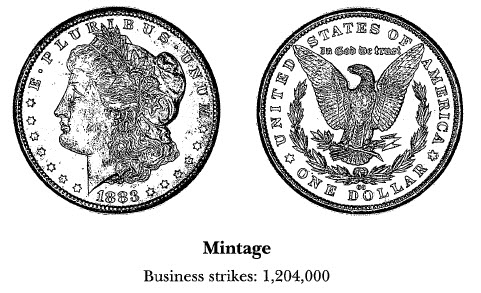
Coinage Context
Carson City busy: The Carson City Mint was busy this year, and before the calendar turned over to 1884, some 1,204,000 silver dollars had been struck, virtually all from metal obtained nearby in the Comstock Lode.
Numismatic Information
Hoard coins: For much of the present century, a vast reserve of 1883-CC dollars was stored in the Treasury Building in Washington, D.C. From this source, examples trickled out over a period of years, with a significant release occurring in 1938-1939. Many bags were given out at face value in the 1950s, when dealers such as Charles J. Dochkus sought to buy them, but demand was such that the market could only absorb limited quantities. At the time, the wholesale price for a $1,000 face value bag was apt to be about $1,200-not a source of windfall profits. Dealer Steve Ruddel stated that about 50 bags (50,000 coins) were released from the Treasury Building in 1955, and that at least that many were released of all other CC Mint Morgan dollars except
1879-CC, 1889-CC, and 1893-CC.! By the late 1950s, the Treasury stopped paying them out.
After the initial Treasury silver dollar releases of the early 1960s, which included very few 1883-CC dollars, a quantity amounting to 755,518 coins, or over 62% of the original mintage, was held back. These were subsequently marketed through the General Services Administration from 1972 to 1980. Of this quantity, 221,665 were offered at a discount becauseof tarnish and surface scratches; most of these would probably be graded MS-60 to 62 today, as would numerous pieces from the larger quantity.
Circulated grades: In worn grades the 1883-CC is fairly scarce, for relatively few were placed into circulation in the nineteenth century. However, enough were always available on the market that 1883-CC was never considered to be a rarity, even in the days before Treasury dispersals. Probably, 12,500 to 25,000 survive.
Mint State grades: As noted, 755,518 Mint State coins were sold from the Treasury hoard. In the 1950s and early 1960s additional coins, probably amounting to over 100,000, were paid out at face value. Today, the 1883-CC is very common in Mint State and is second only to 1884-CC in availability. Most are in grades from MS-60 to MS-63, but quite a few MS-64 and MS-65 coins exist as well. Most coins are quite well struck.
I estimate that 500,000 to 550,000 remain in MS-60 to 62 grades, 250,000 to 300,000 MS-63s, 110,000 to 125,000 MS-64s, and 35,000 to 45,000 MS-65 or better.
The 1883-CC is often compared to the 1884-CC, as both had the best part of a million coins held back by the Treasury in 1964. In terms of total Mint State population, the 1883-CC is the scarcer of the two, but at the MS-65 level the 1884-CC is scarcer than 1883-CC.
Prooflike coins: Prooflike 1883-CC dollars are relatively plentiful, although they become slightly scarcer when DMPL, and much scarcer in higher grades such as MS-65. Some cameo DMPL coins have a satiny aura around Miss Liberty's head, as described under 1882-CC. An 1883-CC dollar called a "Proof," ex Mid American Rare Coin Auctions' 1986 San Diego sale at $7,250, brought $4,620 as Auction '87:1856; rumored to be ex Amon Carter, Jr.; Wayne Miller did not consider the coin to be a Proof.
Probably, upward of 30,000 PL and only slightly fewer DMPL specimens remain. About 10% to 15% of each category exist in MS-65 or higher grade. In both PL and DMPL finishes the 1883-CC is one of the most plentiful of all Morgan dollars and is the most common from the Carson City Mint. Compare the "Proof' in the Chapmans' June 17-18, 1889 sale, at $4 when Uncirculateds brought only half that. The Chapmans claimed only two were known. On the other hand,the "Proofs" offered in USCe's "Collection of a Prominent American" (June 19-21, 1915) and advertised by B.M. Douglas (The Numis-matist, 12/51) were probably DMPLs.
Varieties
Business strikes:
1. Normal date: Breen-5574. Probably not all 10 pairs of dies were used. VAM-4, with repunched date, is remarkable for oblique entry: 18 very heavy, 83 progressively less heavy. Minute variety differences of 1883-CC have attracted little interest among specialists thus far.