Silver Dollars & Trade Dollars of the United States - A Complete Encyclopedia
Q. David Bowers
1879 Morgan Dollar
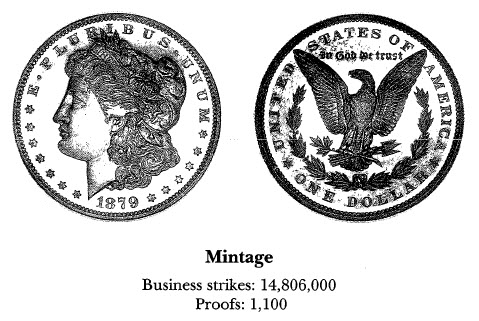
Coinage Context
Silver coins accumulate: Beginning after January 1, 1879, the Treasury paid out silver dollars, gold dollars, and paper dollars at par, legalizing a situation which had been de facto since December 17, 1878. Among countless other effects, for the first time in Mint history, numismatists could order Proof sets and pay for them in paper money at par. Huge numbers of silver coins minted in the 1860s and mid-1870s (many returned from Canada and Central America) piled up in Treasury vaults, thus accounting for the low production of dimes, quarters, and half dollars for the next few years (dimes through 1881 and quarters and half dollars through the late 1880s). Morgan dollars were produced in record numbers due to the mandate of the BlandAllison Act. They were neither needed nor wanted in commerce.
Numismatic Information
Hoard coins: As is the case with most other Philadelphia Mint coins in Mint State, the availability of specimens in early years is difficult to ascertain, as most collectors preferred Proofs, and Uncirculated coins, rare or not, were generally ignored. However, enough Mint State coins appeared on the market that it is evident that this issue has been common virtually from the year of mintage.
Bags came on the market in the late 1940s from storage at the Philadelphia Mint and possibly from Federal Reserve vaults. By 1950-1951 Mint State 1879 dollars were commonly available in quantity. In September 1950, dollar specialist W.E. Johnson offered rolls of 20 coins for $27.00, or $1.35 per coin. The 1879 remained plentiful during the decade of the1950s, and in the Middle Atlantic states was a common sight in banks. However, by the time that the 1962-1964 Treasury dispersal took place, most were gone.
Wayne Miller noted that this issue was extensively promoted on the coin market in the late 1970s and early 1980s by "a few wealthy investors .... One person has accumulated several bags of this date. In the author's opinion the 1884 is much less scarce than the 1879 in BU condition and slightly less scarce than the 1880, 1881, and 1882. This is another example of the ease in which a thin market like silver dollars can be manipulated."
Just one reverse type: All 1879 Philadelphia Mint dollars are of the Third Reverse type with slanting top arrow feather and convex breast on the eagle.
Circulated grades: In well-worn grades, 1879 dollars are very common. Millions. were released into circulation in the late nineteenth century. AU coins are also very plentiful. Presumably, vast quantities were melted not only during the implementation of the 1918 Pittman and 1942 Silver Purchase acts, but, especially, during the run-up of silver bullion prices in the 1970s.
Mint State grades: As might be expected, the 1879 is very common in lower Mint State grades such as MS-60 through MS-63. However, MS-64 coins are scarce, surprisingly so in view of the high mintage, MS-65 examples are relatively elusive. I estimate that at the MS-60 to 62 level, 100,000 to 200,000 remain; followed by 55,000 to 85,000 in MS-63; 20,000 to 30,000 MS-64; and just 2,500 to 4,000 MS-65 or finer.
While most Mint State 1879 dollars are well struck, many exist with flat breast feathers on the eagle (see expanded commentary below). Buyers are advised to look until a sharply struck piece is found, which should not present a problem. Certified coin holders do not take strike into consideration. Lower grade Mint State coins are apt to be heavily bagmarked, undoubtedly from decades of Treasury storage, moving, and counting.The 1879 Philadelphia Mint Morgan dollar was minted in larger quantities than any other dollar of its era. The Philadelphia Mint was concerned with spewing out as many silver dollars as possible, in the least amount of time with the least amount of effort, a philosophy which, in general, applied to the New Orleans Mint as well. To expedite this, little care was taken to space the dies precisely (often they were slightly too far apart), and dies were used for a long time in the presses. The result was the manufacture of quite. a few "sloppy" coiris, as evidenced by weakness of details in the hair over Miss Liberty's ear and light definition of the eagle's breast feathers. Cherrypicking and connoisseurship are advised, for technical grades such as MS-60, MS-61, etc., have nothing to do with sharpness of striking, and often bargain-priced coins turn out to be poor strikes.
Prooflike coins: Semi-prooflike coins abound.
Examples with fully prooflike fields are scarcer. When seen, prooflike coins are usually prooflike on the obverse only, with a frosty reverse. In 1977 a quantity of very high-quality cameo prooflikes (but with some variation in the depth of the mirror surfaces from coin to coin) came on the market through a dealer in San Francisco. These were quickly absorbed. Probably, 3,000 to 6,000 PLs exist today, 90% of which are below MS-65 PL. DMPL coins are somewhat scarcer, probably at the 2,000 to 4,000 population.level, Most are below MS-65.
DMPL coins are rare today.
Proofs: Information on the mintage of Proofs is contradictory. Traditionally, the figure of 1,100 is given. However, Walter H. Breen suggests in his Proof coins Encyclopedia that just 650 Proofs, net, were minted. Per his commentary, 250 were coined in thefirst quarter of the year and 500 in the second, for a total of 750, of which 100 unsold examples were melted in January 1880, leaving a net mintage of 650. According to the same writer, the oft-used figure of 1,100 represents the total mintage of 750 Proof dollars dated 1879 (without regard to the 100 .melted in January 1880) plus 450 leftover Proof dollars of 1878 on hand in January 1879.
There is a problem with the 650 figure. The number of surviving Proofs, as reflected in the, estimates delineatedin my introduction to the Morgan dollar section, suggests that if 1,100 were struck, 59% of this figure survive today. If the 650 figure is used, more than that number exist now. Thus, I believe that more than 650 were struck and distributed. Perhaps thefigureis fewer than 1,100, but it is probably not as low as 650.
Today, Proofs are not rare on the market. However, many have been cleaned, mostly long ago, and gems are elusive.
Varieties
Business strikes:
1. Normal dies: Breen-5526. 129 obverses, 86 reverses, probably all used. The VAM text lists 32 varieties with one to four date numerals repunched. VAM-12 has the 1 triple punched and the other nu-merals double punched. Some V AM varieties have reverse features doubled.
Proofs:
1. Regular issue: All may be from the same dies.
Most have nice cameo contrast between the devices and the fields.