Silver Dollars & Trade Dollars of the United States - A Complete Encyclopedia
Q. David Bowers
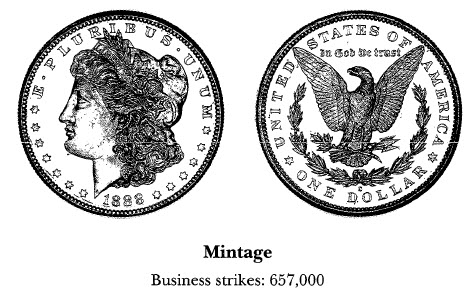
1888-S Morgan Dollar
Coinage Context
Production low: For reasons that are not clear, production of silver dollars remained low at the San Francisco Mint during this era. The greatest mintages occurred in Philadelphia and New Orleans.
Numismatic Information
Hoard coins: The market and hoard history of the 1888-S bears a close resemblance to its cousin, the 1887-S. On the numismatic market the 1888-S was considered to be quite scarce in Mint State, until bags were released in 1942 from storage in the San Francisco Mint. From then until the mid-1950s, quantities could be obtained for face value from that source. In 1956, bags were released in Montana. However, dealer and collector interest was limited, and investor interest was nil. Most that were paid out went to Nevada casinos or to banks, where they were put into circulation and quickly descended the grading ladder in AU or lower levels.
After the mid-1950s, the supply seems to have dried up, and the price of singles and rolls inched upward. So far as I know, the massive Treasury re-leases of 1962-1964 added few if any quantities to the supply of Mint State coins in numismatic and in-vestment circles, although this is contrary to conven-tional wisdom that many bags came out at that time.
The Redfield hoard, auctioned in 1976, is said to have had five to 10 bags, including thousands of prooflike coins. Today, the 1888-S is moderately scarce in quantity, although singles are easy enough to find.
Circulated grades: 1888-S dollars are somewhat scarce in worn grades. As is the case with so many different Morgan dollar varieties, the ready availabil-ity of Mint State coins has diminished the interest in circulated pieces. Probably, many were melted in the run-up of silver bullion prices in the 1970s.
Mint State grades: Mint State 1888-S dollars are scarce in comparison to certain earlier San Francisco Mint dollars of the decade, but on an absolute basis they are often encountered. Most specimens are in lower Mint State levels from MS-60 through 62, at which plateau an estimated 30,000 to 50,000 remain, above which are 10,000 to 18,000 MS-63 coins. MS-64 1888-S dollars are scarce, with an estimated population of 3,000 to 5,000. In the context of the series, it is not stretching things to call an MS- 65 rare, with perhaps 400 to 700 believed to survive.
The striking quality of 1888-S dollars is often un-satisfactory. Specimens are usually weakly struck at the centers. However, sharply struck coins also exist in large numbers. The lustre varies from satiny to frosty but is often the latter.
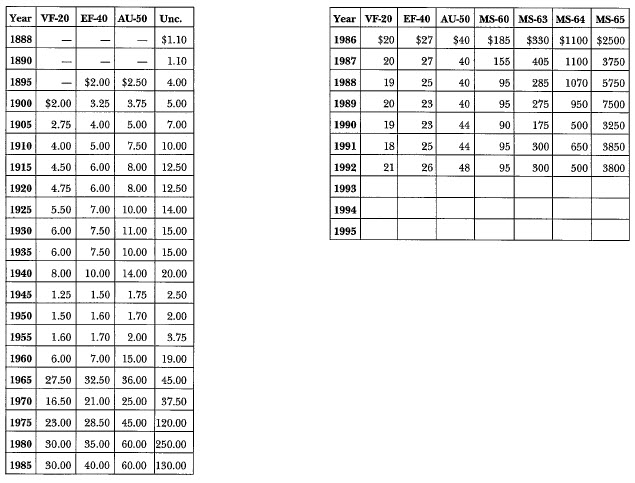
1888-S Morgan: Market Values