Silver Dollars & Trade Dollars of the United States - A Complete Encyclopedia
Q. David Bowers
1901-0 Morgan: Summary of Characteristics
Business Strikes:
Enabling legislation: Act of February 28, 1878, plus the Sherman Silver Purchase Act of July 14, 1890
Designer: George T. Morgan
Weight and composition: 412.5 grains; .900 silver, .100 copper
Melt-down (silver value) in year minted: $0.46093
Dies prepared: Obverse: Unknown; Reverse: 140 (per R.W. Julian).
Business strike mintage: 13,320,000; Delivery figures by month: January: 1,500,000; February: 620,000; March: 1,100,000; April: 1,550,000; May: 1,500,000; June: 1,100,000; July: 800,000; August: 200,000; September: 1,550,000; October: 1,000,000; November: 900,000; December: 1,500,000.
Estimated quantity melted: Probably millions under the 1918 Pittman Act and later private melts.
Approximate population MS-65 or better: 8,000 to 16,000 (URS-15)
Approximate population MS-64: 30,000 to 60,000 (URS-16)
Approximate population MS-63: 80,000 to 150,000 (URS-18)
Approximate population MS-60 to 62: 150,000 to 300,000 (URS-19)
Approximate population G-4 to AU-58: 1,000,000 to 2,000,000 (URS-22)
Availability of prooflike coins: Available, but often unsatisfactory in appearance. DMPL coins are about six or seven times rarer.
Characteristics of striking: Varies, but often weak. Known hoards of Mint State coins: Bags were released by the Treasury over a period of time, especially in 1953, and in very large quantity in 1962-1964.
Proofs:
None
Commentary
The 1901-O is common in Mint State, but well-struck high-grade coins are elusive. Largest dollar mintage from New Orleans.
Additional Information
Distribution of Dollars
The Annual Report of the Director of the Mint 1901, told of the distribution of dollars during the fiscal year: New Orleans:
In the mint July 1,1900,21,197,000; coinage, fiscal year 1901, 10,910,000; total, 32,107,000; transferred from mints to Treasury, 15,500,000; in mint July 1, 1901, 15,823,500; total, 31,323,500; distributed from mint, 783,500.
1901-S Morgan Dollar
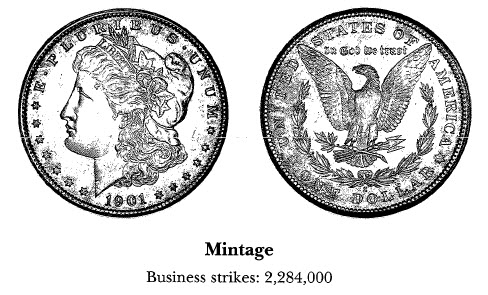
Numismatic Information
Hoard coins: 1901-S dollars were paid out by the San Francisco Mint over a long period of years, beginning at least by 1925. In addition, bags of this issue were stored in the Treasury Building in Wash-ington, D.C. and were released from time to time, as early as the 1930s. Quantities remained in dealers' hands as recently as the 1950s. In later years, the 1901-S became harder to find. Quantities released in 1962-1964 were probably small.
John B. Love noted in The Comprehensive U.S. Silver Dollar Encyclopedia that two bags of these were found in Idaho in the early 1960s and were bought by Bill Holdman in Great Falls, Montana.
Circulated grades: Worn coins are scarce but available.
Mint State grades: The striking and appearance varies. Those from the old C-3 reverse dies are often poorly struck with inadequate lustre. Those from C-4 reverse dies are usually very lustrous with good central features (but keep in mind that breast feathers on C-4 are not well defined).
Most Uncirculated coins are in the MS-60 to 62 range, at which level an estimated 15,000 to 25,000 survive, followed by 6,000 to 10,000 in MS-63, 3,000 to 6,000 MS-64s, and only 500 to 1,000 that grade MS-65 or better.
Some coins have parallel die striae caused by the drawing bench process during planchet preparation. These are often flatly struck at the centers as well. Avoid these, unless you want a curiosity.
The 1901-S Morgan silver dollar has always been a favorite with collectors, possibly because lower denomination 1901-S silver coins are scarce to rare (the 1901-S Barber quarter is a major rarity).
Prooflike coins: With PL finish the 1901-S is very rare and is one of the most difficult Morgans to locate in this state. Possibly, two or three hundred exist. Most have poor contrast, are abraded, and are unappealing. Some DMPL coins exist from the C-3 reverse and are very rare. Certification service numbers as of September 1992: PL = 22. DMPL = 2. Most are in lower grades. Remember, NGC and PCGS data represent only a tiny fraction of the total population.
Varieties
OLD REVERSE HUB: NARROW WING/NECK SPACE, SMALL STARS VAM C-3 REVERSE
Business strikes:
1. Breen-5685, VAM-1, 3. Common in Mint State.
The 25 pairs of dies included both old and new hub reverses; clearly most were not used.
NEW OVER OLD HUB: DOUBLE OLIVE AT CLAW
VAM C-4 OVER C-3 REVERSE
Business strikes:
1. C-4 reverse hub over C-3: Breen-5687, VAM 5-9.Relatively unknown a decade ago, now this general type is recognized as having been made in several die varieties. Now common in Mint State.
NEW REVERSE HUB: WIDE NECK/WING
SPACE, LARGE STARS
VAM C-4 REVERSE
Business strikes:
1. Breen-5686, VAM 2-4, positional varieties. Common in Mint State.