Silver Dollars & Trade Dollars of the United States - A Complete Encyclopedia
Q. David Bowers
"Disbursements for deposits have been largely made in cash, which has been provided at a cost to the Treasury of $3 per $1,000, for transfer of coin from San Francisco.
"[TABLE] Business of the Mint at Carson During the Year Ended October 1, 1887. Gold deposited and parted, $8,407.782; silver purchased, $42,496.29; Silver parted (and purchased) $1,520.34; and silver deposited, $34,983.06.
"From the above statement it is obvious that the convenience at present afforded by this mint to a few local depositors is, on the basis of the operations of the mint at Carson for the past twelve months, at a cost to the mint as high as 18% of the value of the deposits. Esteemed as the convenience is, it is of comparatively little importance to the regular producer, whose general business is conducted at San Francisco, where a market is found at current rates for silver partings, independent of only occasional requirements of the mint at the city.
"The facts above, stated in as brief a manner as warranted by the importance of the subject, tend to prove that the mint at Carson, although, at the time of its establishment at least, not far from the most important mining center in the Republic, has never since proved to be a bullion center like San Francisco or New York, either in the commercial or technical sense of that term. Coinage operations at that mint, begun in 1870, have been since attended with but little further advantage to the citizens of Nevada than what has sprung from the increase of local business incidental to its operations, and from the employment offered to labor.
"The producer of bullion in Nevada, for whose supposed benefit this institution was established, has as a rule found it for his own interest to deposit his bullion at San Francisco rather than at home. The mint service, which was also presumed to be benefited by the establishment of this mint, has gained nothing from its operations, all of which could have been, as still they can be, conducted to greater advantage at other mints.
"While the cost of coinage is some five times that of the same kind at other mints, so as to have been found prohibitory, the net cost to the mint of alone receiving and parting deposits of bullion under the same provisions of law and regulation as in the case of all other mints and the assay office at New York, has proved not less than 18% of the spot value of the deposits, a cost, as held by this Bureau, also prohibitory.
"Under the circumstance that Congress made its usual annual appropriations for the support of the mint at Carson for the present year, after the Committee on Appropriations of the House of Representatives had advisedly omitted to report any, except for the care of building and machinery, the authority of Congress was virtually given for the continued operation of that mint during the present year. The Bureau therefore has found no reason to seek other authority, if such there be, for suspending operations, so clearly proved to be against common expediency, public interests, and ordinary principles of administration.
"No recommendation to Congress has been practicable by way of operations at the mint at Carson.
"Under the circumstances above set forth, the same at present as in the past, and as likely to be in the future, it becomes my duty to recommend for the good of the mint service that the mint at Carson be finally closed, that its machinery and other equipment be distributed among the several mints and assay offices, and that the building be applied to some other public purpose."
Additional Carson City Note (1887)
The Annual Report of the Director of the Mint, 1887, stated that during the fiscal year ended June 30, 1887, 25,000 silver dollars were transferred from San Francisco back to the United States Mint at Carson City. Apparently, at the end of the fiscal year, June 30, 1887, some 9,821 dollars were on hand in the Carson City Mint, and 15,179 had been distributed.
1885-O Morgan Dollar
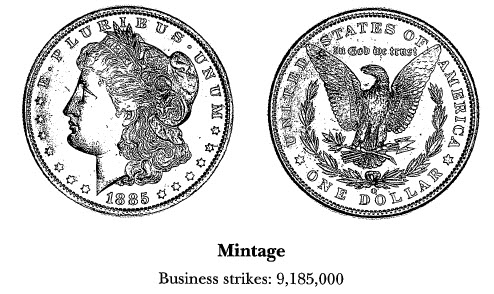
Coinage Context
Nothing but dollars: The New Orleans Mint produced silver dollars exclusively during the 1885 year.
Numismatic Information
Hoard coins: Following the closing of the New Orleans Mint, quantities of 1885O dollars were shipped to the Treasury Building in Washington, D.C. and the Philadelphia Mint for long-term storage. From the Washington vault, 1885-O dollars were paid out beginning by the early 1930s, and in multiple-bag quantities in 1938, 1953, 1954, and 1957. In October 1962, continuing into early 1963, vast quantities, probably amounting to millions of coins, were released from storage at the Philadelphia Mint.
The 1883-O, 1884-O, and 1885-O constitute the bulk of approximately 10 million coins released from a long-sealed vault in the Philadelphia Mint, beginning in October 1962 and continuing through much of 1963. My estimate is that the breakdown of these three dates is about as follows: 1883-O: 1.5 to 2.5 million coins; 1884-O: 2.5 to four million coins; and 1885-O: two to 3.5 million coins. These are, of course, in addition to bags released before 1962. While many went into the hands of investors, hoarders, and collectors, others-possibly amounting to millions of pieces totally-went into circulation.
Many of these were melted in the 1970s during the run-up in silver bullion prices.
Many Uncirculated 1885-O dollars were in the Continental-Illinois Bank hoard.
Circulated grades: The 1885-O dollar is very common in Worn grades and attracts scant numismatic notice, due to the easy availability of Mint State coins.
Mint State grades: The 1885-O is the most common of all New Orleans Mint silver dollars in Uncirculated grade and among certified coins from this mint is the most common issue at levels from MS-63 through MS-65. It is believed that 2.5 to 3.5 million exist at the MS-60 to 62 level, a staggering quantity. In MS-63 grade, the estimated population is 800,000 to 1,300,000, followed by 400,000 to 600,000 in MS-64, and 100,000 to 175,000 MS-65 or better coins.
The strike of 1885-O dollars is average. Examples are seen weakly defined at the centers, while others are sharply struck. Certain flatly-struck coins have what Wayne Miller called a "belly button" or a recessed or dimpled area in the lowest portion of the eagle's breast, due to metal not filling the deepest portion of the die. Cherrypicking is easy to do for this issue and is advised.