Silver Dollars & Trade Dollars of the United States - A Complete Encyclopedia
Q. David Bowers
1881-S Morgan Dollar
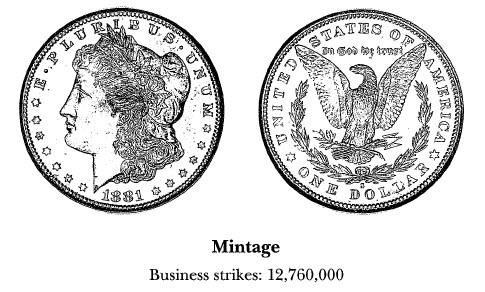
Coinage Context
Busy times at the mint: In 1881 the San Francisco Mint was busier turning out silver dollars than during any other time in the early (1878-1904) era of Morgan dollar production.
Numismatic Information
Hoard coins: It is believed that as of June 30, 1913, most of the original mintage of 1881-S was stored at the San Francisco Mint, to be paid out over a period of decades thereafter. In 1938, many bags were released. During the 1950s, additional large quantities were paid out from storage in the minting facility.
Enough remained in government hands that many more millions of 1881-S dollars were released by the Treasury Department in the early 1960s, especially in 1963. In The Forecaster, September 15, 1971, John Kamin gave his opinion that about 50% of theoriginal mintage of 1881-S was released circa 1962-1964, a figure equivalent to over six million coins.
Many thousands of 1881-S dollars were squirreled away by LaVere Redfield, of Reno, Nevada, whose estate, sold to A-Mark Coin Co. by a 1976 court auction, is said to have had more 1881-S dollars than coins of any other date. Large quantities also went into the vaults of the Continental-Illinois Bank, to be discovered by Chicago dealer Ed Milas, who was in the right place at the right time when the financial institution ran into trouble and had to liquidate its 1.5 million silver dollars, many of which were of the 1881-S issue.
According to John J. Ford, Jr., Philadelphia dealer Harry J. Forman brought to New Netherlands Coin Co. 126 bags (126,000 coins) of this date alone among many others in the early 1960s. Many coins were prooflike gems and many were DMPL. Gohn J. Ford, Jr., in an interview on May 12, 1992, recalled that he handled 140 bags totally of 1881-S dollars).
Circulated grades: Circulated specimens of the 1881-S are fairly elusive, especially in comparison to the large mintage, but usually are ignored by numismatists, due to the proliferation of Mint State coins.
Mint State grades: The 1881-S dollar is the most common of all Morgan dollars of the early (1878-1904) years in Mint State grades. At the MS-60 to 62 level, an estimated 2.5 million to four million exist! In MS-63 grade the 1881-S is also plenteous: 900,000 to 1.4 million may remain today. MS-64 grade comprises 400,000 to 600,000 pieces, still a generous number. In MS-65 or finer grade, 150,000 to 250,000 survive.
Minted in larger numbers than any other San Francisco Mint dollar except the later 1921-S, the 1881-S dollar is the most publicized Morgan issue. During the investment boom of the late 1980s, 1881-S dollar in May 1986 crossed the $800 level in MS-65 grade, later plummeting by 1991 to below $100. (By May 1989, the time representing a price peak for numerous other U.S. coin issues, the 1881-S in MS-65 was still worth a generous $550 or so.) Such gyrations attracted the attention of many who considered it to be a bellwether of the entire coin market (a status which any serious collector would dispute, but which any gullible investor might readily believe).
Nearly all 1881-S dollars are well struck and of attractive appearance. Cherrypicking is not needed when buying this issue. As 1881-S dollars are relatively inexpensive, a specimen makes an ideal introduction to the Morgan dollar series, or an 1881-S can be an excellent coin for a type set. Market takeoff and nosedive considerations excepted, a high grade 1881-S dollar is delightful to own.
Prooflike coins: Prooflike coins, including DMPL specimens, are plentiful on the market. The Redfield hoard is said to have had thousands of DMPL coins. Typically, the contrast is not great between the fields and the devices. Some prooflike coins are prooflike on the reverse only, with good contrast between the mirror field and the eagle and other devices.
In PL, the 1881-S gives the 1880-S a good run for its money and is just slightly less common, per certification service data. Perhaps 80,000 to 90,000 or so exist, although I have seen so many PL coins over the years that I wouldn't want to bet that the population is over the 100,000 mark. In DMPL about one fifth as many 1881-S dollars remain as do PLs. High grade (MS-65 or finer) PL and DMPL pieces are plentiful and constitute about 10% to 20% of the respective populations. DMPL dollars with high-contrast cameo surfaces are in the scarce category. The "Proofs" advertised by William Pukall, B.M. Douglas, and Harry Budd (respectively The Numismatist 2/47, 12/51,8/53) were almost certainly DMPLs.
Varieties
Business strikes:
1. Normal date: Breen-5561. Many varieties with minor traces of repunching on date and/or S. Probably not all 85 pairs of dies were used. V AM lists 51 die combination varieties.
Note: A variety described as 1881-S 8/7 has been catalogued as Breen-5562, which may be the same as VAM-8A and possibly VAM-9. Described by Breen as having the second 8 in date possibly over previous 7, who noted that earliest states, with clearest traces of 7 in 8, and/or 9 within final 1, are rarest. So far as I know, it has not been confirmed by others. I have never seen one, nor have Bill Fivaz or Leroy C. Van Allen.' The latter suggests this: "I know of no variety collector who recognizes this overdate. Probably just die chips within 8."