Silver Dollars & Trade Dollars of the United States - A Complete Encyclopedia
Q. David Bowers
Varieties
Business strikes:
1. Medium oval O: Breen-5527, various VAM varieties. Minority of this date. Many "sliders" and bagmarked Uncirculateds exist.
2. Tall O: Breen-5529. Various VAM varieties.
Sliders are' common as above, gems scarce, prooflikes less so but often heavily bagmarked, DMPLs more so and are mostly mediocre.
3. 1879-O Triple punched O: Breen-5528, VAM-4, Fivaz & Stanton $1.00-002, To quote Fivaz and Stanton: "The original description of this variety read that the O mintmark was first punched into the die in a horizontal position. It was corrected; the remnants of the previous 0 are clearly seen in the center of the mintmark .... Many specialists feel this is actually an O/O/O north and south, because of the convex configuration of the weaker images within the main "O." However, Jeff Oxman, of the Society of Silver Dollar Collectors, takes this view:' "The preponderance of opinion on this variety remains that it is an '0 over horizontal 0' variety. True, it is the only such case in the Morgan dollar series, but that is not a compelling reason for rejecting the hypothesis. It is scarce in all circulated grades, and fewer than a dozen Mint State coins have been identified."
Usually found EF or AU, and relatively scarce as such. Rare in Mint State.
Proofs:
1. Proof issue:
12 Proofs are said to have been struck February 20, 1879 to observe the reopening of the New Orleans Mint.
1879-0 Morgan: Market Values
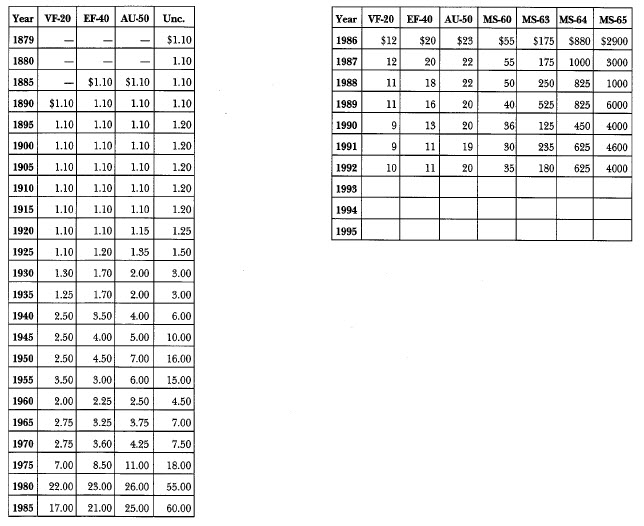
1879-O Morgan: Summary of Characteristics
Business Strikes:
Enabling legislation: As earlier, plus Act of February 28, 1878
Designer: George T. Morgan
Weight and compositions 412.5 grains; .900 silver, .100 copper
Melt-down (silver value) in Sear minted: $0.86928 Dies prepared: Obverse: Unknown; Reverse: Unknown.
Business strike mintage; 2,887,000
Estimated quantity melted: Unknown
Approximate population MS-65 or better: 350 to 500 (URS-10)
Approximate population MS-64: 4,000 to 8,000 (URS-14)
Approximate population MS-63: 20,000 to 30,000 (URS-16)
Approximate population MS-60 to 62: 40,000 to 70,000 (URS-17)
Approximate population G-4 to AU-58: 250,000 to 500,000 (URS-20)
Availability of prooflike coins: Many exist, a good number of which have cameo contrast. Most are in lower grade levels, however, and are extensively bagmarked. DMPL. coins are about three times rarer.
Characteristics of striking: Most are average to above average.
Known hoards of Mint State coins: Many bags were released by the Treasury beginning in October 1962.
Proofs:
12 said to have been struck on February 20, 1879 to observe the reopening for coinage of the New Orleans Mint. Fewer than six have been traced today.
Commentary
This is the first New Orleans Mint Morgan dollar and the first coin of the denomination to be struck at that location since the 1860-O LibertySeated issue. The two sizes of Omintmark were advertised as early as 1955 by Norman Schultz (The Numismatist 11/55). They were unknown to A.G. Heaton (1893) but their actual discoverer is unknown-possibly Howard Newcomb, like other mintmark size changes of later years.
Additional Information
Reopening the New Orleans Mint
In the Annual Report of the Director of the Mint, 1878, it was stated that in the preceding session of Congress provision was made to reopen the New Orleans Mint, but no money was to be expended until the City of New Orleans "should release all title and claim and all conditions of forfeiture to the lands or premises upon which the Mint is located." Further:
"During the late war much of the machinery, apparatus, &c., had been injured and otherwise rendered ineffective from disuse and other causes incident to war, and extensive repairs besides additional machinery were required. As soon as the title to the property had been secured to the government, and the officers of the mint had been appointed, the necessary repairs were commenced, but they have been impeded to a considerable extent by the prevalence of yellow fever in New Orleans, which not only delayed the repairs but prevented skilled mint operatives from going to that city until the epidemic should subside. As many mint operations require special skill and knowledge on the part of the operatives, a few of the appointees to that mint were assigned to duty at the mint in Philadelphia in order to familiarize themselves with the work which they will be called upon to perform, and will be transferred to New Orleans as soon as it is safe for them to go there.
"The various operative rooms in the mint have been placed in good condition, the melting ami annealing furnaces restored, the engine and machinery repaired, and such additional machinery as is required to tender this mint effective for coinage has been procured, and it is believed that by the end of the current calendar year everything pertaining to the mint will be in a condition to commence coinage. The New Orleans Mint will add to the coining capacity of the mints about $1 million in silver dollars per month, but this capacity would be somewhat reduced if called upon to execute any considerable amount of gold or fractional silver' coinage."
However, conditions were not such that New Orleans could begin coinage in 1878. As the director of the Mint noted, hopes were high that operations could commence "by the end of the current calendar year." As it turned out, no New Orleans mintage of any denomination took place until 1879.
1879 Report on the New Orleans Mint
The Annual Report of the Director of the Mint 1879, told of events at New Orleans during the fiscal year ended June 30th:
''Mint at New Orleans.-At the second session of the Fortyfifth Gongress provision was made for reopening this mint for coining purposes. The refitting and furnishing of the machinery was delayed by the yellow fever epidemic, but as soon as it was safe to do so experienced mechanics and others from the mintswere sent to superintend the repairing of old and erection of new machinery, which had been procured. The superintendency was assumed by Henry S. Foote in December 1878, and coinage operations commenced February 20, 1879.
"The mint has not been worked to its full capacity, for the reason that like difficulty has been experienced as at San Francisco and Garson in procuring supplies of silver bullion."