Silver Dollars & Trade Dollars of the United States - A Complete Encyclopedia
Q. David Bowers
1903-0 Morgan Dollar
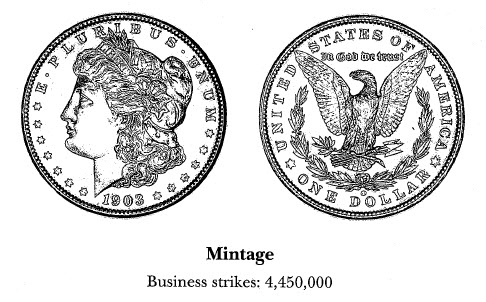
Coinage Context
Mintage not needed: In 1903 at the New Orleans Mint, 4.45 million business strike silver dollars were minted. Not needed in circulation at the time, most of the coins were stored in vaults. Apparently, only a few were released. Later, probably during the implementation of the 1918 Pittman Act, millions were melted. In 1929, those remaining at the New Orleans Mint were shipped to storage in a sealed vault in the Philadelphia Mint, where they remained until October 1962.
Numismatic Information
King of the Morgan dollars: Until October 1962 the 1903-O was the most important, most acclaimed, rarest issue in Mint State in the entire Morgan dollar series. Outranking the 1893-S, 1895, and other contenders, the Mint State 1903-O was so rare that it was estimated that fewer than 10 specimens were known to exist in numismatic circles. Indeed, the rarity of the 1903-O in this grade was legendary. Few collectors or dealers had ever seen one, let alone had the opportunity to own one! A few scattered advertisers claimed to have Mint State 1903-O dollars, but these listings were probably window dressing, representing what they might charge if they had coins available, or they may have been AU "sliders." In the then current Guide Book of U.S.Coins in 1962 an Uncirculated 1903-O catalogued at $1,500.00-the highest price of any Morgan dollar. Yeoman's theory was that most had been melted under the Pittman Act.
This changed in October 1962, when to the great amazement of the numismatic fraternity, a number of bags of Mint State 1903-O dollars came to light, setting off the numismatic equivalent of the California Gold Rush! It is said that the small town of Alma, Michigan was the site of some of the first 1903-O dollar discoveries. The race was on, and the silver dollar market would never be the same again.
The news spread that the 1903-O and other New Orleans silver dollars had been shipped to the Philadelphia Mint in 1929, and had remained in a joint-sealed vault since that time. A generation of distinguished Philadelphia numismatists came and went, without knowledge of their existence in their very backyard! Additional coins came out from hiding in the Treasury Building in Washington, D.C., where, for some unexplained reason, they had not been noticed by coin-wise employees earlier.
Hoard coins: Dozens of bags of 1903-O dollars were released in 1962-1964. Exactly how many coins were involved is not known, and guesses have ranged from 60,000 or so to over 1,000,000. Wayne Miller's estimate is 60,000 to 100,000. Probably, the truth lies somewhere between 60,000 and several hundred thousand. I suggest 200,000 to 350,000. As the 1903-O is rare in worn grades, probably most of the 4.45 million coins originally minted were melted under the Pittman Act.
Reminiscing in The Comprehensive Silver Dollar Encyclopedia, Dean Tavenner said that in Helena, Montana a banker had 1903-O dollars available in quantity by February 1963. The least Dean Tavenner remembers paying for an Uncirculated piece was $7 each, probably in the summer of 1963. He recalled that by November 1975 he sold five rolls for a banker from Dillon, Montana for $2,100-which amounted to $21 per coin.
Writing in an advertisement in The Numismatist in January 1964, Steve Ruddel told of an unspecified Kansas City dealer who "panicked ... when he got a bag of '03-0s. He soon flooded his local market and got $3 or $4 each. At the same time I had a standing offer of $15,000 a bag and couldn't buy any."
I was first told about the release of 1903-O (and 1898-O and 1904-O) dollars by Harry J. Forman, who telephoned dealers and collectors around the country to alert them to the situation and also to warn them against deception. It seems that a few clever insiders obtained coins of these three formerly-rare dates, and hurried to dealers' stores to sell them for cash-at prices based upon the old catalogue listings. One such insider flew to London, where he endeavored to steal a march on B.A. Seaby, Ltd., A.H. Baldwin, and Spink & Son, Ltd., the three leading British rare coin dealers at the time.
After the news broke, I was offered a few bags for $17,000 each in late 1962 or early 1963 by a Detroit source, but I declined, as I was fearful that about four million more coins would be coming out of the Treasury; I was wrong on the four million, but time would have vindicated a purchase at $17,000 per bag.
all ranges, but most 1903-Odollars that I remember seeing in the 1950s were in lower conditions, such as VG and Fine.
Interestingly, earlier sales of worn 1903-O dollars caused a lot of problems after October 1962, when Uncirculated pieces became so common. A number of collectors complained to the officers of the Professional Numismatists Guild about members who had obtained several hundred dollars each for circulated coins earlier in the year. These collectors felt sure that these dealers had some sort of advance warning about the impending release. However, no one did-and dealers were just as surprised as anyone else.
Mint State grades: Mint State 1903-O dollars are plentiful. Around 200,000, or even more, are believed to exist. Most are in lower ranges from MS-60 to 63, with an occasional MS-64. MS-65 coins are somewhat more elusive but are readily available. My population estimates are as follows: MS-60 to 62, 120,000 to 240,000 coins; MS-63, 40,000 to 80,000; MS-64, 20,000 to 40,000; and MS-65 or better, 10,000 to 20,000.
The majority of surviving 1903-O Morgan dollars have attractive frosty lustre. Bagmarks are relatively few, as the coins were not moved around much from the time of striking to the time of distribution. The striking varies from flat to sharp, with the average coin being somewhere in between. Sharply struck MS-65 coins are very desirable.
Prooflike coins: Prooflike 1903-O dollars constituted a tiny majority of the Treasury release of this New Orleans issue. Probably, somewhere between 1,000 and 2,000 exist. The contrast is low, and be-cause of this the demand has been small. DMPL coins are two to three times scarcer than PLs. Most grade below MS-65.
Varieties
NEW REVERSE HUB: WIDE NECK/WING
SPACE, LARGE STARS VAM REVERSE C-4
Business strikes:
1. Breen-5696. Varieties are not notable: open 9, VAM 1-2; closed 9, VAM-3; other differences, including tilted mintmarks and slight repunching of numerals.