Silver Dollars & Trade Dollars of the United States - A Complete Encyclopedia
Q. David Bowers
1878 7 Tail Feathers Morgan Dollar
Coinage Context
The final design: The 1878 7 tail feathers dollar represents the final design of the year, but it was produced with variations as described below.
Numismatic Information
Description of reverses: The 1878 7 tail feathers issue was struck in two major reverse variations:
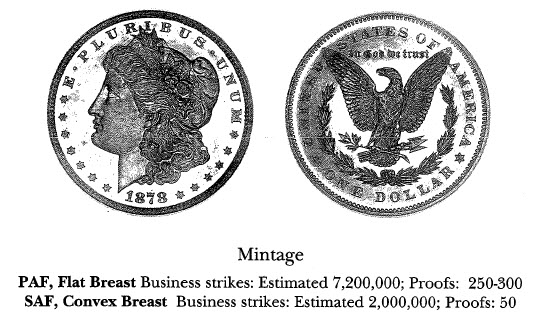
The first is the Second Reverse, with 7 tail feathers, with parallel top arrow feather (P AF), and concave breast on the eagle. This is often referred as the Reverse of 1878. Striking time not known. Walter H. Breen estimated the production quantity at 4.9 million coins, while Wayne Miller suggested seven million as a more likely figure. My estimate is 7.2 million (based upon proportionate population reports and observed pieces).
The other 7 tail feathers issue is the Third Reverse, with slanting top arrow feather (SAF) and convex breast to the eagle. This is the Reverse of 1879. Walter H. Breen estimated the production quantity at 4.3 million coins; Wayne Miller suggested two million. My estimate is also two million (based upon proportionate population reports and observed pieces)
Walter H. Breen in his Encyclopedia gives estimated striking times for the various 1878 dollar issues, but this presupposes a first-in, first-out use of dies relative to their preparation times, a situation which may not be the case.
Morgan's 1877 pattern half dollars, and his pattern silver dollars of early 1878, all had seven tail feathers. Thus, this was the standard number, not a change from eight tail feathers. The 1878 8 TF was a variant.
Numismatic status: As of 1992, there is not a widespread interest in collecting 1878 7 tail feathers Morgan dollars by reverse varieties, although there is no reason why there shouldn't be. At present, many dealers do not differentiate the varieties when offering 1878 7 tail feathers dollars for sale, although the leading certification services identify them. I believe that when the new 3rd edition of the Van Allen-Mallis work (released in September 1992), achieves widespread distribution, interest in varieties of 1878 dollars will increase dramatically.
Hoard coins (of both reverse varieties): The 7 TF coins were not divided into Second and Third Reverse types until relatively recently. Thus, in numismatic literature there is no record of when one reverse or the other was released in quantity. It is known that the 7 TF dollar in general was distributed by the Treasury Department over a long period of time, from the year of striking onward. It has always been considered common. A group of bags came out of the Treasury in 1953, and for a while they were especially plentiful in dealers hands. Additional quantities of bags were paid out during the 1962-1964 Treasury release, especially during 1963, but no account was kept of them. In comparison to certain other issues, the quantities that came out in the early 1960s was small. Today, mint-sealed bags may not survive or are very rare.
SECOND REVERSE, REVERSE OF 1878, PAF:
Circulated grades (Second Reverse): This issue is very common in all circulated grades.
Mint State grades (Second Reverse): Most Mint State 1878 7 TF dollars are of the Second Reverse variety. Specimens are plentiful up to and including MS-64. Coins at the MS-65 level are elusive. My estimates are as fol1ows: MS-60 to 62,50,000 to 100,000; MS-63, 45,000 to 90,000; MS-64, 15,000 to 30,000; and MS-65 or higher, only 1,000 to 2,000.
Wayne Miller wrote this in 1982:
The 1878 7 tail feather flat breast [Second Reverse] dollar is usually adequately struck. However, because the breast of the eagle, by design, is flat and concave, the reverse may appear at first glance to be poorly struck. The typical specimen has poor lustre, but some pieces exhibit superb frosty surfaces, especially on the reverse. Bagmarks are much more prominent than usual and are the primary deterrent in locating a gem. This date is usually underrated In gem condition.
Miller went, on to say that this variety is not rare in prooflike condition, but that prooflike pieces are not particularly attractive, usually have heavy bagmarks, and relatively low contrast. However, "a very-few brilliant prooflike specimens exhibit superior lustre, with a spectacularly frosted eagle, and command runaway price if minimally bagmarked."
Prooflike coins (Second Reverse): coins are sometimes prooflike on one side only. Gems are sometimes-seen and are rare. I estimate that 5,000 to 10,000 or so PL coins survive, of which (percertification service data) about 5% are MS-65 PL or higher DMPL coins are about twice as rare as PLs, and justa tiny number, perhaps 2% to 3%, are MS-65 OMPL or higher.
Proofs (Second Reverse): 200 Proofs were struck on March 26, 1878, according to conventional wisdom. 100 pieces may have been VAM-131 7 TF, and 100 ofVAM·lO (8 TF), or all could have been 7 TF.
However, the number of extant specimens is sufficiently high that I believe the mintage was at least 250 to 300, which means that the March 26 delivery would not have sufficed. Mint issue price was $1.50 each. Many unsold pieces are believed to have been melted. G.W. Rice had seen none; compare his June 1898 Numismatist article quoted at 1878 8 TF. Examples today are very elusive.