Silver Dollars & Trade Dollars of the United States - A Complete Encyclopedia
Q. David Bowers
1889 Morgan Dollar
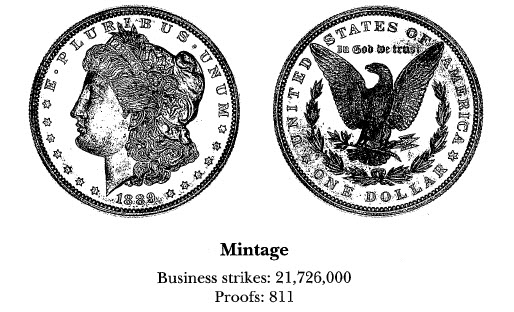
Coinage Context
Production continues apace: In 1889, most silver coinage was limited to dollars, the exception being nearly a million dimes struck at the San Francisco Mint. The Philadelphia, Carson City, New Orleans, and San Francisco facilities turned out over 33.5 million Morgan dollars.
The total of 21,726,000 business strikes places the 1889 as the highest-mintage Morgan dollar of the 1878-1921 era. However, millions were probably melted under the Pittman Act of 1918 (and/or also the 1942 Silver Act), with the result that the 1889 is not the commonest Morgan dollar of the earlier series today ..
Numismatic Information
Hoard coins: The story of the 1889 dollar echoes that of 1888 and certain other Philadelphia Mint is-sues of the 1880s. Many were placed into circulation in or near the time of mintage, after which quantities were relegated to storage. It is likely that millions were melted under the 1918 Pittman Act. Occasional mint-sealed bags were paid out over a period of years-not enough that Mint State coins became common, but a sufficient quantity that 1889- dated dollars never became expensive either. Part of the-reason for this is that Proofs were readily available to satisfy the no more than, say, several hundred specialists who in the 1920s and 1930s were building high-grade Morgan dollar collections.
A few bags were released in the postwar market of the late 1940s, but enough to depress the price. By about 1950, $5.00 was a standard value for an Uncirculated coin. Beginning about December 1954, large numbers of bags containing millions of coins were dispersed through banks, mainly in the East. Collectors, dealers, and what few investors there were, looked at the gargantuan mintage figure and ignored the coins. As a result, most ended up in mixed bags of dollars, where they were among the most common dates. Additional quantities continued to be paid out for a long time, including during the 1962-1964 Treasury releases.
Circulated grades: The 1889 dollar is very common in all circulated grades.
Mint State grades: The 1889 is very common in Mint State. Most are in grades MS-60 to MS-62, at which plateau it is believed that 400,000 to 800,000 exist. Tens of thousands survive at the MS-64 level. In the MS-65 or better category, the population drops sharply, and in the context of the series the 1889 is elusive-about 5,000 to 10,000 survive.
Most 1889 dollars are weakly struck at the centers. Most coins have poor lustre, often with "metal flow" ridges in the fields near the borders. Other coins are frosty with nice lustre.
Prooflike coins: Semi-prooflike coins are scarce, and DMPL coins are even scarcer. By the "old DMPL standards" coins in this category were major rarities; as of 1982, Wayne Miller never saw a superb one. Under today's looser interpretations, many hundreds of DMPL specimens exist, of which 124 were certified by NGC and PCGS as of September 1992.
Die rotation: VAM-1 exists with the reverse die rotated 20° counterclockwise from the normal orientation. Mint State coins are known.
Proofs: The situation of flatly struck Proof coins begun in 1888-coins with lightness of strike above Miss Liberty's ear on the obverse and on the eagle's breast feathers on the reverse-was continued. How-ever, the problem in 1889 does not seem to be as bad as with the year before. The Guide Book lists a Proof mintage of 811 pieces; Walter H. Breen's Encyclopedia gives 711 as the figure.
Varieties
Business strikes:
1. Normal date: Breen-5605. Many positional va-rieties, including these: Even 9, many varieties, some with partly repunched dates; High 9, VAM-7, 8, 9, 11. Even if all 57 obverses and 50 reverses were used, average die life exceeded 380,000 per obverse: so high that one suspects a typographical error may have occurred in the Mint records.
2. Doubled date: Jack Beymer showed Walter H. Breen one with a doubled date, plainest on 1 and 9.
3. Doubled Die obverse: Four doubled die obverses are known, VAM-16, 18,20,21. All have similar doubling at the back edge of Miss Liberty's ear; the last two discovered by Jeff Oxman.
Proofs:
1. Normal issue: Proofs (fitting the description of VAM-1, closed 9) have date slanting up to right; heavy die polish at eye and initial M.