Silver Dollars & Trade Dollars of the United States - A Complete Encyclopedia
Q. David Bowers
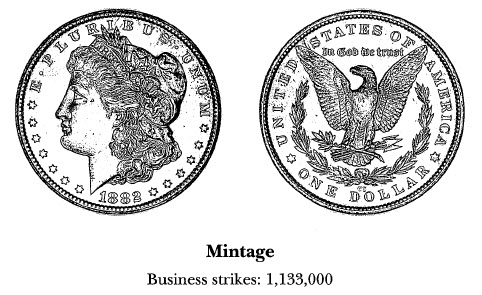
1882-CC Morgan Dollar
Coinage Context
Mint busy: In the silver dollar department the Carson City Mint was busy in 1882, and 1,133,000 spewed forth from the presses by year's end, the highest production since 1878. But larger mintages were to come in 1883-1884.
Numismatic Information
Hoard coins: The Cash Room in the Treasury Building in Washington had a huge quantity of 1882-CC dollars. These were released sparingly over a period of time. In the early 1930s, dealer John Zug acquired specimens at face value and offered them for sale at $2 each. In 1938, larger quantities became available at face value. In 1938-1939, Harry X Boosel bought pieces from the Cash Room for $1 each and sold them for $2.25, the extra 2M being for postage.
A recitation of selected earlier prices, taken from the historical prices given earlier in the present text, indicates at once the scarcity of 1882-CC in the early days, and the erratic, inconsistent nature of the pricing structure: 1911 Fine $2.10; 1912 Unc. $8.90; 1914 AU $7.25; 1915 EF $1.25; 1915, another sale, VG $6.00; 1916 EF $6.00; 1919 prooflike Unc. $2.10; 1921 EF $1.50; and 1925 AU $9.00. Obviously, it is difficult for a student of silver dollars, or anyone else, to make much sense of such numbers! However, it is readily apparent why when in the 1930s, John Zug and Harry X Boosel offered brilliant Uncirculated pieces for just $2 each, they were flooded with orders!
During the 1940s, few 1882-CC dollars were released by the Treasury, and the price crept up. In 1955, bags came out from two storage areas: the San Francisco Mint and the Treasury Building in Washington. Dealer Steve Ruddel stated that about 50 bags (50,000 coins) were released from the Treasury Building in 1955, and that many more came out later. 1
The market price, which had risen to about $8 to $10 each by 1955, dropped to $3 per coin and less. By 1959, the supply dried up, and the price once again ascended. The 1962-1964 Treasury releases apparently included some bags of 1882-CC, but probably not many.
When the government shut the floodgates of dollar distribution in 1964, 605,029 Uncirculated 1882-CC dollars remained on hand, or well over half the original mintage! These were subsequently sold through a series of auctions staged by the General Services Administration. The G.S.A. mail bid sales offered Uncirculated coins, including many gems, at $30 each. Most were in the lower levels of MS-60 to MS-63. Few of these were prooflike or DMPL. They also sold 216,116 lower grade coins at the minimum bid of $15 each; many were actually Uncirculated in the MS-60 range.
Availability of hoard coins: As is true of all G.S.A. dispersals of Carson City coins, many went to the general public, rather than specifically to numismatists. Thus, probably at least several hundred thousand coins are scattered outside of the hands of collectors and dealers. Many of these will be off the market for a long time, possibly forever. I mention this to deflect any thoughts that, for example, over 600,000 1882-CC dollars are in numismatic hands, and that quantities can be purchased easily. It has been my experience that 1882-CC dollars in G.S.A. holders sometimes are held by dealers in quantities of a few dozen, but I have never heard of as many as 1,000 G.S.A. coins being held by one person at one time. The same is true, proportionally, of 1883-CC, 1884-CC, and other CC issues sold in quantity by the G.S.A. Thus, the estimated populations given in the Summary of Characteristics in each instance represent an estimate as to the total number surviving, but the number actually available on short notice on the coin market is something else entirely.
Circulated grades: In worn grades the 1882-CC is quite scarce, many multiples scarcer than Mint State coins. About 8,000 to 16,000 are believed to exist. Most worn coins are either in lower grades such as Good and VG, or higher grades such as AU. There are few in the middle ground. Apparently, very few were released into circulation.
Mint State grades: The typical Mint State 1882-CC dollar is very well struck and has deeply lustrous and frosty surfaces. Examples are readily obtainable in grades from MS-60 through MS-63 and MS-64, and even MS-65 coins are often seen. With the 1883-CC and 1884-CC, this issue is one of the commonest Carson City dollars in Mint State. However, 1882-CC is slightly scarcer than its 1883 and 1884 counterparts.
Here are my population estimates for 1882-CC:MS-60 to 62, 350,000 to 450,00; MS-63, 150,000 to 200,000; MS-64, 75,000 to 100,000; and MS-65, 25,000 to 35,000.
Prooflike coins: Prooflike coins are frequently seen, including cameo DMPL specimens in high grades. Some of the latter have a "foggy" or somewhat satiny aura around the head of Miss Liberty, extending for a distance into the mirror field. Probably, upward of 20,000 PL and only slightly fewer DMPL specimens exist. About 10% to 15% of each category exist in MS-65 or higher grade. The "Proof' advertised by B.M. Douglas in The Numismatist, 12/ 51, was most likely a DMPL.
Varieties
Business strikes:
1. Normal date: Breen-5569. From 15 pairs of dies, probably not all used. Open or closed 2's; former with or without partially repunched dates. The single reported Proof has not been verified. Five varieties listed by VAM, plus the following.
2. Doubled reverse die. Breen-5570, VAM-2. Doubling plainest on legend. Scarce, but collector demand is negligible.