Silver Dollars & Trade Dollars of the United States - A Complete Encyclopedia
Q. David Bowers
1883 Morgan Dollar
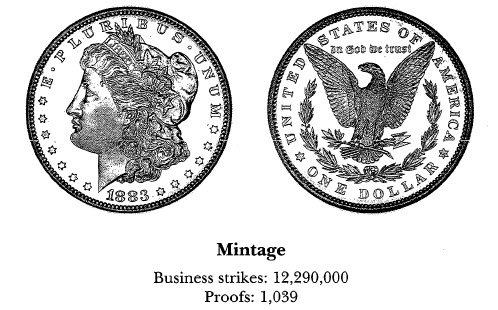
Coinage Context
Statistical precision: The Annual Report of the Director of the Mint for fiscal year 1883 reported that the average cost of silver was $1.0056949 per ounce of standard fineness (90% silver, the coining alloy) and $1.11743885 per fine ounce during the year. (A Morgan dollar contained 0.859937500 standard ounce, or 0.77343375 ounce fine silver-or was supposed to.) Although these figures are carried out to umpteen decimal places, in reality the figures were not that precise. Silver prices varied on a daily basis and were not calculated to such extremes. However, the averaging of many numbers can and did produce statistics of unintended precision, just as two thirds, a proportion expressed casually, does not necessarily imply a precision of 0.6666666666+, etc.
Numismatic Information
Hoard coins: The 1883 Morgan dollar was one of the most common dates seen in bank bags in the early 1950s, when I began sorting through them. Large quantities were released in the early 1960s as well. 12,000 to 15,000 1883 dollars, including many high-grade examples, were in the Continental-Illinois Bank hoard.
Circulated grades: The 1883 is very common in worn grades. As Mint State coins are so readily available, worn 1883 dollars have attracted very little attention in numismatic circles. Presumably, vast quantities were melted in the decade of the 1970s when silver bullion prices rose to unprecedented levels.
Mint State grades: Mint State 1883 dollars are very plentiful, especially at levels from MS-60 through MS-63 and MS-64. As might be expected, MS-65 coins are scarcer, but there are enough around that a wealthy person could nearly go broke within a year by buying all offered. At the MS-60 to 62 level there are 175,000 to 275,000 estimated to exist, 100,000 to 175,000 at the MS-63 stage, 60,000 to 120,000 at the MS-64 stage, and 30,000 to 60,000 MS-65 or finer coins.
The lustre on a typical 1883 dollar is excellent.
While some good strikes exist, many are weakly defined on the eagle's breast feathers, due to the dies being slightly too far apart in the coining press.
In The Morgan and Peace Dollar Textbook, Wayne Miller related the following: A considerable number of very lustrous 1883 dollars on close examination with the naked eye, appear to have a sandblast appearance-particularly on the raised surfaces. Under high magnification such specimens are found to be covered with tiny blobs of metal. The most plausible explanation is rusted dies ... . They tend to produce a fuzzy appearance. However, the superior lustre of these coins still makes them desirable.
Prooflike coins: The 1883 is recognized as the most often seen prooflike dollar from the Philadelphia Mint after 1878 and to this point in time, although specimens of the following year, 1885, are even more numerous. Most 1885s are semiprooflike, although in recent years many have been marketed as prooflike, as standards for determining prooflike have declined. Some prooflikes are onesided.
I estimate that 5,000 or more PL coins survive, and an equal or larger number of DMPLs. About 80% to 90% of each are in grades below MS-65. Years ago, before the decline in grading interpretations, DMPL 1883 dollars were considered to be rare, especially with cameo contrast.
Proofs: Many of the 1,039 Proofs minted have been cleaned, a situation common to most of the earlier Proof dates in the Morgan series. At the time, it was considered permissible to lightly clean Proofs to maintain their brilliance. Indeed, by the turn of the twentieth century, the early Proofs in the MintCabinet had each been cleaned several times.
Varieties
Business strikes:
1. Normal date: Breen-5571. The Low 3 variety (VAM-6) may represent a three-digit or even two-digit logotype. More remains to be researched on the subject of the number of digits in date logotypes of the era (as also evidenced from questions still lin-gering about certain 187- undertype dates among overdates of the early 1880s). The 15 VAM listings for 1883 include many with two or more date digits doubled. VAM-9 exhibits doubling on the date and motto. VAM-10 shows doubling on the date and motto, but the stars are quadrupled to sextupled. For an excellent discussion of date positions and logotypes see Van Allen and Mallis, 3rd edition, pp. 114 and 115.
Proofs:
1. Normal issues: All Proofs examined to date are from a single pair of dies with a wart on the cheek (pit mark in the die). This is highly unusual in that generally any Proof dollar die of the era would be unfit for use after 800 or fewer impressions.