Silver Dollars & Trade Dollars of the United States - A Complete Encyclopedia
Q. David Bowers
1883 Morgan: Market Values
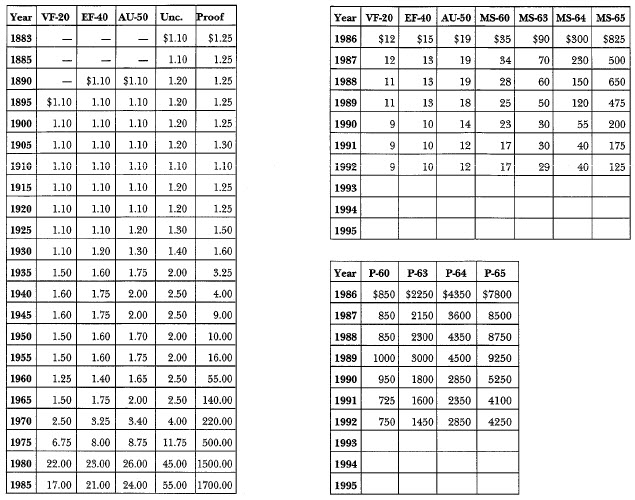
1883 Morgan: Summary of Characteristics
Business Strikes:
Enabling legislation: As earlier, plus Act of February 28, 1878
Designer: George T. Morgan
Weight and composition: 412.5 grains; .900 silver, .100 copper
Melt-down (silver value) in year minted: $0.85754 Dies prepared: Obverse: 62; Reverse: 59 (less Proof dies).
Business strike mintage: 12,290,000
Estimated quantity melted: Probably millions under the 1918 Pittman Act and other legislation. Additional coins were melted in the 1970s during the increase in silver bullion prices.
Approximate population MS-65 or better: 30,000 to 60,000 (URS-16)
Approximate population MS-64: 60,000 to 120,000 (URS-17)
Approximate population MS-63: 100,000 to 175,000 (URS-18)
Approximate population MS-60 to 62: 175,000 to 275,000 (URS-19)
Approximate population G-4 to AU-58: 1,250,000 to 2,500,000 (URS-22)
Availability of prooflike coins: Common PL and DMPL.
Characteristics of striking: Many are weakly struck on the eagle's breast, although sharply struck coins also exist.
Known hoards of Mint State coins: Millions were released by the Treasury in the 1940s, 1950s, and early 1960s.
Proofs:
Dies prepared: Obverse: At least 1; Reverse: At least 1.
Proof mintage: 1,039
Approximate population Proof-65 or better: 116+/ - (URS-8)
Approximate population Proof-64: 144+/- (URS-9)
Approximate population Proof-63: 105+/- (URS-8)
Approximate population Proof-60 to 62: 220+/- (URS-9)
Commentary
The 1883 Morgan dollar is readily available in all grades through and including MS-65.
Additional Information
Too Many Silver Dollars
The Annual Report of the Director of the Mint, 1883, contained this commentary from Director of the Mint Horatio C. Burchard:
"Since the passage of the act, in 1878, requiring the monthly purchase of not less than two million dollars worth of silver bullion, and its coinage into silver dollars, $154,370,899 had been coined prior to October 1883. That this, with the $81 million worth of fractional silver coin in the country, a total of $235 million, is in excess of the requirements of the country for silver circulation is apparent from the large amount of these coins in the vaults of the Treasury not represented by outstanding certificates and not required to be held for their payment, namely, over 39 million silver dollars, and nearly $27 million of fractional silver coin, a total of $66 million.
"My views in this regard to the policy of further continuing the coinage of silver dollars were expressed in my report two years ago, and remain unchanged. While believing that the equal coinage of both metals by all nations is desirable in order to give greater stability to the values of commodities and credits, yet, in view of our inability to continue the increase of our silver circulation at the present rate without ultimately expelling a large portion of the present stock of gold, as well as of the waning hope for the co-operation of leading commercial nations in securing the general use of silver and its unlimited coinage as money, and of the present abundant paper and increasing gold circulation in this country, I suggest the question again for the consideration of legislators, whether the law directing the monthly coinage of not less than two million dollars' worth of silver bullion into standard dollars should not be modified or repealed."
The same report told of quantities of undistributed silver dollars on hand in mints as of June 30, 1883: Philadelphia, 4,354,571 on hand; distributed during the year, 11,494,617; San Francisco, in mint, 30,841,960, distributed, 1,622,447; Carson, in mint, 1,914,522, distributed, 466,379; New Orleans, in mint, 6,193,537; distributed, 6,588,758.
The Year 1883 in History
On March 3, 1883, Congress voted to build three new warships, the first constructed since the Civil War. Since that internecine conflict, America had fallen to 12th place among sea powers of the world.
On May 24, 1884 the Brooklyn Bridge opened in a special ceremony (in which 12 people were trampled to death), and Brooklyn and Manhattan were linked by one of the engineering wonders of the world. The dormant volcano Krakatoa, located between Java and Sumatra in the Sunda Strait, exploded on August 27, 1883 in the greatest volcanic disaster since the demolition of most of the island of Santorini (Thera) in l470 B.C., an eruption that ended much of the Minoan civilization on nearby Crete. Krakatoa took an estimated 36,000 lives and spewed so much dust and smoke into the sky that sunsets around the world were bright red for a year thereafter.
On the entertainment scene, on March 26, 1883 William H.Vanderbilt, age 34, son of Commodore Vanderbilt, threw a party at his Fifth Avenue mansion at a cost of $250,000 to the delight of the social set, perhaps a precursor to other lavish spending which would culminate in the 1890s in the erection of The Breakers, the Vanderbilt "cottage" by the sea in Newport, Rhode Island. Robert Louis Stevenson's Treasure Island saw print in book form, and Mark Twain's (Samuel L. Clemens') book, Lifeon the Mississippi, was published from the world's first significant manuscript for a book submitted on typewritten sheets. William Cody's traveling entourage, "Buffalo Bill's Wild West Show," opened at Omaha, Nebraska in 1883 and went on to achieve great fame in years to come, as Americans were and still are enchanted with dramatizations of the rough and ready cowboy life. Two years later, Annie Oakley would at the age of 25 join the show and become renown for her sharpshooting prowess, including shooting holes in cards and tickets. Admission tickets punched by theatre owners as free passes would for many years later be known as Annie Oakleys.
In 1883 Dye's Coin Encyclopcedia. was published in Philadel-phia. This immense volume comprised 1,152 pages and con-tained over 1,500 illustrations. Distributed widely, the book did much to advance the cause of coin collecting in America in an era in which few textbooks or price guides were available. Buying and selling prices were given for various United States dollars, among other coins.
In the selling category, Dye listed these prices for Good and Fine examples of silver dollars: 1794 $35 Good, $50 Fine; 1795 $1.50, $2.50; 1796 $1.60, $2.75; 1797 $1.60, $2.85; 1798 Large Eagle $1.15, $1.25; 1798 Small Eagle, $2.50, $5.00; 1799 $1.15, $1.25; 1799,5 Stars Facing, $2.50, $4; 1800 $1.25, $1.50; 1801 $1.50, $2.75; 1802 $1.50, $2.75; 1803 $1.50, $2.75; 1804 $375, $650; 1836 $5, $8; 1838 $15, $35; 1839 $10, $25.
The following silver dollars were priced in Uncirculated condition by Dye: 1840-1849, each $1.50; 1850 $1.75; 1851 $20, $35; 1852 $25, $40; 1853 $1.75, $2.75; 1854 $5, $9; 1855 $4, $7; 1856 $3, $5; 1857 $2.25, $3.75; 1858 [impaired and unimpaired Proofs? Dye doesn't specify, but he does list two prices] $15 and $35; 1859 to 1869, inclusive, each $1.75. Dye listed Proof silver dollars as follows: 1870-1873 and to 1878-1881, each $1.25 to $1.75.