Silver Dollars & Trade Dollars of the United States - A Complete Encyclopedia
Q. David Bowers
1880-CC Morgan Dollar
Coinage Context
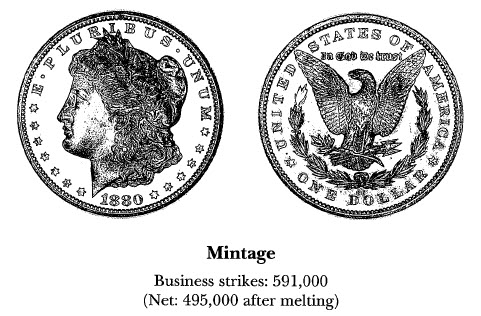
Carson City: The mint at Carson City suffered from sporadic shortages of silver, due to the local preference for shipping bullion to distant San Francisco. However, in 1880 enough metal was on hand that 591,000 dollars were made. Relatively few of these were passed into circulation at the, time, but were stored at the mint. Coinage was suspended from November 1, 1879 to May 1, 1880.
In February 1881, the Assay Commission determined that a number of 1880-CC dollars were of insufficient silver fineness.' Because of this, 96,000 1880-CC dollars were subsequently melted at the mint, leaving a net production figure of 495,000 coins.
Numismatic Information
Commentary: In the early days of the present century, the 1880-CC was virtually unknown in Uncirculated grade in collections. Typical grades offered in auctions ranged from VG to VF. Apparently, 1880-CC dollars were released only in limited numbers at or near the time of coining, and after that no quantities were paid out by the Treasury. No one knew that vast numbers of mint-sealed bags Still existed!
Hoard coins: Several bags of Uncirculated 1880-CC dollars were paid out from the Cash Room in the Treasury Building, Washington, D.C., in 1938. At the time, the theoretical value of a Mint State 1880-CC dollar was close to the $10 range, if you could find .one. Few if any were on the market. Among those getting 1880-CC dollars at face value in 1938 was Harry X Boosel, who was then working in government service in Washington. He mailed postcards and ran advertisements offering the coins in 1938-1939 for $2.25 each, the extra 25¢ being for postage. This was like giving $10 bills away for $2, and he was flooded with orders! In his mailbox he received a number of letters from skeptics who thought he might be engaging in some sort of a scam similar' to that prevailing in the commemorative field at the time. The offer was legitimate, and those who received the sparkling coins were delighted.
Apparently, the Cash Room payouts trickled to an end sometime in the late 1930s or early 1940s, and after that time the 1880-CC once again became scarce on the market. Prices rose to the $7.50 to $10 range by 1945, and $15 to $20 by 1951. Historical prices quoted in my introduction to the Morgan series tell the story. By autumn 1954, the 1880-CC was sufficiently hard to find that an example graded just VF fetched $35.50 in Stack's sale of the Anderson-Dupont Collection.
History repeated itself, and what occurred in 1938 happened again in 1955. Out of the vault in the Treasury Building in Washington, D.C. came many mint-sealed bags, which went into the hands of dealers with the right connections. Dealer Steve Ruddel stated that, for starters, about 50 bags (50,000 coins) were released from the Treasury Building in that year. (Reference: His advertisement in The Numismatist, January 1964.)
From about $15 per coin in 1955, the value drifted lower. By March 1958, Dan Morafka was selling rolls of 20 coins for $52, which equals $2.60 per coin. Bags seemed to be available during the late 1950s, but, again, only to those with the right con-nections. About 1957, Harry J. Forman bought several bags from Charles J. Dochkus, who obtained them from the Cash Room. J. Grove Loser was properly fixed with Washington friends, and quite a few bags reached the market through his coin dealership. Quantities remained plentiful until 1959-1960, after which the supply dried up. By January 1961, Loser was charging and getting $225 per roll ($11.25 per coin). After that point, quantities were rarely offered.
Circa 1962-1964, when the Treasury began releasing dollars in quantity, many more 1880-CC dollars came to light, and some bags were paid out. In March 1964, the government took stock of the Treasury Building drain and called a halt, deciding to hold back 131,529 1880-CC coins, which were sold by the General Services Administration beginning in 1972. The G.S.A. sale coins included the 1880/79- CC overdates (described below).
How many Mint State coins remain today? For starters, consider the 131,529 G.S.A. sale coins, and add perhaps 100,000 or more distributed earlier, and the total is in the 230,000 range. As is true of most other CC dollars, many if not most of the pieces released in the 1950s and 1960s went into the hands of investors and the public, not to numismatists. Because of this, only a tiny fraction have been certified, and population reports cannot be used to estimate the number surviving. However, such reports can be a handy guide to the quick availability of coins on the market.
In general, during the time of mass distributions of 1880-CC dollars prior to the mid-1960s, dealers and collectors did not know and/or care about the various technical varietiesdescribed below. There were only a few isolated mentions in catalogues, a listing of 1880-CC dollars as "Type of 1878" and "Type of 1879" in B. Max Mehl's 1947 Will W. Neil sale being a rare exception.
Overdates: As is the case with the Philadelphia, NewOrleans, and San Francisco dollars of 1880, overdates exist for the 1880-CC as well. Indeed, the overdates for this particular issue are the most pub-licized, and in the early 1960s received wide cover-age in Coin World and elsewhere.
The best overdate from a visibility viewpoint is that with the full date 1880 over 1879, with 80 show-ing over the underdigits 79. Other varieties exist with the 8 in the date over an undertype 7. When first publicized following the Treasury release of 1962-1964, the 1880-CCoverdate was considered to be extremely rare and of high value, worth many multiples of the ordinary Carson City issue. As re-search progressed and additional identifications were made, it was realized that the varieties, while scarce, did not qualify as major rarities. As the overdates require magnification to see clearly, they are not included in everyone's sets. However, they do add an interesting dimension to coins ofthis date and mintmark.
Reverse types: Not generally appreciated is the fact that certain overdated 1880-CC dollars exist with two major reverse types, the Second Reverse and the Third Reverse (as delineated under 1878 and 1879-S). While the Second and Third Reverse varieties of 1879-S dollars have been recognized by much of the collectingcommunity during the past two decades, by and large 1880-CC dollar reverse varieties have been ignored (although NGC and PCGS do differentiate them). It could well be that the 1880-CC with Second Reverse is a major scarcity, if not even a rarity.
What should I collect? There are various ways to collect 1880-CC dollars. My suggestion is to obtain at least two coins: one of the Second Reverse (which will be a visible overdate) and one of the Third Reverse. These reverse differences are very desirable, but to date they have not had the press coverage given to the 1879-S (which also occurs with Second and Third Reverse variations).