Silver Dollars & Trade Dollars of the United States - A Complete Encyclopedia
Q. David Bowers
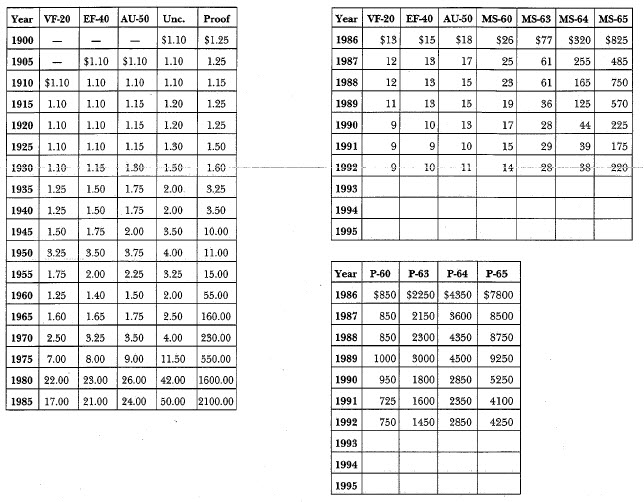
1900 Morgan: Market Values
1900 Morgan: Summary of Characteristics
Business Strikes:
Enabling legislation: Act of February 28, 1878, plus the Sherman Silver Purchase Act of July 14, 1890
Designer: George T. Morgan
Weight and composition: 412.5 grains; .900 silver, .100 copper
Melt-down (silver value) in year minted: $0.47958
Dies prepared: Obverse: 66; Reverse: 61
Business strike mintage: 8,830,000; Delivery figures by month: January: none; February: 440,000; March: 1,600,000; April: 1,422,000; May: 56,000; June-August: none; September: 1,500,000; October: 2,002,000; November: 1,322,000; December: 488,000.
Estimated quantity melted: Probably 2,000,000 to 4,000,000 under various acts, many more in later private melts.
Approximate population MS-65 or better: 12,500 to 20,000 (URS-15)
Approximate population MS-64: 30,000 to 60,000 (URS-16)
Approximate population MS-63: 80,000 to 150,000 (URS-18)
Approximate population MS-60 to 62: 400,000 to 800,000 (URS-20)
Approximate population G-4 to AU-58: 750,000 to 1,500,000 (URS-21)
Availability of prooflike coins: PL coins are available, but are often one-sided and usually of poor finish and striking quality. DMPL coins are, perhaps, 50 times more elusive.
Characteristics of striking: Varies from poor to sharp but is usually average. Lustre ranges from dull to frosty.
Known hoards of Mint State coins: Many bags were released by the Treasury in the 1950s, and a few more were released 1962-1964.
Proofs:
Dies prepared: Obverse: 2; Reverse: 2
Proof mintage: 912; Delivery figures by month:
January: none; February: none; March: 377; April: none; May: none; June: 135; July: none; August: none; September: 100; October: none; November: none; December: 300.
Approximate population Proof-65 or better: 86+/- (URS-8)
Approximate population Proof-64: 88+/- (URS-8)
Approximate population Proof-63: 100+/- (URS-8)
Approximate population Proof-60 to 62: 155+/- (URS-9)
Commentary
The striking quality and lustre vary dramatically; cherrypicking for quality is advised.
Additional Information
Distribution of Dollars
The Annual Report of the Director of the Mint, 1900, gave in-formation concerning the distribution of dollars: Philadelphia: In mint, July 1, 1899,69,610,954; transferred from Treasury for storage, 500,000; coinage, fiscal year 1900 3,558,984; total,73,669,938; in mint July 1, 1900, 73,243,954; total 73,243,954;distributed from mint, 425,984.
Dollar Edge Differences
The May 1900 issue of The Numismatist posed these questions and gave the answers:
"Did you ever try to pick out U.S. mintmarked dollars byexamining the edge? Did you know that the dollars from thePhiladelphia Mint are broader than those from New Orleans andSan Francisco? They are, as can readily be determined bydriving two pins and a board so a mintmarked dollar will passeasily between them, at the same time touching both; now try topass a Philadelphia dollar between the pins and it will be foundappreciably larger. Take a stack of dollars and note that somehave an edge with rounded corners, the milling being plain incenter of edge but not reaching to the corners; these are allPhiladelphia coinage. The others, from branch mints, were struckwith a slightly smaller collar, with the result that the millingshows across the whole edge, the corners being sharp. Thedistinction to the eye is destroyed, of course, on coins that haveseen any considerable circulation."
The Year 1900 in History
On March 14 Congress passed an act setting a gold standard against which other monentary units including currency would be valued, thereby effectively ending the long-continuing controversy about the gold and silver ratio. Silver, although dethroned, continued to be a focus of public interest and played a part in the 1900 election rhetoric.
Hawaii became a United States territory on June 14, 1900. The Populist and the Democratic parties both selected William Jennings Bryan as their presidential candidate, and the Republicans named President McKinley for re-election. Governor Theodore Roosevelt of New York was nominated for the vice presidency on the Republican ticket. By that time, Roosevelt was well-known as an author and politician and for his accomplishments in the Spanish-American War. On November 6, McKinley, who campaigned with the promise of a "full dinner pail," was re-elected by an overwhelming majority. The Electoral College gave McKinley 292 votes against Bryan's 155.
On December 29, negotiations to purchase the Virgin Islands, known as the Danish West Indies, were completed, but Congress did not appropriate the necessary funds until 1917. Prohibition advocate Carry Nation led a group of followers through Kansas, and with much fanfare and publicity trashed saloons and other places that served liquor. The temperance movement, which had been an important social movement since the early nineteenth century, continued to gain advocates. The U.S. population stood at 75,994,575, according to the decennial census. In the preceding decade 3,688,000 immigrants had come to America. Illiteracy touched a new low of 10.7%.1,335,911 telephones were in use.
In 1900 there were 8,000 automobiles registered in the United States. During the year about 4,000 automobiles were produced. (By contrast, two decades later in 1920, 187,000 were manufactured.) The first automobile show was held in Madison Square Garden, New York City, in November 1900. The Olds company was set up in Detroit, Michigan with a capitalization of $350,000, the first large-scale automobile factory in America. Most of the components were purchased from other manufacturers and assembled under the Olds roof. During 1900400 cars were made by Olds, followed by 1,600 in 1901 and 4,000 in 1902. On April 15, 1900 an automobile race was held in Springfield (Long Island) New York, and was won by A.L. Riker, who drove his electric car 50 miles in two hours and three minutes. In 1900 there were about 18 million horses and mules furnishing power for transportation and work, and about 10 million bicycles. On April 30, 1900, "Casey" Jones died at the throttle of the Cannon Ball Express train traveling from Memphis, Tennessee, to Canton, Mississippi. In 1900, Wilbur and Orville Wright produced a glider incorporating certain of their aeronautic theories.
The Carnegie Steel Company, which had been organized in 1899, was incorporated in New Jersey, which had liberal laws for corporations, with a capital of $160 million. The International Ladies' Garment Workers Union (ILGWU) was established. At the time the typical work week was 70 hours. The garment industry employed many people doing piecework in their homes, at an average wage of about 30 cents a day, according to social reformer Jacob A. Riis, Pipes, cigars, and chewing tobacco were the most popular forms of consuming tobacco. Cigarettes were considered to be unmanly; nevertheless, some four billion were produced. The names "New Century" and "20th Century" were popular as part of brand names, such as the New Century music box and New Century washing machine. Actually, the new century commenced with 1901, but few people bothered to wait.
Among books published was L. Frank Baum's The Wonderful Wizard of Oz. Theodore Dreiser's first novel, Sister Carrie, was published, but only to the extent of 1,000 copies, as the publisher feared it would not have lasting value. The 1900 Paris Universal Exposition was held. Art Nouveau was all the rage in France, and Alphonse Mucha's work for the Exposition drew much favorable acclaim. On view were many exhibits from America. On October 15, 1900, Symphony Hall in Boston opened. It was designed by New York architectural firm McKim, Mead, and White. In New York City the Hall of Fame was established to commemorate great Americans. The American League was formed in Chicago on January 29. The new baseball league was not recognized by the National League until 1903.
Under the Act of March 14, 1900, the Treasury was authorized to recoin all worn and uncurrent coins that were received then and in the future, and to pay for them at par, with any loss to be borne by the government. This effectively ended the glut of worn coins that were in circulation and in Treasury vaults, including earlier-dated coins that had come back from Latin America in the late 1870s, although most such coins had already disappeared.
Lafayette commemorative silver dollars, dated 1900, but minted on December 14, 1899, were offered for sale for $2 each. Eventually, about 36,000 of the 50,000 mintage were sold.