Silver Dollars & Trade Dollars of the United States - A Complete Encyclopedia
Q. David Bowers
1890 Morgan Dollar
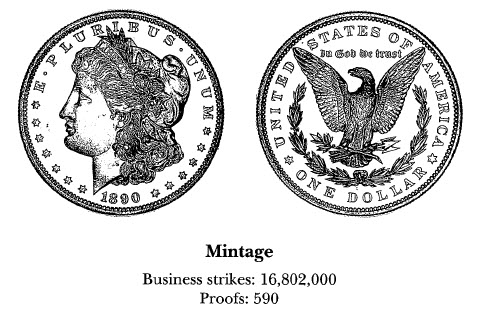
Coinage Context
The Sherman Act: The Bland-Allison Act, under which silver had been purchased for the minting of dollars since 1878, was repealed and replaced by the Sherman Silver Purchase Act of July 14, 1890. Under the new legislation, the Treasury was ordered to buy 4.5 million ounces of silver per month (subject to certain provisions), and to pay for same with a new issue of paper money (known to collectors today as Coin Notes, Series 18901). In essence, the government once again provided a subsidy for silver mine owners, in obeisance to western politicians. Further (per the wording of the act): "The secretary of the Treasury shall each month coin two million ounces of the silver bullion ...into standard silver dollars until [July 1, 1891,] after which time he shall coin ... as much as may be necessary to provide for the redemption of the Treasury notes herein provided for.
Effects of the Sherman Act: The Annual Report of the Director of the Mint, 1894 (quoted in detail under Additional Information, 1894, below), commented as follows:
Further legislation by the United States, still more favorable to silver, was enacted by the Act of July 14, 1890, which provided for the purchase of 54 million ounces annually, the estimated production of our domestic mines. The effect of this act was to cause a temporary advance in the price of silver, but the high price could not be maintained owing to the largely increased output by the silver-producing countries of the world, and the price commenced to decline in September 1890, and continued to do so.
By November 1, 1893, the Treasury was in trouble. The cycle of buying silver, paying for it in Treasury notes, and redeeming the Treasury notes by paying out silver dollars "destroyed the solvency of the government," to quote historian Neil Carothers. The glut of silver drove gold from the marketplace. Vast quantities of gold were withdrawn from the Treasury and shipped to Europe. To stanch the flow, on November 1, 1893, the silver purchase provisions of the 1890 Sherman Act were repealed. However, enough silver remained on hand to coin dollars through 1904, a supply augmented by melted-down trade dollars.
Numismatic Information
Hoard coins: Uncirculated 1890 dollars were available on the numismatic market virtually from the time of striking, although in the years before about 1940, the demand of specialists assembling high-grade Morgan dollar sets was fulfilled by Proofs. Quantities of the date were dumped on the market in 1941-1942, the mid-1950s, and after that time, continuing through the great Treasury release of 1962-1964. As was the case with its Philadelphia Mint brethren from the years of the 1880s, the 1890 was ignored by just about everyone. When it came to stashing away a few rolls or bags for investment, most hoarders seemed to prefer coins with mintmarks. In any event, most Mint State coins dis-tributed in the 1950s found their way into bags of mixed dollars.
The bag quantities released by the Treasury in the 1950s and 1960s mostly consisted of lower Mint State grade coins. Wayne Miller reported that many of these were coated with a dark, greasy substance that did not hurt the coins, but which had to be care-fully removed with a solvent. I personally do not re-call seeing cosmoline-or whatever it was-on quan-tities of 1890 dollars in eastern banks, but enough greasy coins must have existed at one time that no-tice was taken of them by others.
Circulated grades: In worn grades the 1890 is one of the most common issues in the Morgan series. Well over a million remain. Untold additional quantities were melted in the late 1970s during the increase in silver bullion prices. At the time, a worn or even an MS-60 or so 1890 held little numismatic interest.
Mint State grades: Mint State 1890 dollars are common in lower ranges, MS-60 through 63, and hundreds of thousands survive. MS-64 coins are harder to find and number perhaps 12,000 to 20,000 pieces all told. MS-65 specimens are surprisingly rare; only an estimated 400 to 800 exist. Of course, the financial consequences of this elusivity are mitigated by the availability of Proofs.
Most 1890 dollars are poorly struck, from dies spaced too far apart and/or worn beyond their normal useful life, and have indifferent or even poor lustre. Lower grade pieces tend to be heavily bagmarked, the result of Treasury storage and handling. However, sharply struck coins exist. Cherrypicking for quality is advised.
Prooflike coins: Prooflike coins tend to have little contrast. Most are lightly struck over Miss Liberty'S ear. Such coins are readily available in lower Mint Statelevels. Fully prooflike and DMPL coins are very rare in grades over MS-64. In fact, of the 129 DMPL coins certified by NGC and PCGS as of September 1992, just one coin was higher than MS-64! It is to be remembered that these certification services have graded just a tiny percentage of such coins in existence. David Hall estimated that no more than 5% to 10% of gem silver dollars have passed through the services. Probably, well over 1,000 DMPL 1890 Morgan dollars survive totally-with perhaps a dozen or two being MS-65 DMPL or finer.
Proofs: The situation of flatly struck Proof coins begun in 1888 continued-coins with lightness of strike above Miss Liberty's ear on the obverse and on the eagle's breast feathers on the reverse. However, 1890 dollars are often nicer than those of the years immediately preceding and following. Most Proofs have very attractive cameo contrast.
Varieties
Business strikes:
1. Even date, Breen-5611, closed or open 9; high zero, Breen-5612, VAM-7, others, usually closed 9. Probably all 48 obverses and 49 reverses were used until they wore out and/ or broke. Even so, the num-ber of coins per obverse (400,046) is so high as to suggest typographical error in the number of dies, or omission of one or more die deliveries. At least eight VAM varieties show partly repunched dates, the most dramatic being VAM-4.
Proofs:
1. Proof issue. Proofs are VAM-1, heavy date, closed 9.