Silver Dollars & Trade Dollars of the United States - A Complete Encyclopedia
Q. David Bowers
1894 Morgan Dollar
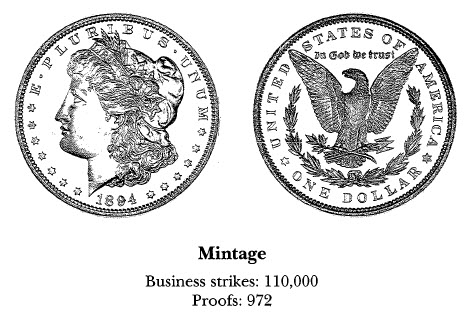
Numismatic Information
Once a rarity: From the time of mintage through the early decades of the twentieth century, the 1894 was a major rarity. Very few had been released into circulation. However, Proofs were available readily enough, and took care of the need to acquire the date. This situation was true of such other Philadelphia dates as 1892, 1897, and 1899, among others. Accordingly, the formidable rarity of business strikes of this date in earlier years was not even suspected.
The 1894 dollar has the lowest business strike mintage of any Morgan dollar except the 1893-S (not including the 1895). As such, they have always been popular with collectors. Although quantities of Mint State coins existed in the 1950s and early 1960s, nearly all have been dispersed by now.
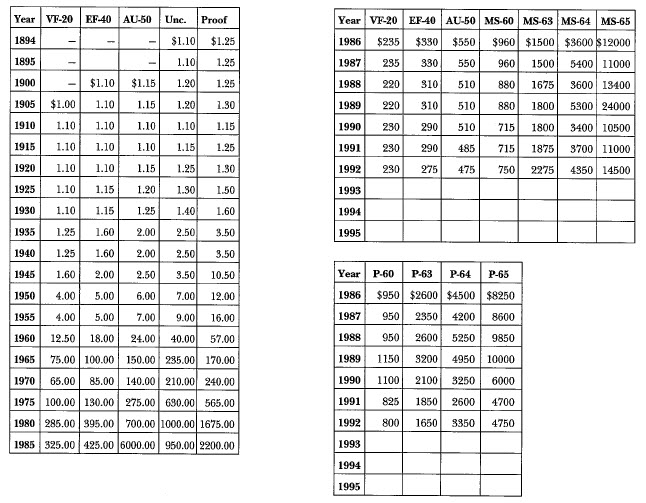
Hoard coins: Several 1,000-coin bags of Uncirculated 1894 dollars were released in the 1950s and early 1960s. The nadir in pricing may have been around November 1958, when Harry Warner offered 20-coin rolls for sale for $24.00 ($1.20 per coin). That was about as good as it was ever going to get. After about that point, the value of the 1894 trended upward. A bag from Great Falls, Montana was sold by John B. Love around 1961 but did not cause even a ripple in the price structure, which was firming and building. In the early 1960s, a bag containing a mixture of Uncirculated 1893 and 1894 dollars was located in San Francisco. This date was not represented in significant quantities in the Treasury release of 1962-1964, so far as I know.
Circulated grades: In very worn grades the 1894 is very hard to find and is one of the rarest of all Morgan issues. In 1925, numismatist E.S. Thresher reported that despite searching since 1919, he had not been able to find an example in circulation; one of just eight coins absent from his Morgan dollar collection (the others were 1884-CC, 1885-CC, 1889- S, 1892, 1893-S, 1897, and 1899).
When seen, worn coins are apt to be in higher grades, VF and above. However, the general avail-ability of Uncirculated coins in lower Mint State ranges has dampened the price of circulated pieces, although the Uncirculated pieces are hardly cheap. I estimate that 5,000 to 10,000 worn 1894 dollars survive.
Mint State grades: Among Philadelphia Mint Morgan dollars, the 1894 is the second rarest (after 1901) in Mint State. Examples are offered for sale with regularity, but in the modern market it is seldom that even a small group is found. Most coins are in lower Mint State ranges. The demand for the latter is softened somewhat by the availability of high-grade Proofs.
The striking quality of Mint State 1894 Morgan dollars ranges from average to sharp. The lustre on most well-struck pieces is frosty and attractive. On the other hand, average to below average coins are apt to have weak breast feathers on the eagle, and have unsatisfactory lustre.
Prooflike coins: Prooflike coins are rare and usually have low contrast. DMPL coins are extremely rare. Wayne Miller knew of only two in the latter category. As of September 1992, NGC and PCGS had certified only six PL and one DMPL.
Proofs: After several years of poor striking, the Mint produced sharp Proofs this year. Proof 1894 dollars are usually well struck, attractive, and in demand as a date.
Caveat emptor: 1894 dollars in high circulated and lower Mint State grades are sometimes fabricated by removing the mintmark from a branch mint coin such as 1894-O.
Varieties
Business strikes:
1. Normal date: Breen-5634. Possibly only one pair of dies sufficed for business strikes among the seven obverses and five reverses shipped.
Proofs:
1. Proof issue: Two varieties of Proofs have been identified: (1) Date well to left, heavy closed 9, die file marks slant down to right between back of neck and wing. (2) Date far right, reverse of 1895 with two spines slanting down to right through two lowest outer berries on left branch. VAM-2.
1894 Morgan: Market Values