Silver Dollars & Trade Dollars of the United States - A Complete Encyclopedia
Q. David Bowers
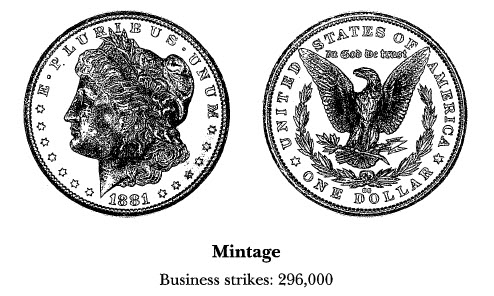
1881-CC Morgan Dollar
Coinage Context
What might have been: Coinage at Carson Citywas suspended from April 1 to October 1, 1881. Ac-cordingly, only 296,000 silver dollars were struck in1881, the second lowest mintage of the early 1878-1885 series. By most standards, 1881-CC should be ararity today. But it is not. Unlike the higher mintage 1879-CC and 1889-CC dollars, large quantities of1881-CC were stored by the Treasury, to be released 80 years later to delight a generation of numismatists unborn when the coins were made.
Many dies were made: Many dies were made, butfew were chosen. Of 25 pairs of dies shipped fromPhiladelphia (where all dies are made) to Carson City, only a few were used.
Numismatic Information
Hoard coins: At the time of mintage, probably fewer than 50,000 1881-CC dollars were released. As the years went on, the issue was recognized as a scar-city, although occasionally a few Uncirculated coins would come to light.
In 1938-1939, the Cash Room at the Treasury Building in Washington, D.C. parceled out a few Uncirculated coins, but not enough to seriously affect the market. Coins of this date became increasingly scarce as demand for Morgan dollars increased. In 1954, the Cash Room paid out several bags of 1881-CCs, and the price plummeted from about $50 per coin to the point at which B.M. Douglas, Washington dealer, was retailing single coins for $15 in December of that year.
More came out, and in October 1955, E. Ward Russell, also a Washington dealer, was offering singles for $7.95 each to readers of The Numismatist. Washington professional numismatist Steve Ruddel stated that about 50 bags (50,000 coins) were released from the Treasury Building in 1955, and that this was just the beginning of a new wave of releases.' In January 1956, the Silver Dollar Mart, again of Washington, D.C., retailed individual coins for $5.95 each. In May 1957, John and Frances Holden were selling Uncirculated coins for $3.75 each, and the price would go even lower.
In the meantime, the San Francisco Mint shipped bags of 1881-CC dollars to Nevada casinos, where they were recognized as being desirable; many were resold to dealers. Harry J. Forman advertised that he had mint bags for sale. In October 1957, California dealer Dan Morafka was charging $50 per roll of 20 coins, a price which he dropped to $42 ($2.10 per coin) by March 1958.
By and large the quantities were soon dispersed a bag here, a few rolls there, and a few coins some-where else. By the early 1960s, the 1881-CC was rela-tively scarce once again. However, the Treasury Building in Washington still had more, and an addi-tional 147,485 Uncirculated pieces remained in March 1964. These were sold through the General Services Administration beginning in the early 1970s and ending in 1980. Van Allen and Mallis estimated that about 40% of the total consisted of VAM-2 (Breen-5564).
Probably, about 200,000 of the original mintage of 296,000 1881-CC dollars still survive in Mint State. To my knowledge, mint-sealed bags have long since been dispersed. Today, even rolls are seldom seen in dealer-to-dealer transactions. However, individual coins are relatively plentiful.
Circulated grades: In worn grades the 1881-CC is one of the scarcest coins in the Morgan dollar series, ranking with 1885-CC, 1889-CC, 1893-CC, 1893-S, 1894, 1895-S, and 1903-0. Today, the 1881-CC is much easier to find in Mint State than in worn grades, an anomalous-appearing situation to those who do not know the coins' history. When seen, worn 1881-CC dollars are apt to be in lower grades such as VG and Fine. I estimate that 2,500 to 4,000 exist in grades from VG-8 to F -15, and only 1,000 to 2,000 in VF-20 through AU-58.
Mint State grades: The 1881-CC is easy to find in all Mint State grades from MS-60 to MS-64, and even MS-65 coins can be obtained with little searching. At the MS-60 to 62 level, 70,000 to 90,000 are believed to exist, followed by 60,000 to 80,000 MS-63 coins, and 40,00 to 55,000 in MS-64 preservation. About 15,000 to 30,000 remain in MS-65 and higher grades. Examples at all Mint State grade levels are usually very well struck and very frosty. The issue is scarcer than the Carson City dollars of the next three years.
Prooflike coins: Semi-prooflike coins are available in large numbers and are sometimes called fully prooflike. As explained in the introduction to the Morgan dollar section, the commercial application of the prooflike term has deteriorated, and yesterday's semi-prooflike is sometimes today's prooflike (this comment includes coins certified by grading services). Prooflikes in the mirror-surface sense are elusive, and true DMPL coins are rare.
Probably, over 10,000 PL and a like number of DMPL 1881-CC dollars survive. About 10% to 15% of these are MS-65 or finer.
Varieties
Business strikes:
1. Normal date: Perfect date, without digit 7 below second 8. Includes later impressions of VAM-2 and production from limited additional die pairs. Six V AM varieties (including late states of VAM-2, below).