Silver Dollars & Trade Dollars of the United States - A Complete Encyclopedia
Q. David Bowers
1891-S Morgan Dollar
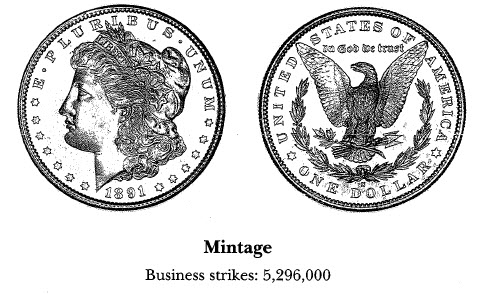
Numismatic Information
Hoard coins: Quantities of Uncirculated 1891-S dollars were stored at the San Francisco Mint after striking, and remained there for many years. Bags were released from time to time-not many, but enough to keep the market price in the "common date" category. In 1941-2 a major payout occurred, and from that time through the next 10 years, 1891-S dollars were plentiful, especially in West Coast bank vaults and in the stocks of dealers there. The supply seems to have diminished during the early 1950s, and by later in the decade bag quantities were no longer seen and roll holdings were sparse.
It said that the 1962-1964 Treasury dispersals included a few 1891-S dollars, but I have no record that any significant quantity came out. Probably, most had been paid out before that time. The Redfield estate (1976) is said to have contained about 5,000 pieces, which Wayne Miller described as being well struck and lustrous, but "with plentiful abrasions."
Circulated grades: The 1891-S is common in worn grades up to and including AU-58. Many of the latter "sliders" were sold as Uncirculated coins years ago. Indeed, this situation was endemic in the 1960s and 1970s.
Mint State grades: In lower ranges from MS-60 to MS-62 the 1891-S Morgan dollar exists to the extent of an estimated 40,000 to 70,000 pieces. As grades increase, quantities decrease. I estimate that 12,000 to 20,000 MS-63 coins exist, 6,000 to 10,000 MS-64 examples, and only 1,600 to 2,600 MS-65 specimens.
Most Mint State 1891-S dollars are well struck and have excellent lustre. However, in lower grades many have a double dose of bagmarks.
Prooflike coins: Prooflike coins are plentiful but often have bagmarks and are in lower grades. About one in three prooflike 1891-S dollars is DMPL. Among DMPL coins, about 95% are below MS-65. In his Morgan and Peace Dollar Textbook, Wayne Miller had this to say about a cache of coins that came on the market in the late 1970s:
The Redfield hoard contained a significant number of prooflike pieces. These were of two distinct varieties. some with deep mirror surfaces on obverse and reverse but with gray spots which appeared to be caused either by exposure to salt water or peach juice or long-term temperature or humidity extremes. Others have very deep mirror surfaces on the obverse, and relatively free of spotting, but the reverses are only semiprooflike. Although the latter are more attractive overall, the prooflike pieces are more usually preferred. The enormous quantity of prooflike 1891-S dollars in this hoard reduced the relative prooflike rarity of this date. However in fully prooflike condition and without spotting, the 1891-S is still a rare coin.
Varieties
Business strikes:
1. Normal date: Breen-5622. Different positional varieties exist. Most or all the 27 pairs of dies must have been used.
2. Doubled Obverse Die: Breen-5623. VAM-3. Stars on the left and certain other features are doubled. Scarce, but probably only a small percentage of extant 1891-S dollars have been checked for this feature. VAM-8, 9 also show doubling of stars.
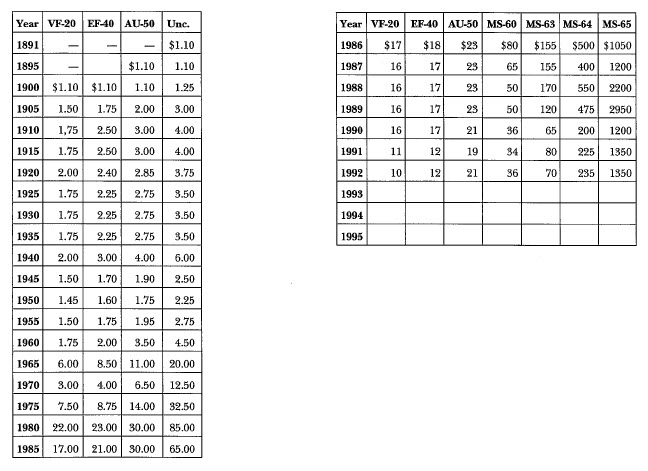
1891-S Morgan: Market Values