Silver Dollars & Trade Dollars of the United States - A Complete Encyclopedia
Q. David Bowers
1885-CC Morgan Dollar
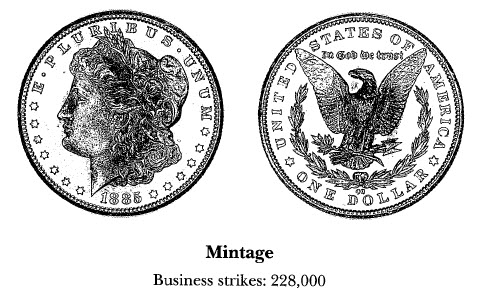
Coinage Context
Mint closed: The Carson City Mint was closed to coinage in November 1885, by which time 228,000 1885-CC dollars had been struck. 200,000 of these were made in January and February and were thus listed as having been produced in fiscal year 1885 July 1, 1884 to June 30, 1885). Additional coins to the amount of 28,000 pieces were struck in August 1885 (which was in fiscal year 1886), giving rise to the old-time theory that there were "1886-CC" dollars, which was not the case. See Additional Information below for further details of the Carson City Mint's operations during this time period.
Numismatic Information
Distribution: Although 228,000 1885-CC dollars were minted in the year indicated, it is apparent that very few were actually placed into circulation at the time. To suggest that as many as 28,000 were used in the channels of commerce might be an exaggeration, for today worn coins are few and far between and, in fact, are the rarest of all Morgan dollars in circulated grades (not including the Proof-only 1895, of which worn pieces are occasionally seen).
A rarity: In 1925, numismatist E.S. Thresher reported that despite searching since 1919, he had not been able to find an example in circulation; one of just eight coins absent from his Morgan dollar collection (the others were 1884-CC, 1889-S, 1892, 1893-S, 1894, 1897, and 1899; he had found 1895 and 1903-O).
The desirability of the 1885-CC in the early days is illustrated by these selected market prices from auction sales and dealer listings. As always with branch mint Morgan dollars, the figures were erratic. However, the 1885-CC stands out as one of the most expensive coins in the series: 1890: Unc. $3.40; 1898: Fine $1.60; 1912: VG $11.75; 1914: Unc. $21.00; 1915: "Proof' $10.00 and VG $8.25; 1916:Unc. $25.50 (a Proof 1895 in the same auction brought all of $1.60!); 1919: Unc. $11.00; 1925: VG $2.35; 1939: Unc. $12.50; and 1941: $5.60.
Hoard coins: Uncirculated 1885-CC dollars were considered to be very rare, the creme de la creme of the series, until the 1930s, when John Zug and a few others obtained small quantities from the Cash Room at the Treasury Building in Washington. In 1941-1942, several bags were released, after which the supply seemed to dry up. In 1955, multiple bags came out of hiding in the Treasury Building, and 1885-CC dollars became common on the market, a situation that remained until 1957-1958. During the mid to late 1950s, bags wholesaled for about $1,200 each and retailed for about $1,600.
At the time Harry J. Forman, C.J. Dochkus, J. Grove Loser, John Skubis, Arnold Rosing, and perhaps others as well, actively bought and sold Uncirculated 1885-CC dollars in quantity. In 1958, multiple bags were released in Montana; these were probably from storage at the San Francisco Mint or one of the Federal Reserve facilities.
Additional quantities, probably modest in total, of Uncirculated 1885-CC were turned loose during the Treasury dispersals of 1962-1964, at the end of which 148,285 were held back for later sale by the General Services Administration. These were offered in the 1972-1974 mail bid sales (minimum bid $60). All but 31,569 sold, and those went in the final 1980 sale. The Redfield hoard may have contained as many as 1,000 coins.
It is my guess that perhaps 175,000 Mint State coins are known in the hands of the public and collectors, and that of the other 52,000 coins originally struck, perhaps 28,000 Gust a guess) were released in the nineteenth century and subsequently became largely lost, strayed, or melted, and that perhaps 25,000 were melted under the Pittman Act of 1918.
Of course, all of this is conjecture, but the fact remains that the vast majority of the original mintage still exists in Mint State. The low mintage of this issue has made it very attractive to collectors, and there has always been a strong demand for them.
Circulated grades: In terms of business strikes in worn grades, the 1885-CC is the king of Morgan dollars, outranking even the 1893-S. I estimate that only about 2,000 to 4,000 survive, mostly in lower grades from Good to Fine. Apparently, very few were placed into circulation during the nineteenth century. After the 1885-CC, the rarest Morgan dollar in circulated grades is probably the 1903-O.
Mint State grades: An estimated 175,000 or so remain, but these are so widely dispersed today that significant groups rarely come on the market. Rather, they are usually seen in groups of a few dozen or so at most. The majority of 1885-CC dollars are in grades MS-60 through 64, but MS-65 and finer coins are not rare.
My population estimates are these: MS-60 to 62, 80,000 to 90,000; MS-63, 50,000 to 60,000; MS-64, 25,000 to 35,000; and MS-65 or better, 15,000 to 20,000.
Lower grade Mint State coins are apt to have many bagmarks (indeed, this is what usually makes them merit the lower grade designation). As a rule of thumb, 1885-CC dollars are usually more bagmarked than are typical dollars of 1882-CC through 1884-CC.
The typical 1885-CC is very well struck and possesses excellent mint lustre.
Prooflike coins: Many prooflike coins exist. Most have deep mirror surfaces and excellent contrast. However, the majority are in lower grade levels and are heavily bagmarked. Probably, over 10,000 PL and a like number of DMPL 1885-CC dollars survive. About 10% to 15% of these are MS-65 or finer. This date is slightly more plentiful than 1881-CC. The "Proof' in USCC's "Collection of a Prominent American" sale (May 19-21, 1915) at $10 was probably a DMPL.
Varieties
Business strikes:
1. Perfect date: Breen-5585. VAM-1 to 4. Probably not all 10 pairs of dies were used; the three obverses and two reverses described by Van Allen and Mallis would have sufficed.